


On this page
- What are matching and sorting, and how do they grow?
- Why do therapists start with matching?
- Ten matching and sorting activities with things you already have
- How do I keep it short and almost mistake-free?
- What do I do when my child gets it wrong?
- My child matches at the table. Why not anywhere else?
- What about matching activities for toddlers with autism?
- When are picture matching activities on paper or a screen useful?
What are matching and sorting, and how do they grow?
Matching means putting one thing with another that is the same. Sorting means putting many things into groups. Most children start with two objects that are exactly alike, then match an object to its picture, then picture to picture, then things of the same kind that look different.
The order is a guide. Some children sort toy cars by color for an hour and won’t match two spoons. Start with what your child already does.
Therapists call this “match to sample.” You’ll see it in the early levels of the VB-MAPP and in most early programs, including the ones in our early intervention guide.


Why do therapists start with matching?
Matching teaches a child to look at something, scan a few choices and pick one on purpose. Later skills lean on those habits, such as finding the right picture when someone says a word.
In one small study, how autistic students did on early checks such as matching mostly lined up with how they later did at finding a picture by its name. In another, two children only learned to pick the picture for a spoken word once the help included a matching step.
Nobody should promise you that sorting socks leads to words. If your child isn’t talking yet, our article on nonverbal autism covers more ways to see what they understand.
Ten matching and sorting activities with things you already have
Use the chores you’re doing anyway. Pick one or two that fit your day. Two minutes inside a real chore is plenty.
The first six use real objects. The last four use pictures, colors and things that are the same kind but look different.
- 1Sock pairsPut three very different socks on the sofa. Hand your child one partner and say “find the same.”
- 2Shoes by the doorLine up one shoe from each of three pairs. Your child puts the other shoe of one pair beside its partner.
- 3The cutlery trayLeave one spoon and one fork in their slots as examples. Hand over the rest one at a time. Keep the knives yourself.
- 4Cups and platesPut one plastic cup and one plastic plate on the counter. Your child stacks cups on the cup and plates on the plate.
- 5Two snack bowlsPut one cracker in one bowl and one apple piece in the other. Your child sorts a mixed plate, and eats the result.
- 6Toy tidy-upA car in one box, a block in the other. Cars go with the car, blocks with the block. Later, tape a photo to each box and take the example out.
- 7Real thing on its photoPrint three photos from your phone, or lay out three picture cards. Your child puts the real spoon on the picture of the spoon.
- 8Picture on pictureTake two copies of the same store flyer. Cut a few pictures out of one. Your child lays each on the same picture in the other.
- 9Sort by colorPut a red block in one bowl and a blue block in another. Hand over blocks one at a time. Laundry works too: whites here, darks there.
- 10Same kind, different lookSocks on one pile, shirts on another. A baby sock and Dad’s football sock both go on the sock pile. This is the hardest one.


How do I keep it short and almost mistake-free?
Start with two choices that look nothing alike, and help before your child can go wrong. When that’s easy, go to three choices, then four. If it gets shaky, go back a step.
Therapists call this errorless teaching. You take the help away bit by bit.
- 1Two choices, far apartA sock and a fork. Not a sock and a mitten.
- 2Help first, then waitAt first, point to the right place as you hand the thing over. Then wait a second or two before you point. Then don’t point.
- 3Move the answer aroundSwap the bowls or the socks between turns. A child who always goes left is matching the side of the table.
- 4Keep your eyes on your childChildren read where you’re looking. Look at your child, and keep your hands still.
- 5Stop earlyThree to six turns. End on one your child got, and then do something they love.

What do I do when my child gets it wrong?
Stay calm. Don’t say “no” or “wrong.” Show where the thing goes, and offer the same turn again with a little more help. If mistakes keep coming, go back to fewer choices.
A sharp “no” teaches some children to stop trying. Others like the reaction and start getting it wrong on purpose. A calm “look, here,” while you slide the sock to the right pile, works for both.
In a trial with autistic children learning to name things, preventing mistakes with early help and gently correcting them afterwards both worked. Neither way includes telling a child off.
My child matches at the table. Why not anywhere else?
Because a skill often stays stuck to the place, the things and the person it was learned with. That’s called a generalization problem, and it’s common in autism. Plan for it: different rooms, different objects, different people.
Use more than one pair of socks. Match shoes at the door on Monday and at Grandma’s on Sunday. Let a sibling hand things over. Researchers wrote back in 1977 that this shouldn’t be left to luck.
“Same kind, different look” takes longest. In one study, older autistic children and adults were slower than their peers with unusual examples of a category. So start with typical examples. The same goes for a child with a global developmental delay.
What about matching activities for toddlers with autism?
Keep it on the floor, with big objects, for a minute or two. Join what your toddler already does. A child who lines up cars by color or uses a shape sorter is already matching and sorting.
Sit beside the line of cars and add one where it belongs. Hand over the next one. Now you’re sorting together.
Good first materials fit into something: stacking cups, lids on tubs, balls in a bucket. If your child needs a lot of support, use more help and fewer choices, as in our article on level 3 autism.
When are picture matching activities on paper or a screen useful?
Once your child matches real objects easily. Pictures let you practice many more things in less space. Use them as an extra, next to the socks.
For paper, the matching worksheets are free, and the visual perception pack has a sort-by-color page. Make cards of your own child’s things with the picture card maker.
When sorting by kind gets easy, the feature, function and class printables go on to what things are for.
On a screen, look for few choices at first, more later, and a calm answer to a wrong tap. Our piece on independent practice covers what a child can do alone.
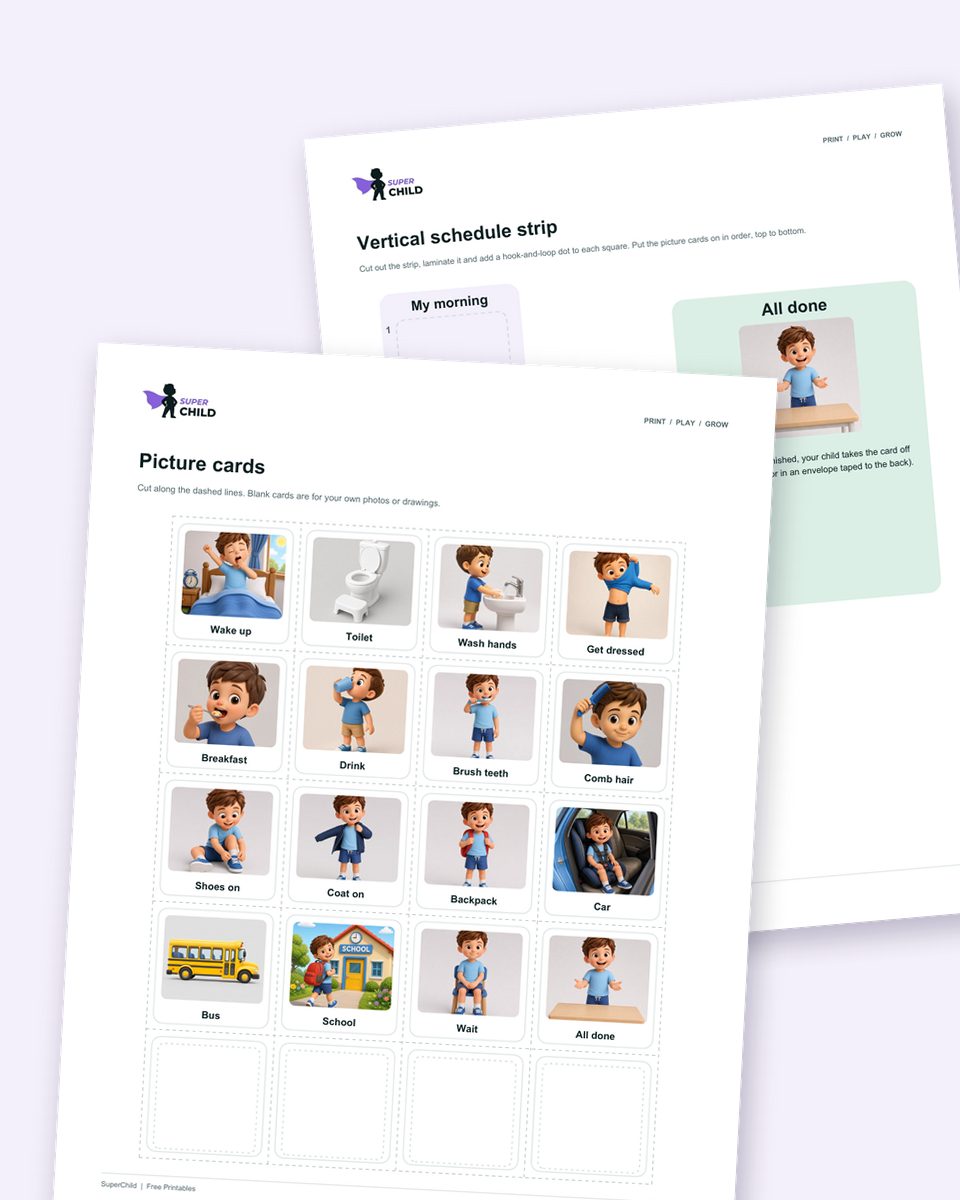
Free download1 PDF · 25 pages
Get the free visual schedule printable
Morning and bedtime routines plus picture cards for the whole day, with strips, a parent guide and a log.
Sources
- Kodak et al. (2015). Examination of the relation between an assessment of skills and performance on auditory-visual conditional discriminations for children with autism spectrum disorder. J Appl Behav Anal
- Fisher, Kodak and Moore (2007). Embedding an identity-matching task within a prompting hierarchy to facilitate acquisition of conditional discriminations in children with autism. J Appl Behav Anal
- Grow and LeBlanc (2013). Teaching receptive language skills: recommendations for instructors. Behavior Analysis in Practice
- Leaf et al. (2020). Comparing error correction to errorless learning: a randomized clinical trial. The Analysis of Verbal Behavior
- Stokes and Baer (1977). An implicit technology of generalization. J Appl Behav Anal
- Gastgeb, Strauss and Minshew (2006). Do individuals with autism process categories differently? The effect of typicality and development. Child Development
Cite this page
Citation (APA style)
SuperChild. (2026). Matching and sorting activities for autistic children, with things from around the house. Retrieved from https://superchild.ai/blog/sorting-activities-for-autism
Link for your website
<a href="https://superchild.ai/blog/sorting-activities-for-autism">Matching and sorting activities for autistic children, with things from around the house</a> (SuperChild)