On this page
- What is ABA therapy?
- The ABC model: antecedent, behavior, consequence
- Reinforcement, prompting and generalization
- ABA therapy and autism: what the evidence says
- Who is who: BCBA, BCaBA and RBT
- What an ABA session looks like
- How ABA goals are chosen
- ABA teaching methods: DTT, NET and task analysis
- Verbal behavior in ABA: mands, tacts, intraverbals and more
- How ABA uses data and graphs
- Is ABA therapy harmful? The criticism, and how good practice responds
- How to start ABA therapy
What is ABA therapy?
ABA therapy is a teaching approach based on applied behavior analysis: it breaks meaningful skills into small steps, teaches them with prompts and reinforcement, and measures progress every session to decide what to do next.
Applied behavior analysis is the science of how learning happens: behavior followed by something a person values tends to happen again. ABA therapy applies it to goals that matter in daily life, such as communicating wants, playing with a sibling, using the toilet or coping when plans change.
Three things make it ABA. It is individualized: goals come from an assessment of this child. It is data-driven: the team records every response and changes the plan when progress stalls. And it is supervised: a BCBA writes the plan and checks the data; RBTs usually do the teaching.
ABA has changed a lot since the 1970s. Best practice today is play-based, follows the child’s assent (a willing yes, and stopping when the child says no in words or behavior) and treats parents as partners.
The ABC model: antecedent, behavior, consequence
The ABC model (the three-term contingency) says every behavior sits between an antecedent, what happens just before it, and a consequence, what happens just after it; ABA changes antecedents and consequences to teach new behavior.
A child sees bubbles on a shelf (antecedent), says “bubbles” (behavior) and gets bubbles blown for them (consequence). Because the word worked, it is more likely next time. That loop, in the diagram at the top of this page, drives every ABA program.
It also explains behaviors that get in the way. If screaming during a hard task gets the task removed, screaming works as an escape. A BCBA uses ABC data (try the ABC sheet in our ABA data sheet generator) to find the function, then teaches a better way to get the same result, such as asking for a break.
- Antecedent (A)
- Right before: an instruction, a toy in view, a transition, hunger.
- Behavior (B)
- What the child does, defined so two people would count it the same.
- Consequence (C)
- Right after, making the behavior more or less likely next time.
Reinforcement, prompting and generalization
Reinforcement makes a behavior more likely, prompts help the child succeed, prompt fading removes that help step by step, and generalization makes the skill work with new people, places and materials.
These ideas show up in every method below, and every response is recorded as data.
- Reinforcement
- Anything after a behavior that makes it more likely again. Positive reinforcement adds something (praise, a turn with the car); negative reinforcement removes something (a break from a hard task). The child, not the adult, decides what is reinforcing.
- Prompting
- Extra help so the child succeeds: physical guidance, a model, a gesture, a verbal hint or a picture. Most-to-least starts with more help; least-to-most with less.
- Prompt fading
- Reducing help on purpose (for example with a time delay) so the child responds to the real cue. Without it, children can become prompt dependent.
- Generalization
- Using the skill with new people, places and materials: “dog” for a real dog, a toy dog and a picture. It is planned from day one, not hoped for.
ABA therapy and autism: what the evidence says
ABA-based interventions are among the most studied approaches for young autistic children, and the American Academy of Pediatrics describes them as having strong evidence for improving communication, social and adaptive skills.
Large reviews of evidence-based practices for autism list many ABA techniques by name, including prompting, reinforcement, discrete trial training, naturalistic teaching, task analysis and functional communication training.
Results vary from child to child. Starting early helps (see early intervention for autism), as do goals the family cares about, skilled supervision and teaching that carries over to home and school.
Who is who: BCBA, BCaBA and RBT
A BCBA designs and supervises the ABA program, a BCaBA assists under a BCBA, and an RBT delivers day-to-day sessions under supervision; all three are certified by the Behavior Analyst Certification Board (BACB).
You will see the BCBA at the assessment, supervision visits and parent training, and the RBT several times a week. Ask how often the BCBA observes sessions.
The three BACB credentials you meet in ABA therapy
BCBA (Board Certified Behavior Analyst)
- Training
- Graduate degree, supervised fieldwork, exam
- What they do
- Assesses, writes the plan, trains staff and parents, supervises RBTs
BCaBA (Board Certified Assistant Behavior Analyst)
- Training
- Bachelor’s degree, fieldwork, exam
- What they do
- Helps with assessment and programming, under a BCBA
RBT (Registered Behavior Technician)
- Training
- 40-hour training, competency assessment, exam
- What they do
- Runs sessions and records data; supervised for at least 5% of service hours monthly
| Role | Training | What they do |
|---|---|---|
| BCBA (Board Certified Behavior Analyst) | Graduate degree, supervised fieldwork, exam | Assesses, writes the plan, trains staff and parents, supervises RBTs |
| BCaBA (Board Certified Assistant Behavior Analyst) | Bachelor’s degree, fieldwork, exam | Helps with assessment and programming, under a BCBA |
| RBT (Registered Behavior Technician) | 40-hour training, competency assessment, exam | Runs sessions and records data; supervised for at least 5% of service hours monthly |
New RBTs can rehearse the exam with our free [RBT practice test](/free-tools/rbt-practice-test).
What an ABA session looks like
A typical session mixes play, short bursts of structured teaching, practice in routines like snack, and breaks, with the RBT recording data throughout.
Sessions happen at home, in a clinic or at school. A good one looks a lot like play with a very attentive adult.
- 1PairingThe RBT joins the child’s play and becomes the source of fun, so the child chooses to engage.
- 2Preference checkWhat does the child want right now? Motivation drives the session.
- 3Teaching in mixed formatsShort sets of discrete trials at the table or floor, then natural environment teaching in play and routines.
- 4Breaks and choicesPlanned breaks, and a way for the child to ask for one.
- 5Wrap-upNotes for the family: what went well and what to practice.
How ABA goals are chosen
The BCBA chooses goals from a skills assessment such as the VB-MAPP or ABLLS-R, a look at any behaviors of concern, and what matters most to the family.
For young children, the VB-MAPP and ABLLS-R map language, play, social and learning skills. Older learners may be assessed with PEAK or the AFLS for daily living skills. Our comparison of VB-MAPP, ABLLS-R, PEAK and AFLS explains which fits whom.
Good goals are specific (“requests 20 items with words or AAC in two settings”) and make the child’s day easier or more joyful. The same skills can become school goals; see IEP goals for autism.
ABA teaching methods: DTT, NET and task analysis
The three methods you will meet most are discrete trial training (short, structured trials), natural environment teaching (teaching in play and routines) and task analysis (breaking a routine into steps).
They are tools, not camps: good programs often teach one skill several ways.
What is discrete trial training (DTT)?
Discrete trial training is an ABA method that teaches a skill in short, repeated trials: a clear instruction (SD), a prompt if needed, the child’s response, a consequence and a brief pause.
Each trial has a clear start and end, so DTT is fast and easy to measure: ten chances in a few minutes, each marked on a DTT data sheet.
Massed trials repeat one target in a row, for brand-new skills. Mixed trials rotate new targets with known ones, which keeps success high and shows real understanding. Errorless learning prompts right away on new targets, so the child practices the right answer instead of guessing, then fades the prompt.
- 1Get readyChild motivated and attending; reinforcer ready.
- 2Give the SDOne short, clear instruction: “Touch red.”
- 3Prompt if neededRight away on new targets; after a few seconds on known ones.
- 4Child respondsCorrect, prompted, error or no response.
- 5Deliver the consequenceReinforce correct answers at once; after an error, re-present with a prompt.
- 6Inter-trial intervalRecord, pause 1–3 seconds, start the next trial.
What is natural environment teaching (NET)?
Natural environment teaching is an ABA method that teaches skills during play and everyday routines, using what the child already wants in that moment as the reason to learn and the reinforcer.
In NET the child leads. If they reach for a toy train, the adult holds the next piece and waits for “train,” or asks “What color?” first. The reinforcer is natural: the very thing they were after.
In incidental teaching the adult sets things up (a snack in a clear, closed box, a puzzle missing a piece) so the child has a reason to communicate. NET at snack, bath time and the park is strong for generalization and social skills.
DTT vs NET: when to use each
DTT is best for quickly building a new, clearly defined skill with many practice chances; NET is best for motivation, spontaneous use and generalization. Most children do best with both.
A common pattern: teach a label in DTT, then use it in play the same day.


Discrete trial training and natural environment teaching compared
Who leads
- Discrete trial training (DTT)
- The adult
- Natural environment teaching (NET)
- The child’s interest
Setting
- Discrete trial training (DTT)
- A table or quiet spot
- Natural environment teaching (NET)
- Play, routines, home, park
Reinforcer
- Discrete trial training (DTT)
- Chosen beforehand (praise, a token)
- Natural environment teaching (NET)
- Natural: what the child reached for
Best for
- Discrete trial training (DTT)
- New skills, many fast practice chances
- Natural environment teaching (NET)
- Mands, play, spontaneous language, generalization
Watch out for
- Discrete trial training (DTT)
- Skills stuck at the table
- Natural environment teaching (NET)
- Fewer practice chances if unplanned
| Discrete trial training (DTT) | Natural environment teaching (NET) | |
|---|---|---|
| Who leads | The adult | The child’s interest |
| Setting | A table or quiet spot | Play, routines, home, park |
| Reinforcer | Chosen beforehand (praise, a token) | Natural: what the child reached for |
| Best for | New skills, many fast practice chances | Mands, play, spontaneous language, generalization |
| Watch out for | Skills stuck at the table | Fewer practice chances if unplanned |
What is task analysis in ABA?
A task analysis breaks a multi-step routine, such as handwashing or brushing teeth, into small, observable steps in order, so each step can be taught, prompted and measured on its own.
Once the steps are written, the BCBA picks a chaining method. In forward chaining the child learns step 1 while the adult does the rest, then step 2 is added. In backward chaining the adult does everything but the last step, so the child finishes and gets the reward at once. In total task chaining the child does every step with prompts, which suits children who know some steps.
Record each step as independent or prompted on a task analysis data sheet, and show the routine as a picture sequence from the visual schedule maker.
A short brushing teeth task analysis: 1. Pick up toothbrush. 2. Wet the brush. 3. Add toothpaste. 4. Brush top teeth. 5. Brush bottom teeth. 6. Spit. 7. Rinse the brush. 8. Put the brush away. Match the steps to how your family really does it.

Verbal behavior in ABA: mands, tacts, intraverbals and more
Verbal behavior, from B.F. Skinner, classifies language by why it is used: a mand is a request, a tact is a label, an intraverbal is an answer to someone else’s words, and an echoic is a repeat of what was heard.
One word can be different skills: “juice” to get juice is a mand, “juice” about a picture is a tact, and “juice” to answer “What do you drink?” is an intraverbal. Each is taught directly. The VB-MAPP is built on these categories.


What is manding in ABA?
Manding is requesting: the child asks for something they want, like an item, help, a break or information, and the reward is getting exactly what they asked for.
Mands are usually taught first because communication instantly gets the child something. A mand is driven by a motivating operation, a passing state that makes something valuable now (thirst makes water valuable; being full makes cookies less so). So mand teaching follows the child’s interests: you can’t teach a mand for a toy the child doesn’t want.
A mand can be a word, a sign, a picture exchange or a tap on a device; many children start with pictures or AAC. A mand for a break or help also reduces challenging behavior.
What is a tact in ABA?
A tact is a label: the child names something they see, hear, smell or feel, such as saying “dog” when a dog walks by, and the reward is social, like praise or shared attention.
Tacts grow vocabulary and let children share their world (“Look, airplane!”). Early tacts are objects, people, animals and body parts; later come actions, colors and feelings. Unlike a mand, a tact is about the thing being there, not getting it. Our body parts activities are ready early tact targets.
What is an intraverbal? Fill-ins, questions and conversation
An intraverbal is a verbal response to someone else’s words, where the words do not match: answering “cat” to “What says meow?” or finishing “Ready, set…” with “go.”
Intraverbals build conversation. Teaching starts with intraverbal fill-ins: song lines (“Twinkle, twinkle, little…” “star”), routines (“Ready, set…” “go!”) and animal sounds; then questions and conversation.
They are often harder than mands and tacts because nothing in view hints at the answer. The WH questions printables give structured practice.
Echoics, listener responding, LRFFC and textual behavior
These are taught alongside mands, tacts and intraverbals, not after them.
- Echoic
- Repeating what was heard: the adult says “ball,” the child says “ball.” Echoics are used as prompts for the other operants.
- Listener responding
- Also called receptive language: following “touch nose” or “give me the cup.” See our receptive language activities.
- LRFFC
- Listener responding by feature, function and class: finding the cup from “You drink from a…” Try the feature, function and class activities.
- Textual
- Reading written words aloud. Taught later, once other language is in place.
How ABA uses data and graphs
ABA teams record every target each session, graph it, and use the trend to keep going, change the teaching, or move on once a mastery criterion is met.
Common measures are percent correct, frequency, duration, and step-by-step independence for task analyses. Data goes on a line graph with phase change lines when teaching changes, so anyone can see whether a change helped.
To check reliability, a second person sometimes records at the same time and the records are compared as interobserver agreement (IOA). Build sheets with the ABA data sheet generator, graph with the ABA graph maker and check agreement with the IOA calculator.
Is ABA therapy harmful? The criticism, and how good practice responds
Some autistic adults describe past ABA as harmful because it pushed compliance and tried to erase autistic traits; good modern ABA responds by seeking the child’s assent, choosing goals that help the child, and leaving harmless autistic behaviors alone.
The criticism deserves a fair hearing. Early programs used aversives, long drilling and goals like stopping hand flapping or forcing eye contact. Self-advocates also raise concerns about masking and children learning their “no” doesn’t count.
Ask providers about it. Good answers: we pause when assent is withdrawn; we don’t teach compliance for its own sake; goals target communication, independence, safety and joy, not looking “typical”; harmless stimming is left alone; parents can watch any session.
How to start ABA therapy
In the US, ABA usually starts with a diagnosis and referral, then insurance authorization, then a BCBA assessment. Under three? Ask about your state’s early intervention program too; see our early intervention guide.
- 1Get the paperworkA diagnosis report and a referral for ABA; check what your insurer requires.
- 2Interview providersAsk about supervision, assent, parent training and goals.
- 3Join the assessmentBring the two or three skills that would change your family’s day most.
- 4Agree on the planAsk how each goal is measured and see the graphs at every review. More on our parents page.
Free starter kit
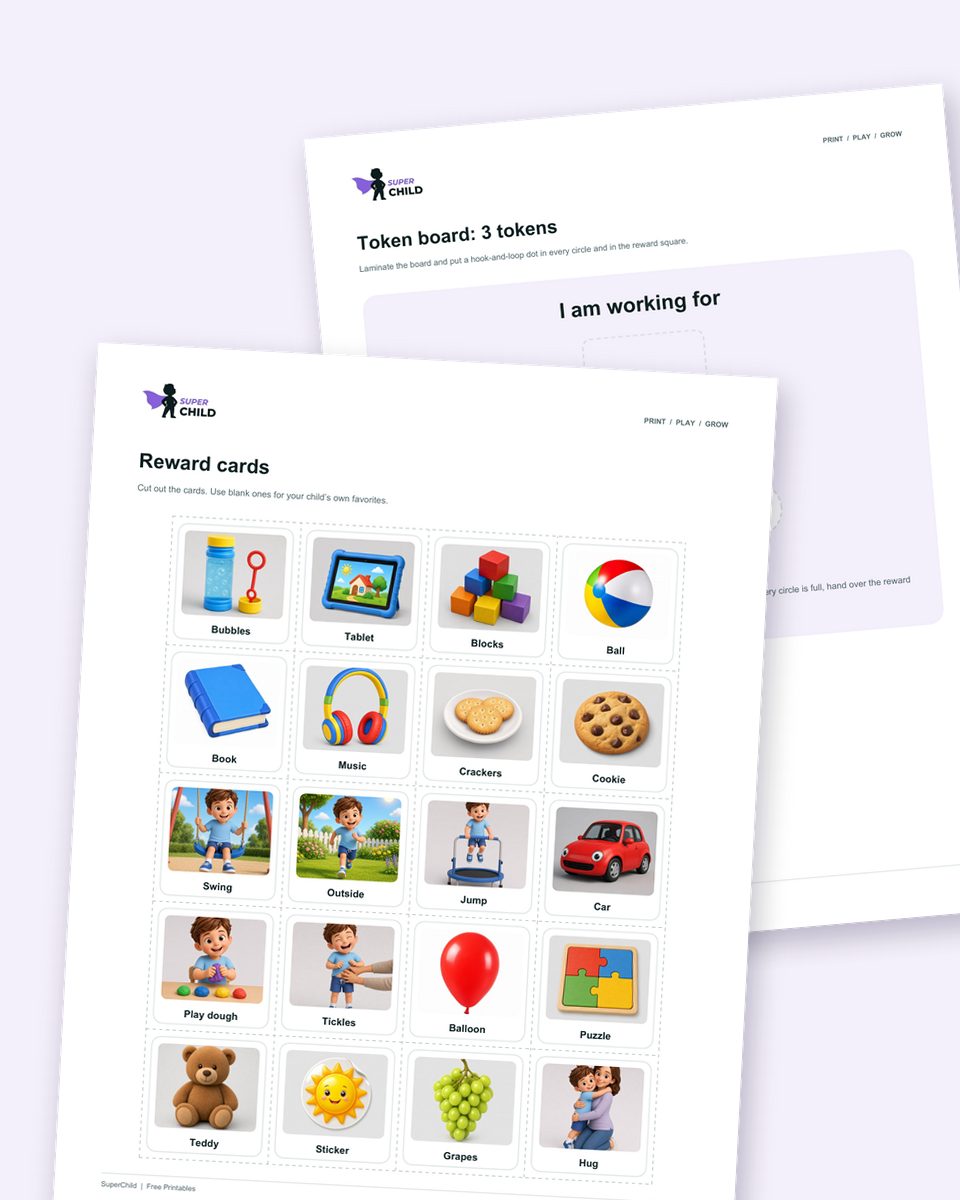
Use the same token board and first-then board at home as in sessions
The visual supports ABA teams use every day, ready to print for home: 12 PDFs with a short adult guide and a log each, and a first-week plan.
- Token boards with 3, 5 and 10 tokens, a first-then board and visual schedules.
- A picture exchange starter book and two social stories.
- Starter skill packs for matching, receptive identification and yes/no.
Free download
Get the 12 PDFs free
Three quick answers and the PDFs open right here.
Sources
- American Academy of Pediatrics: Identification, Evaluation, and Management of Children With Autism Spectrum Disorder (Hyman et al., Pediatrics, 2020)
- Wong et al.: Evidence-Based Practices for Children, Youth, and Young Adults with Autism Spectrum Disorder (J Autism Dev Disord, 2015)
- Sundberg & Michael: The Benefits of Skinner’s Analysis of Verbal Behavior for Children with Autism (Behavior Modification, 2001)
- Behavior Analyst Certification Board: Registered Behavior Technician (RBT)
- Behavior Analyst Certification Board: Board Certified Behavior Analyst (BCBA)
- CDC: Treatment and Intervention for Autism Spectrum Disorder
Cite this page
Citation (APA style)
SuperChild. (2026). What is ABA therapy? A clear guide to how it works. Retrieved from https://superchild.ai/guides/aba-therapy
Link for your website
<a href="https://superchild.ai/guides/aba-therapy">What is ABA therapy? A clear guide to how it works</a> (SuperChild)