On this page
- What is a speech delay? Speech delay vs language delay
- Speech and language milestones from 12 to 36 months
- When to worry about speech delay
- Speech delay vs autism: how to tell the difference
- What causes a speech delay?
- Therapy for speech delay: what speech therapy for toddlers looks like
- How to do speech therapy at home: 9 strategies that work
What is a speech delay? Speech delay vs language delay
A speech delay means a child says fewer words or sounds than expected for their age. A language delay means a child has trouble understanding words (receptive language) or putting words together to say what they mean (expressive language), whether by talking, signing or pointing.
Parents say “speech delay” for any child who isn’t talking yet. Speech-language pathologists (SLPs) split it in two, because each points to different help. Speech is the mechanics: making sounds and words clearly with the lips, tongue and breath. Language is the meaning: knowing words, understanding what people say, and combining words into ideas.
A child with only a speech delay understands what you say and uses lots of gestures, but the words won’t come out. Most toddlers who are “not talking yet” have an expressive language delay, sometimes with a receptive one too.
- Speech delay
- Fewer sounds or words than expected, or words that are hard to understand. Understanding is usually on track.
- Expressive language delay
- Small vocabulary and few word combinations for their age. The most common pattern in toddlers.
- Receptive language delay
- Trouble understanding words and directions, like “get your shoes.” See receptive language activities.
- Late talker
- A toddler (usually 18 to 30 months) whose expressive language is behind, with no other known developmental condition.


What is a late talker? Late talker vs speech delay
A late talker is a toddler who has fewer than about 50 words, or no two-word combinations, at 24 months, while understanding, playing and connecting with people like other children of the same age.
“Late talker” is a description, not a diagnosis. Studies put roughly 10 to 15 out of every 100 two-year-olds in this group, and boys more often than girls. ASHA calls it late language emergence. Many late talkers, often more than half, catch up with their peers by the time they start school. Others are later diagnosed with a developmental language disorder, and for some, late talking is an early sign of hearing loss or autism.
The honest answer to “will my child grow out of it?” is: maybe, and you can’t tell yet. Late talkers who understand well and use many gestures tend to do better; those who also struggle to understand, use few gestures, or have a family history of language problems more often need help. So the advice is the same for all: get it checked now and start the home strategies below today.
Speech and language milestones from 12 to 36 months
By 18 months most children try to say three or more words besides “mama” and “dada,” by 2 years they say two words together like “more milk,” by 30 months they say about 50 words, and by 3 they hold a conversation with at least two back-and-forth exchanges.
These are the CDC’s 2022 milestones, which list what at least 3 out of 4 children do by each age. That makes them a floor, not an average. Understanding, gestures and pointing count as much as spoken words, so the timeline shows them all, plus red flags for each age.
Speech delay in an 18-month-old
Word attempts count at 18 months, like “ba” for ball. An 18-month-old with few words who understands, points and brings you things to look at is a possible late talker, and the home strategies below are a good first step.
An 18-month-old who doesn’t point, rarely looks where you look, doesn’t respond to their name, or has lost words they used to say needs a closer look now. The 18-month checkup is also when US pediatricians screen for autism with the M-CHAT-R/F, so bring your notes.
Speech delay in 2-year-olds
By 2, most children say at least two words together (“more milk,” “daddy go”), point to things in a book when you ask, point to at least two body parts, and use gestures beyond waving and pointing, like nodding yes or blowing a kiss.
A speech delay in two-year-olds is the most common reason families first see an SLP, and it’s a good age to start: children this age learn language fast. If your 2-year-old uses fewer than 50 words, doesn’t combine words, or is hard to understand even for you, ask for an evaluation.
When to worry about speech delay
Talk to your pediatrician as soon as your child misses a milestone, and right away if they lose words or skills they had, don’t respond to sounds, or stop pointing and looking at you. Waiting to see rarely helps; checking costs little.
Ask for an evaluation if your child:
- Isn’t babbling with consonants (“bababa,” “dadada”) or waving by 12 months.
- Has no words and doesn’t point by 15 to 18 months.
- Has fewer than about 50 words, or no two-word phrases, at 24 months.
- Doesn’t seem to understand simple words or directions you say without gestures.
- Mostly repeats what others say instead of saying their own words (echolalia), past age 2.
- Is hard for you to understand at 2, or hard for strangers to understand at 3.
- Has frequent ear infections, or doesn’t turn when you call from another room.
Speech delay vs autism: how to tell the difference
A late talker usually connects easily: they point to show you things, look where you look, answer to their name and play pretend, they just don’t have the words yet. In autism, the differences show up in social communication too, often with repetitive behaviors or intense interests.
Late talking is often the first thing parents of autistic children notice, so the worry makes sense. But talking late on its own is not a sign of autism. What tells them apart is everything around the words: whether your child shares attention with you (looks at the plane, then back at you, then points), uses gestures to make up for missing words, responds when you call them, copies what you do, and plays with toys the way they are meant to be used.
No single sign decides it. Some autistic toddlers have big vocabularies, some late talkers are shy, and a child can have both a language delay and autism. Only an evaluation can tell, so use the comparison below to know what to mention.
Autism or speech delay? How to get an evaluation
You don’t need to know which it is before asking for help. One set of steps covers both.
- 1Write down what you see for a weekList the words your child says (word attempts count), the gestures they use, and when they point, look at you or answer to their name. Short videos help.
- 2Ask your pediatrician for a developmental screenThe AAP recommends developmental screening at 9, 18 and 30 months and an autism screen with the M-CHAT-R/F at 18 and 24 months. You can ask for one at any visit.
- 3Get a hearing testAsk for a full hearing evaluation by an audiologist. A passed newborn screen does not rule out hearing loss later, and fluid from ear infections can muffle sound for weeks.
- 4Call Early Intervention (under 3) or your school district (3 and up)In the US, every state runs a free Early Intervention program for children under 3. You can refer your own child; no doctor’s referral is needed. From age 3, the local school district evaluates for free and can provide preschool services.
- 5In the UK, talk to your health visitor or GPYour health visitor sees your child at the 2 to 2½ year review and can refer to NHS speech and language therapy. Many areas also let parents refer themselves.
What causes a speech delay?
Often there is no single cause: many late talkers simply have a family history of talking late. Known causes include hearing loss (including fluid from repeated ear infections), autism, intellectual disability or global developmental delay, and motor speech problems like childhood apraxia of speech.
It’s natural to look for something you did. In almost every case there isn’t anything. These are the causes and risk factors with good evidence behind them.
- Hearing
- Hearing loss of any degree, including temporary loss from fluid behind the eardrum after ear infections. Every child with a speech delay should have their hearing tested.
- Family history
- A parent or sibling who talked late or had language or reading difficulties is one of the strongest risk factors.
- Being born early or small
- Prematurity and low birth weight raise the chance of late talking. Boys are also more often late talkers.
- Autism
- Autistic children often talk late, alongside differences in social communication and play.
- Developmental conditions
- Intellectual disability, global developmental delay and genetic conditions such as Down syndrome usually slow language too.
- Oral-motor and motor speech
- Childhood apraxia of speech (trouble planning mouth movements) or weak oral muscles make words hard to produce even when a child knows them.
Does bilingualism or screen time cause speech delay?
Three things parents often hear blamed, and what the evidence says:
- Bilingualism is not a cause. Children learning two languages reach first words and word combinations on the same schedule. Count words in both languages together, and keep speaking the language you know best.
- Screen time is a maybe, not a known cause. Studies link lots of screen time, especially background TV, with smaller vocabularies, mostly because it replaces talk and play with people. The AAP advises avoiding screens other than video chat before 18 to 24 months. Cutting back is sensible, but it doesn’t replace an evaluation.
- Tongue-tie is rarely the reason. It can affect some sounds, but it doesn’t stop a child from learning words.
Therapy for speech delay: what speech therapy for toddlers looks like
Speech therapy for toddlers is play-based: the SLP plays with your child on the floor, sets up moments where your child wants to communicate, and coaches you to do the same at home, because daily practice with parents is where most of the progress happens.
Don’t expect flashcards. A session with a 2-year-old looks like bubbles, cars, snacks and songs. The SLP picks a few target words or gestures, creates many small chances to use them, then shows you how and gives feedback while you try. Research reviews find that parent-implemented language interventions help toddlers’ expressive language and vocabulary, which is why programs like the Hanen Centre’s It Takes Two to Talk and Target Word are built around parents.
If your child has very few words, the SLP may add signs, picture cards or a speech device. Parents often worry this will stop speech; the research says it doesn’t, and it often helps words come. Read more in the AAC guide. For autistic children, behavior analysts often track early communication with the VB-MAPP, whose first level includes requesting (mands) and copying sounds and words (echoics). The VB-MAPP goal mapper turns those milestones into plain-language goals and activities.
- How often
- Usually once a week, 30 to 60 minutes, at home, at a clinic or by video. Early Intervention often comes to your home.
- Who is in the room
- You. In good toddler therapy, the parent is part of every session.
- What gets measured
- New words, word combinations, gestures, how often your child starts communicating, and how much they understand.
How to do speech therapy at home: 9 strategies that work
Speech therapy at home means turning daily routines into many small chances to communicate: follow your child’s lead, wait for them to try, and answer with their word plus one more. Ten minutes a day of focused play, plus these habits during meals and baths, is a strong start.
You don’t need special toys or a diagnosis to start. These are the strategies SLPs coach parents to use. Pick two this week, and add more once they feel natural.
- 1Get face to face and follow their leadGet down to your child’s eye level and play with what they choose. Children learn words for the things they are already looking at and interested in.
- 2Observe, Wait, Listen (OWL)Watch what your child is interested in, then wait, silently and expectantly, for 5 to 10 seconds. Listen to any sound, gesture or look they offer, and treat it as communication.
- 3Narrate instead of quizzingDescribe what your child is doing in short phrases: “Car go. Car up. Car crash!” Ask fewer test questions like “What’s this?”
- 4Expand by one wordWhen your child says one word, say it back with one word added: “ball” becomes “big ball” or “throw ball.” Two words become three. Stay just one step ahead of them.
- 5Offer choicesHold up two things and name them: “Juice or milk?” Your child hears the word right when they want it, and can answer with a word, a point or a picture.
- 6Create communication temptationsSet up small reasons to ask: a snack in a clear jar they can’t open, bubbles you blow once and stop, a toy on a high shelf. Then wait.
- 7Pause and let them finishIn songs, rhymes and routines your child knows, stop before the last word: “Ready, set…” “Twinkle, twinkle, little…” and wait for them to fill it in.
- 8Repeat the same words in routinesUse the same short words every time in meals, baths and bedtime: “up,” “off,” “wash,” “all done.” Repetition is how toddlers learn words.
- 9Celebrate every tryRespond to word attempts as if they were perfect: if your child says “ba” for ball, hand over the ball and say “ball!” Don’t make them repeat it correctly first.

Communication temptations: set up reasons to talk
A child who has everything they need without asking has no reason to communicate. Communication temptations, which SLPs sometimes call “sabotage,” put a small, friendly obstacle between your child and something they want. The goal is a request of any kind: a word, a sound, a sign, a point or handing you a picture.
Keep it playful. If your child gets upset, say the word and give the item. Picture cards like the ones in the PECS communication book give children who can’t say the word yet a way to ask.


Speech therapy for 2-year-olds at home: a daily routine
Set aside ten minutes a day for focused play with no phone and no TV: bubbles, a ball, cars, a shape sorter or a snack. Use OWL, expansion and one or two temptations. Then carry the same habits into three routines you already do every day, like breakfast, bath and getting dressed. A visual schedule or a first-then board makes those routines predictable and gives you pictures to name together.
As your child moves into phrases and sentences, printable activities help practice understanding and answering: following directions with real objects, yes/no questions, sequencing cards for telling what happened first and next, and later WH questions like “who” and “where,” which most children start asking around 3.
- Free printableFollowing directionsOne-step to three-step directions with a cup, a box and a toy car, plus picture pages to point at.
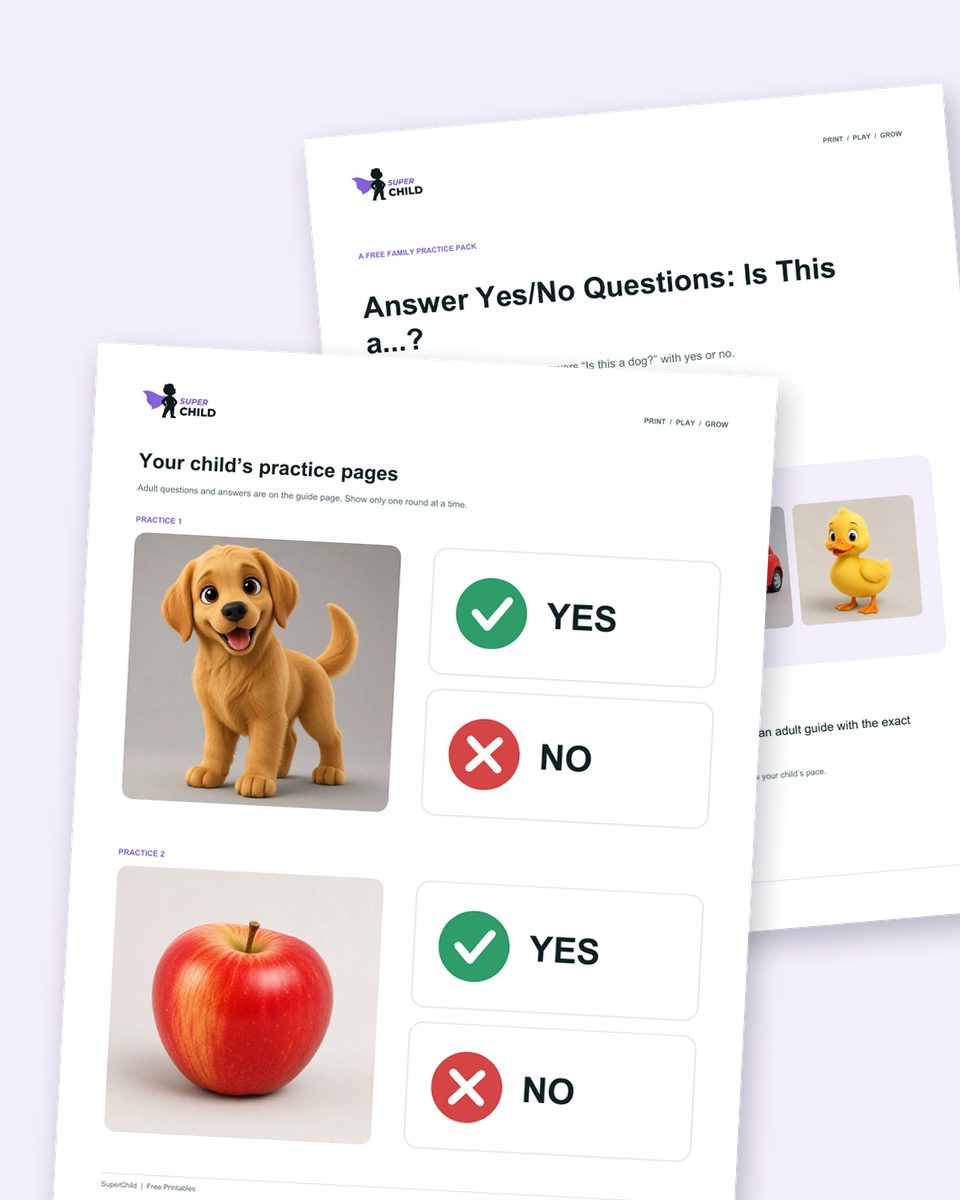
- Free printableYes/no questionsPicture pages with YES and NO cards, so your child can answer before they can say the words.
- Free printableSequencing cards3-step and 4-step picture sequences for first, next and last, at home or in speech therapy.
- Free printableWH questionsWho, what and where worksheets your child answers by pointing, for when they are ready.
Free speech practice packs
Four printable speech practice packs for home
For children who already point at pictures: short picture games for the skills SLPs often target next, in five-minute rounds with a log to share at the next session.
- Pointing to everyday objects and daily routine actions when you name them.
- Answering “Is this a dog?” with yes or no.
- Putting three pictures of a routine in order.
Free download
Get the 4 PDFs free
Three quick answers and the PDFs open right here.
Sources
- CDC: Developmental milestones, Learn the Signs. Act Early. (2022 revision)
- ASHA Practice Portal: Late Language Emergence
- ASHA: Late blooming or language problem?
- ASHA: Learning more than one language
- NIDCD: Speech and language developmental milestones
- M-CHAT-R/F: Modified Checklist for Autism in Toddlers, Revised with Follow-Up
Cite this page
Citation (APA style)
SuperChild. (2026). Speech delay in toddlers: late talker, autism, or something else? Retrieved from https://superchild.ai/guides/speech-delay
Link for your website
<a href="https://superchild.ai/guides/speech-delay">Speech delay in toddlers: late talker, autism, or something else?</a> (SuperChild)