
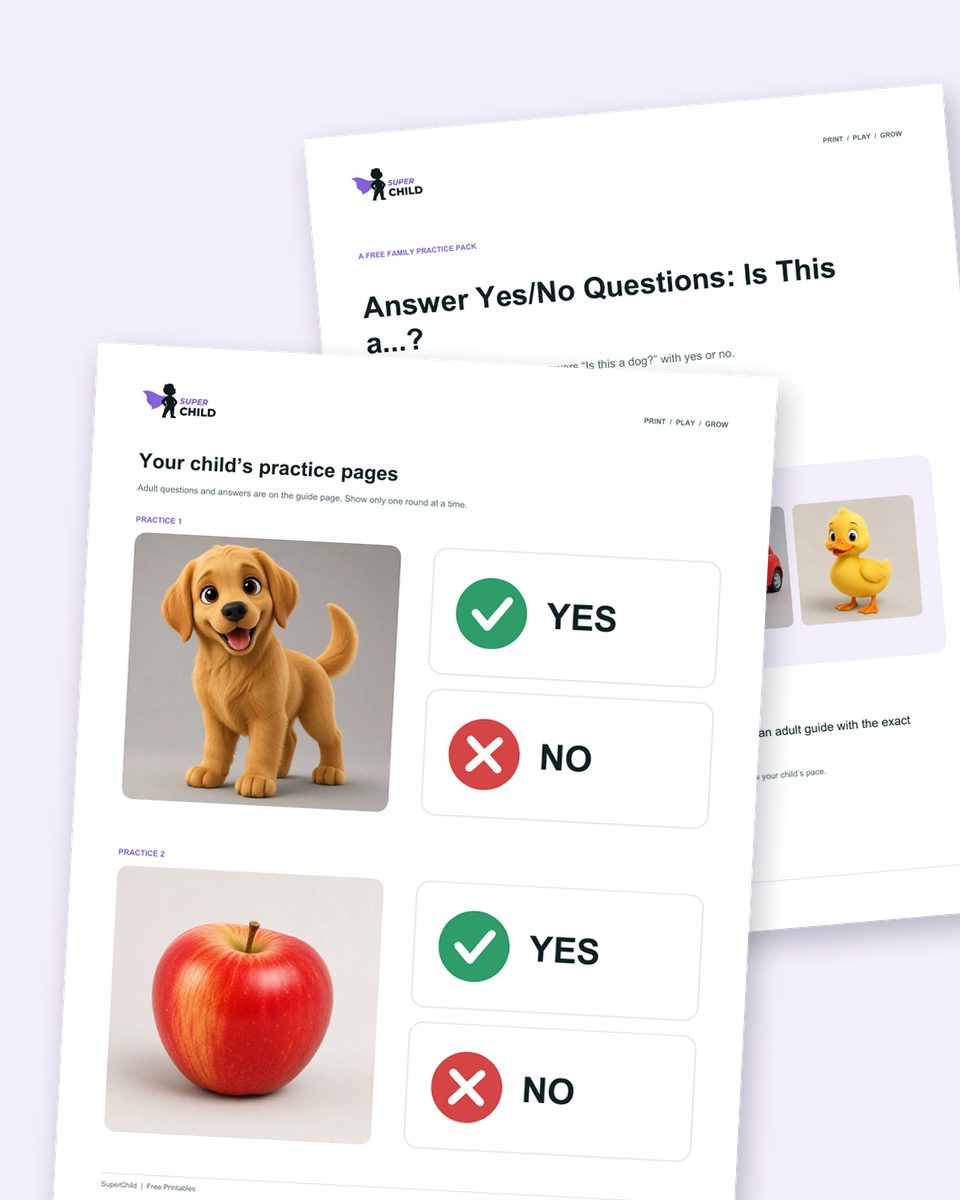
What counts as a yes or no answer?
In these yes/no question worksheets, any clear yes or no counts: pointing to or handing you the YES or NO card, nodding or shaking the head, signing, or saying the word. Decide before you start which response you will count, and count only that one during the check, so the answers stay comparable.
If your child usually points to cards, don’t switch to expecting a spoken “no” halfway through.
The cards are big on purpose, with a green check on YES and a red cross on NO. Cut out a pair and keep it on the table during practice. For a child who doesn’t talk yet, a card they can touch is often the clearest way to say no.
Yes/no questions list, with answers
These yes/no questions are the exact questions from the adult guides, with the expected answer next to each one. The answers are mixed on purpose, so a child who always says yes gets half of them wrong. Every question is about a familiar picture, and none depends on your child’s own habits or tastes.
“Is this a...?” practice rounds
- Is this a dog?yes
- Is this a banana?no
- Is this a car?yes
- Is this a fish?no
- Is this a book?yes
- Is this a hat?no
“Is this a...?” check rounds
- Is this a cow?no
- Is this a banana?yes
- Is this a spoon?no
- Is this a cow?yes
- Is this a bike?no
- Is this a fish?yes
Everyday Facts practice rounds
- Do you eat a shoe?no
- Is a bed for sleeping in?yes
- Can a fish swim?yes
- Do you wear a banana?no
- Does a cow say moo?yes
- Can a car fly?no
Everyday Facts check rounds
- Is a banana yellow?yes
- Do you eat a book?no
- Is a chair for sitting on?yes
- Is a ball for eating?no
- Can a duck swim?yes
- Do you wear a sock on your head?no
Which yes/no questions to start with
Start yes/no questions with the “Is this a...?” pack, the easier one. The question names something, and your child decides whether it matches the picture in front of them. Use pictures your child already knows by name; the receptive language activities are a good way to teach those names first.
Ask two questions about the same picture, one with a yes answer and one with a no (“Is this a dog?” and “Is this a cat?”), and switch which comes first, so your child has to listen to the name and not just say yes.
Move on to Everyday Facts once that goes well. Here the picture helps your child think about the object, but the answer depends on the question: a picture of a shoe, and “Do you eat a shoe?”. Start with the questions where the funny “no” is obvious. Many children find them silly, and silly helps.
Don’t give the answer away
Children practicing yes/no questions pick up on tiny cues fast: a raised voice, a smile, a nod while you wait. Ask the exact question once, in a neutral voice, then give a calm pause. Show one round at a time and keep the adult guide out of sight, so the answer has to come from the question.
- Mix yes and no answers in no fixed order. If the answer is always yes on the first turn, your child will learn the pattern instead of the question.
- Watch your own head. It is easy to nod without noticing while you wait for a yes.
- Record helped answers separately from answers your child gave alone.
Yes/no to facts is not the same as yes/no to offers
Yes/no questions about facts (“Is this a cup?”, “Can a car fly?”) are a different skill from saying yes or no to an offer, like “Do you want juice?”. An offer is about what your child wants right now, and the answer changes from moment to moment, so there is no right answer to check against a guide.
These packs practice the first kind only.
The packs say so plainly: answering yes or no to requests is not checked here. Many children learn to accept and refuse offers in daily routines, at snack time or when choosing a toy, and your child’s speech therapist or BCBA can tell you how to work on that. A child who can say “no” to “Is this a shoe?” may still say yes to every offer, and the other way around.
Take yes/no questions into the day
Take yes/no questions off the page by asking about real things when they are in your hands. Hold up a cup and ask “Is this a cup?”, then “Is this a shoe?”. Ask “Do we wear shoes in the bath?” as you run it. A few willing turns at breakfast and playtime count for more than one long session.
When yes and no are steady, WH questions for autism are a natural next step: what, who and where.
Teach first, check later
Each yes/no pack keeps its 6 check rounds separate from its 6 practice rounds. During a check, record your child’s first response before any help: no pointing, nodding or hinting between attempts. The log uses I for independent and correct, H for correct with help, X for incorrect or no response.
If your child says no to the session itself, stop and note it.
Mostly I? Try the questions in a new place or with another adult. Some help needed? Keep the same step and make one thing easier. Repeated errors or upset? Go back to fewer, easier questions and teach again when your child is calm. A good check shows your child can do it with this material. It is not a speech or language assessment.
How to teach yes/no questions at home
To teach yes/no questions at home, show one familiar picture, ask “Is this a…?” once in a neutral voice, and let your child answer with a YES or NO card, a nod or a word. Mix yes and no answers, model the answer during teaching, and help a little less on each turn. Keep sessions to 3 to 5 minutes.
- Print the pages in color at actual size (on A4, choose fit to page) and cut out a pair of YES and NO cards. Keep the adult guide out of sight.
- Decide which response you will count: touching a card, a nod or head shake, a sign or a spoken word.
- Show one round at a time and ask the exact question from the guide once, then give a calm pause.
- During teaching, model the answer: point to YES and say “Yes, it is a dog.” On the next turn, pause a little longer before helping.
- Mix yes and no answers in no fixed order, and ask a yes and a no question about the same picture.
- Run the 6 check rounds on another day, record the first response as I, H or X, and use the log to decide what comes next.