
What is PECS, and how is this book different?
The Picture Exchange Communication System (PECS) is a specific teaching protocol with six phases, developed by Andy Bondy and Lori Frost. PECS starts with the exchange itself, a child handing over a single picture to get what they want, and later phases build toward choosing between pictures and making sentences. Professionals trained in the protocol usually teach it.
This free book is different. It is a set of picture exchange starter cards and sentence strips that fit inside whatever plan your child’s team uses, PECS or another form of picture communication. It does not teach the six phases, and it is not a replacement for PECS training. The official PECS protocol comes from Pyramid Educational Consultants.
What’s in the picture exchange book
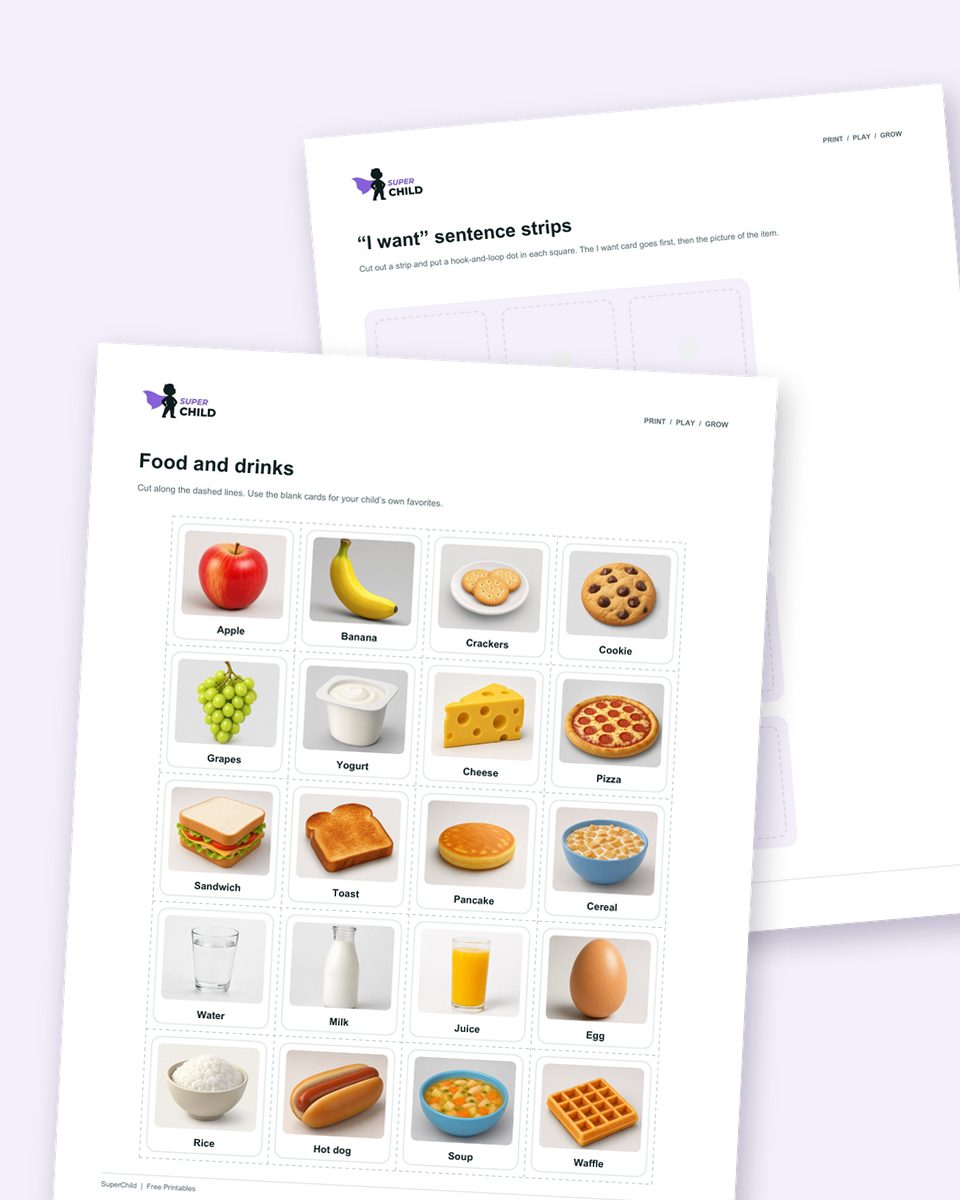
The Picture Exchange Starter Book is 10 US Letter pages in color, with SuperChild’s own pictures: a cover, “I want” sentence strips, 8 core cards, 20 food and drink cards, 20 toy and activity cards, safety notes for the adult and a request log for the week. That is 48 PECS-style picture cards in total.
- A book cover, “My talking book”, with a line for your child’s name and the note: “I use pictures to ask. Please wait for me to give you a picture.”
- “I want” sentence strips: the I want card goes first, then the picture of the item.
- 8 core cards: I want, more, help, break, all done, toilet, drink, eat.
- 20 food and drink cards, from apple, banana and crackers to juice, milk, pizza and waffle.
- 20 toy and activity cards: bubbles, ball, blocks, tablet, swing, slide, tickles, hug, drawing, swimming and more.
- Safety notes for the adult: cut grapes and other round foods lengthwise into quarters and follow your child’s feeding plan. An adult blows up and holds any balloon; keep uninflated or broken balloons away from your child and throw pieces away straight away.
- A request log for the week.
Which picture cards to start with
Start a picture exchange book with pictures of the things your child reaches for most, and only those. A PECS card for something your child does not care about will not be used. Watch for a day or two: the snack they point at, the toy they bring you, the activity they ask for with their whole body.
Help, break, all done, toilet, drink and eat are always available and never something your child has to earn. Keep those core cards in the book from the start, even before your child uses them.
Starting with one picture card
Start picture exchange with one picture of one thing your child loves, with the real item in sight but out of reach. Wait for your child to pick up the card. As soon as the card is in your hand, give the item and name it: “Cookie!” Keep turns tiny: one piece of cracker, a few seconds of bubbles.
If your child does not pick up the card, ask your SLP or BCBA to show you how they teach the first hand-over. Any physical help needs coaching for your child individually, and stops whenever your child pulls away or says no in any way. Until then, model it yourself: hold the card, hand it to a second adult and get the item, so your child sees what the picture does. Keep the card within easy reach and honor every other way your child already asks, like reaching, leading you or a sound.
When the exchange is easy, make it a little harder in small steps before you add pictures: another adult, another room, a little more distance to the book or to you. Then add a second picture and teach your child to choose. Create small reasons to ask during the day: snacks in a clear box, bubbles on a shelf, one piece of the puzzle at a time.
From single PECS cards to a sentence board
Move from single PECS cards to the sentence strip once your child chooses between several pictures and comes to find you to ask. The sentence strip has two spaces: the I want card first, then the item card. Read the strip back as you hand over the item: “I want juice.” Keep naming every item, every time.
The log has a line for every request: the picture used, I (gave the picture with no help) or H (with help), whether your child came to find you and whether they said a word too. Still needing a lot of help? Go back to fewer pictures and stronger favorites, and ask your SLP or BCBA what to change.
Will pictures stop my child from talking?
No. Picture exchange does not stop a child from learning to talk. The pack says: “Using pictures does not stop a child from learning to talk. Keep naming each item as you hand it over.” A spoken word is always welcome, but the hand-over is the request. If you have questions about your child’s speech, ask your SLP.
How to make a PECS book at home
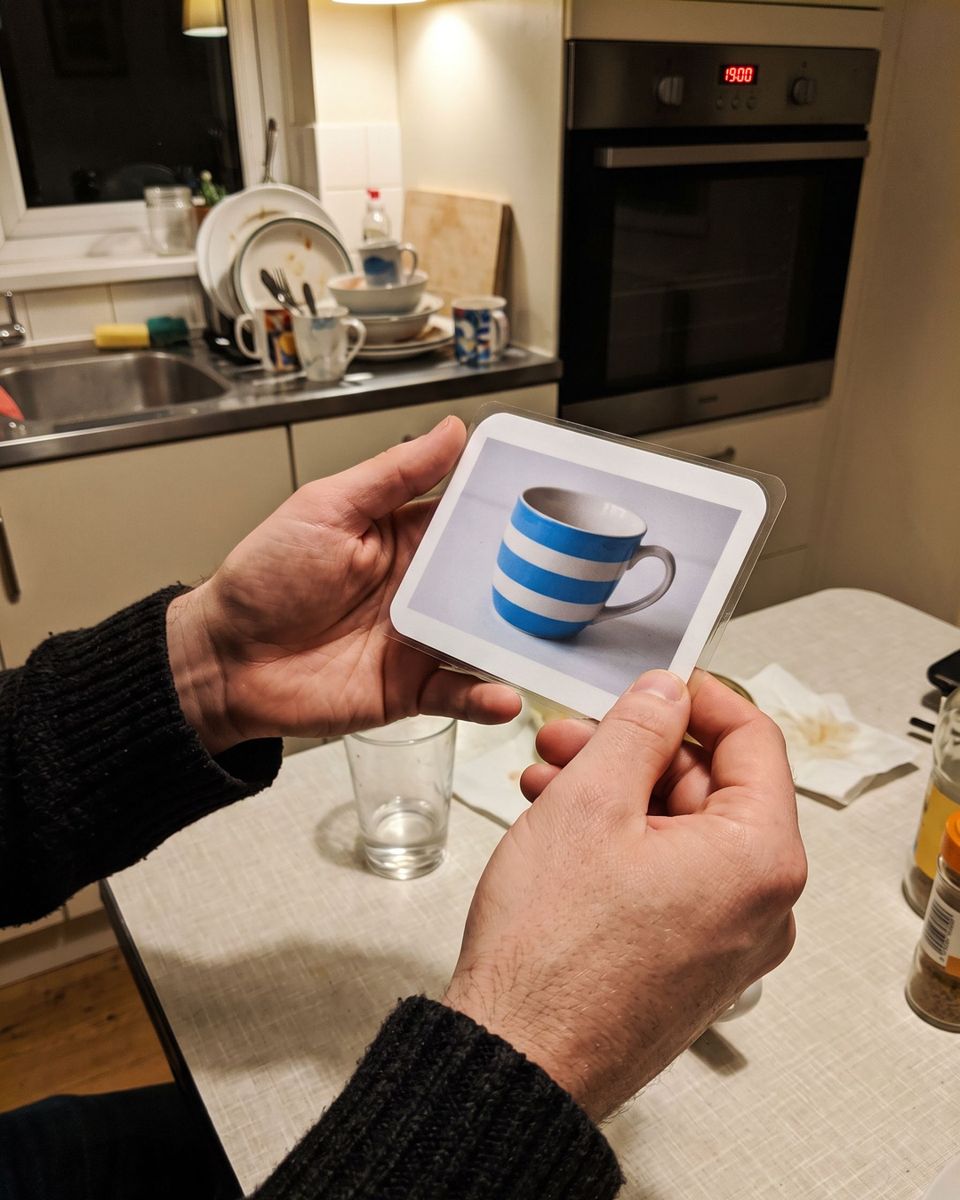
To make a PECS-style book at home, print the picture cards in color, cut and laminate them, put a hook-and-loop dot on the back of each, and keep them in a small binder with dots along the pages. Start with one picture of something your child loves, and keep the book where your child can always reach it.
- Print the cover, sentence strips and picture cards in color at actual size (on A4, choose fit to page).
- Cut out the cards, laminate them or cover them with clear tape, and put a hook-and-loop dot on the back of each card.
- Glue the cover to the front of a small half-inch binder and put strips of dots along the inside pages and on the front.
- Put only one or two favorite pictures in the book to start, plus the core cards for help, break, toilet, drink and eat. Use the blank cards for your child’s own favorites.
- Keep the book where your child can always reach it, at home and on the go, and give the pictured item straight away every time your child hands you a card.
- Log each request for a week and share the log with your SLP or BCBA, or use a free ABA data sheet if they ask for frequency data.