
What is a visual schedule?
A visual schedule is a row of pictures that shows the steps of a routine in order, so an autistic child can see what is happening now and what comes next. Spoken directions disappear as soon as you say them. A picture stays on the wall, and your child can check it as often as they need to.
Many autistic children, and children with a developmental delay, find a change of activity much easier when they can see it coming instead of hearing about it at the last minute. A schedule also gives your child a job: check the picture, do the step, move the card to All done. That small routine of checking is the real skill. Talking is not required at any point.
These packs are ready-made. Prefer to customize? Make your own visual schedule with your own steps and photos in the free visual schedule maker, and print it the same way.
What’s in the free visual schedule printables
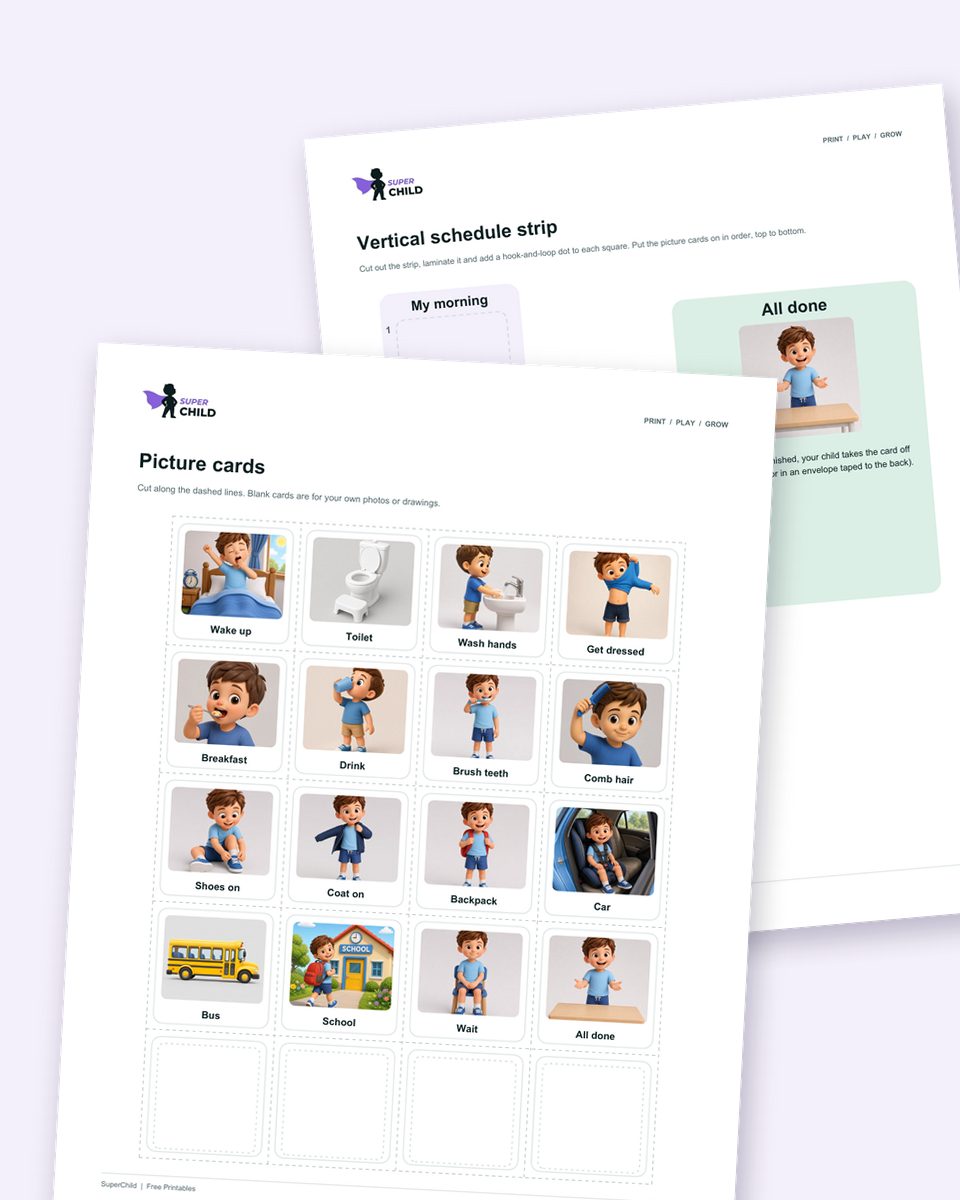
The free visual schedule printables come as three color PDF packs: a morning routine, a bedtime routine and 36 picture cards for the whole day. Every pack is US Letter, uses SuperChild’s own soft illustrations of a boy and everyday objects, and includes a two-page adult guide, the cards and strips, and a log page.
- Morning Routine: 16 picture cards (wake up, toilet, wash hands, get dressed, breakfast, brush teeth, shoes on, coat on, backpack, bus, school and more), 4 blank cards, a vertical “My morning” strip with an All done pocket and two short strips.
- Bedtime Routine: 12 picture cards from dinner, bath and pajamas to story, hug, quiet time and sleep, 8 blank cards, the same vertical strip and two short strips.
- The Whole Day: 36 picture cards for places (school, store, park, library, doctor, haircut), meals, play (swing, puzzle, bubbles, tablet) and cards for Wait, Break and Clean up, plus 4 blank cards, a full-day board with eight places and two short strips.
Where to put a visual schedule at home
A visual schedule works best where the routine happens: the morning strip on the bathroom door or in the hallway by the shoes, the bedtime strip near the bath or the bedroom, and the whole-day board in the kitchen or by the front door. A visual schedule that lives in a drawer does not get used.
Take the next card with you when you leave the house. Hold the Park card while you put on shoes, then hand it over at the park gate. A card that travels makes the picture mean the place.
Visual timetables at school: UK and Australian classrooms
A visual timetable is the name UK and Australian schools use for a visual schedule: the same pictures in order, on the classroom wall or on a child’s desk. These printables work as a visual timetable at home, and the whole-day cards include School, Classroom, Table time, Clean up and Break, so home and school can use matching pictures.
In the UK, a visual timetable is often part of a child’s SEN support or EHCP, set up by the class teacher, a teaching assistant or the SENCo. Many classrooms also use a now and next board for single transitions, which is the same idea as the first-then board printable. In Australia, a speech pathologist or occupational therapist, often funded through the NDIS, may build one with you. In the US, it is usually the teacher, BCBA or OT. Wherever you are, ask how the class schedule works and copy the order and the words at home.
A visual schedule for preschoolers: start with first, then
A visual schedule for preschoolers should start short, because a whole morning on one strip is a lot for a three-year-old. Every pack has a three-space “First, then...” strip and a four-space “My schedule” strip for the table, the car door or the fridge.
Fewer pictures are easier. Show the next two things, and show more of the day only once your child checks the strip without being told.
What to do when the plan changes
When the plan changes, swap the visual schedule card in front of your child before the change happens and name the new one calmly. Only put up what will really happen. Children learn quickly whether a card means what it shows, and a schedule that is often wrong stops being trusted.
The same goes for Wait and Break: show Wait only when your child really has to wait, and give a Break when it is asked for.
The log page has columns for steps on the schedule, steps done independently (I), steps done with help (H) and whether a change caused upset. Mostly independent? Try the schedule in a new place or with another adult. Repeated upset? Go back to fewer pictures and teach again when your child is calm.
How to use a visual schedule with your child
To use a visual schedule, pick one daily routine, choose two or three steps your child already does and put something they enjoy last. Print the picture cards in color, laminate them, stick them on a strip in order and hang the strip where the routine happens. Then teach your child to check it before every step.
- Print the pack in color at actual size (on A4 paper, choose fit to page). Cut out the picture cards and the schedule strip.
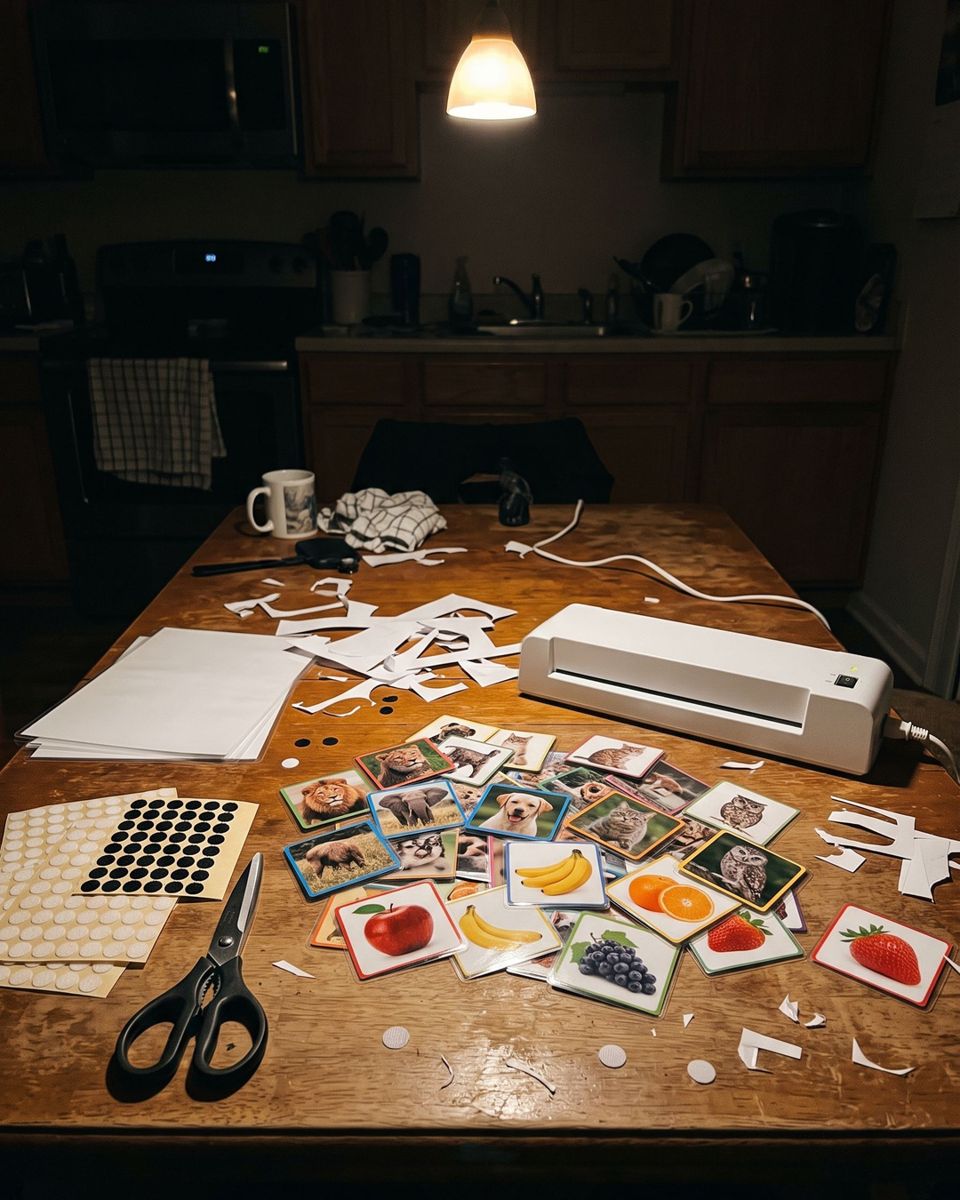
- Laminate the cards and the strip, and add hook-and-loop (Velcro) dots to the strip and the back of every card. Plain tape works for the first week while you see whether the routine sticks.
- Pick two or three steps your child already does every day and put something they enjoy last. Put the cards on the strip while your child watches and name each one once: “Wake up, toilet, get dressed.”
- Hang the strip where the routine happens: the bathroom door, the hallway by the shoes or next to the bath.
- Before each step, point to the top card and say its name. When the step is done, your child moves the card to the All done pocket. Praise the finished step, not the card.
- Fade your help over the next days: walk your child to the schedule and point, then just gesture toward it, then only say “Check your schedule.”
- Add one step at a time once the routine runs smoothly, and note independent (I) and helped (H) steps on the log page.