
What is a social story?
A social story is a short picture story that describes one situation, step by step, from the child’s point of view: what usually happens, what other people do, and one or two things the child can do. A social story tells an autistic child what to expect. It is not a list of rules or a reward chart.
That difference matters. A child who has never had clippers buzz near their ear has no way of knowing it is coming, or that it stops. A story that says so, a few times on calm days, gives your child a picture of the visit before the real one starts. Success is modest and real: your child listens, looks at the pictures, maybe turns the pages, and later meets the situation a little more calmly.
Social story examples: the four free stories
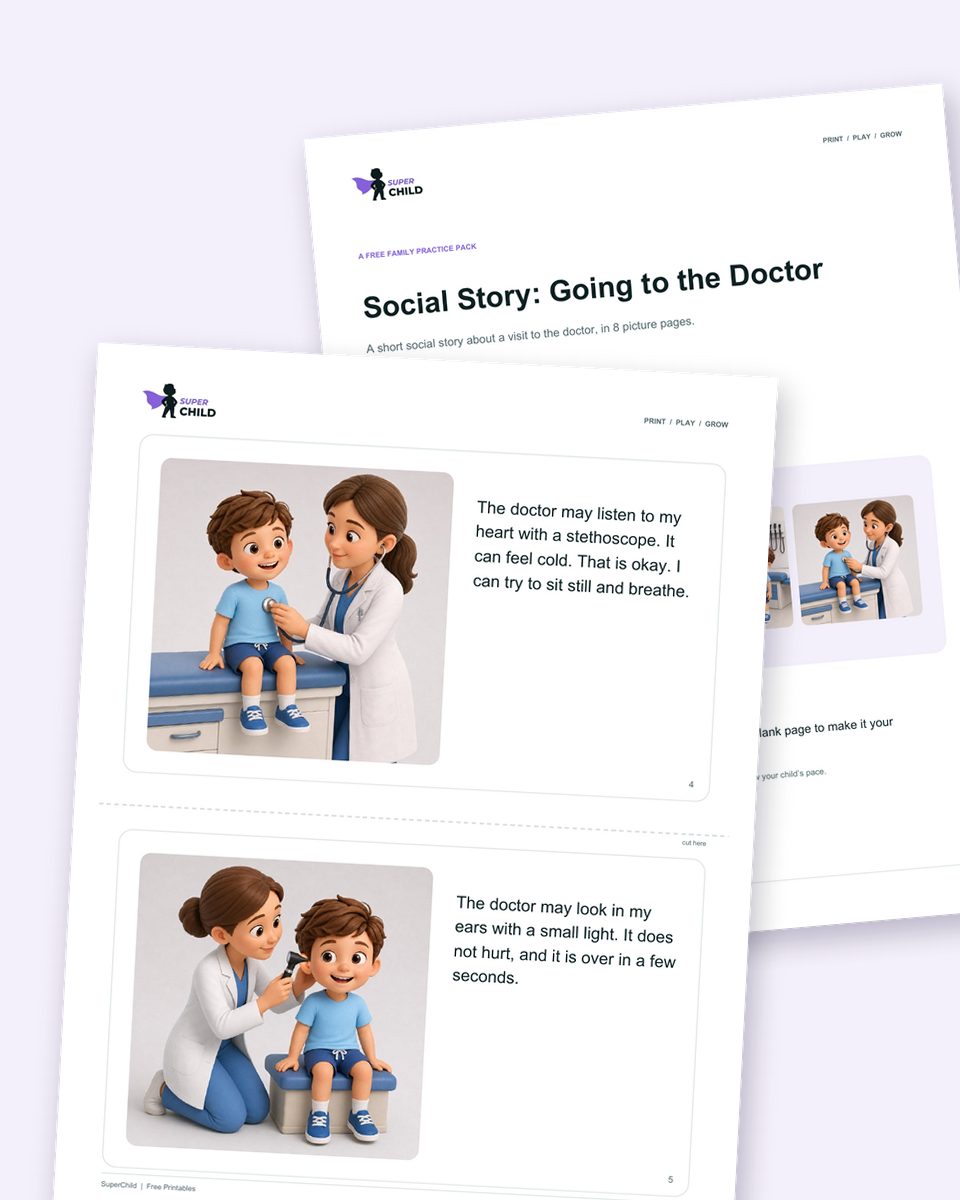
The four free social story examples cover handwashing, a doctor visit, waiting for a turn and a haircut. Each social story has a cover and 8 pages, two half-pages per printed sheet, with a picture and one or two short sentences on each page. The pictures are SuperChild’s own soft illustrations of a young boy.
- Washing My Hands: when hands get dirty, water, one push of soap, rubbing fronts, backs and between the fingers while counting to 20, rinsing, drying, and feeling proud.
- Going to the Doctor: the waiting room, the white coat, the cold stethoscope, the small light in the ears, holding your grown-up’s hand or asking for a break, and sometimes a sticker.
- Waiting for My Turn: waiting at the bottom of the slide, taking a big breath or counting to 5, then the same idea at home with a board game and a die.
- Getting a Haircut: the big chair and the cape, scissors that go snip, hair on the floor, buzzing clippers, a break or headphones if it is too loud, and the mirror at the end.
A social story example, page by page: Getting a Haircut
Here is how the Getting a Haircut social story reads, page by page. Notice that most sentences simply describe what happens at the barber shop: the chair, the cape, the scissors, the clippers. Only a few sentences say what your child can do, and those use “I can”, not “I must”.
If your child’s barber never uses clippers, or always uses them, change that page with a pen before you read it. The story should match what your child will really see.
- Sometimes my hair gets long. Then it is time for a haircut.
- At the barber shop, I sit in a big chair. The barber puts a cape on me to keep hair off my clothes.
- The barber uses a comb and scissors. The scissors go snip, snip. Cutting hair does not hurt. I can hold a toy.
- Little pieces of hair fall on the floor. That is okay. Someone will sweep them up later.
- Sometimes the barber uses clippers. Clippers buzz and can tickle. If the sound is too loud, I can ask for a break or wear my headphones.
- I try to keep my head still. The barber may count down: 5, 4, 3, 2, 1.
- When it is finished, I can look in the mirror. My hair is short and neat.
- All done! Getting a haircut is something I can do.
When to read a social story, and when not to
Read a social story on calm days, a few times before the situation comes up, and never in the middle of a meltdown. A child who is already upset cannot take in new information. The best moments are quiet ones: after lunch, at bedtime, or on the sofa a day or two before the visit.
If your child wants to stop, stop, and leave the book where they can pick it up on their own. When the situation gets easy, the story can go on the shelf. Some children like to keep reading it anyway, and that is fine too.
A social story pairs well with other visual supports. A visual schedule printable shows the order of the day, and a first-then board shows what comes right after the hard part: “First haircut, then park.”
Social story template: how to write your own
Every free social story pack ends with a blank page with two spaces to draw or glue a photo, and that page is your social story template. A photo of your child’s real doctor, your barber’s chair or the slide at your park makes a story much more personal. Write a sentence under each picture by hand.
You can also write a whole new story about something else: a fire drill, a new sibling, the first day at a new school. Keep it short and use the free stories as a model.
- Pick one situation and tell it in order, from your child’s point of view (“I”, “my”).
- Mostly describe: where you are, what happens, what other people do.
- Add only one or two things your child can do, like “I can take a big breath.”
- Say “usually” and “I can try”, not “always” or “I must”. Real life does not always go to plan, and the story should not promise it will.
- End on something calm or positive that is true, like going home or looking in the mirror.
What if the social story isn’t working?
Every social story pack includes a small log: the date, when you read the story, how your child listened, how the real situation went and what to try next time. After a few visits, the log shows you whether the haircut, the doctor or the waiting is getting easier, or whether something else needs to change.
If it is still hard, read only the pages about the hardest part, add a real photo of that part, or ask your child’s teacher, speech therapist or BCBA for ideas. If they want more detail on what happens before and after a hard moment, an ABC data sheet is a simple way to write it down. A story helps your child know what is coming. It won’t remove a sensory problem like a loud clipper, so pair it with practical help such as headphones or a break.
How to use a social story with your child
To use a social story, read it with your child on calm days before the situation, sit side by side, and go slowly: one page, one picture, one or two sentences. Read it again the day before and on the day, bring it along, and reread the last page afterwards. There is nothing to answer and nothing to score.
- Pick the story for the situation coming up, print it in color, cut each sheet in half and staple the pages into a little book. Change any page that does not match what your child will really see.
- On a calm day, sit side by side and read each page slowly. Point to the picture and let your child turn the page. If the story is too long, read two or three pages at a time.
- Read it a few times over the next days, then the day before and again on the day, a little while before you leave.
- Bring the book along to the doctor or the barber, and look at the page for the part that is happening if it helps.
- Afterwards, read the last page again and talk about what went well. Note in the log how the real situation went.
- Want a story for something else? Use the blank page as a social story template, with photos of the real place and one sentence under each picture.