On this page
The transition social story, page by page
“When It Is Time to Stop and Go” has 11 pages: everyone does many things in a day, stopping can feel hard, a warning comes first, the timer ends, the toy goes in the finished box, the schedule shows what is next, and the toy will be there another time.
Copy the pages into a small book and add a picture to each one, ideally a photo of your child’s own timer, finished box and schedule. Name the real activities your child finds hard to leave: the tablet, the trampoline, the block corner.
The story follows Carol Gray’s Social Story criteria: first person, a calm voice, “usually” and “sometimes” where life varies, and at least two sentences that describe for every sentence that coaches. Seven pages describe and three coach (pages 6, 7 and 9).
- Page 1 (cover): When It Is Time to Stop and Go
- Page 2: Every day I do lots of things. I play, I eat, I go to school and I take a bath.
- Page 3: When one thing ends, something new starts. Moving from one thing to the next is called a transition.
- Page 4: Sometimes I am having fun when it is time to stop. Stopping can feel hard. Many kids feel that way.
- Page 5: Usually my grown-up tells me before it is time. They show me the timer and say, “Two more minutes.”
- Page 6: When the timer ends, the activity is finished. I can put my toy in the finished box.
- Page 7: I can look at my schedule to see what is next.
- Page 8: My toy waits in the finished box. Usually I can play with it again later, and the schedule shows me when.
- Page 9: If I feel upset, I can take a big breath or hold my squishy ball while I walk.
- Page 10: Then I go to the next thing. Sometimes the next thing is fun too.
- Page 11: Stopping and going is something I am learning. My grown-ups are glad when I try.


Why transitions are hard for autistic children
Transitions ask a child to stop something, shift attention, understand where they are going and accept that a favorite thing is gone for now. Each part draws on skills that are often harder for autistic children: predicting what comes next, flexible thinking and processing spoken words.
Picture it from the child’s side. The tablet is warm and predictable. “Time for bath” arrives as a few words in the air, maybe while the video is still loud, and nothing says when the tablet comes back. Losing a loved thing with no end date in sight is hard for any child, and many autistic children also need more time to switch attention and to process spoken language.
The direction of the switch matters most. Going from something your child dislikes to something they love is easy. Going from loved to disliked is the hard one, and it is where the warning, the first-then board and a little extra reinforcement do the most work.


The transition toolkit: five tools to use with the story
Use a visual timer warning, a finished box, a schedule check, a first-then board and a transition object, in the same order every time. The story explains the routine, and the tools let your child live it.
Studies of children with autism found that visual supports like timers and schedules cut the time transitions take and reduce problem behavior during them. Put all five in one strip on the wall or the fridge so the steps never change, no matter who is with your child.
- 1Warn with a visual timerGive a 2-minute warning with a visual timer your child can see, plus a few words: “Two minutes, then tablet is finished.” For some children a 5-minute and a 1-minute warning work better; a few do best with no countdown at all, so watch which version stays calm.
- 2Use a finished boxA shoebox or basket labeled “finished.” When the timer ends, the toy goes in the box. It makes “finished” a concrete action and keeps the toy safe, which answers the worry that it is gone forever.
- 3Check the scheduleYour child goes to their visual schedule, takes off or turns over the card that just ended and looks at the next one. Carrying that card to the next place helps many children.
- 4Show first-thenFor a hard switch, a first-then board shows the less loved thing and the reward right after it: “First bath, then bubbles.”
- 5Hand over a transition objectSomething to carry that belongs to the next place: the towel for bath time, the car keys for leaving, a ball for recess. A comfort object, like a squishy ball, also works for children who need something in their hands.


How a visual schedule helps with transitions
A visual schedule for transitions shows the whole day, or the next few steps, in pictures, so the child can see what is next and when a favorite activity comes back. It turns “time to stop” into “time to check.”
Start with 3 to 5 pictures for one part of the day, like after school: snack, tablet, bath, dinner, bed. Put the favorite things where the child can see them coming later; seeing “tablet” again after dinner makes stopping it now easier.
Younger children and children with limited language often do better with a short strip of two or three cards than with a whole day. When your child checks the schedule on their own, add more cards. You can print ready-made cards from our visual schedule printables or make a custom one in the visual schedule maker.
Transition scripts for home and school
Use the same short words for every transition: name the warning, name what is finished, name what is next. “Two minutes, then tablet is finished. Then bath.”
Keep the words few and the same. Long explanations at the moment of a transition add more language to process when your child is already working hard. Here are scripts for the moments parents and teachers ask about most.


When plans change: teaching the “change” card
Teach surprises on purpose. Add a “change” card to the schedule for small, happy surprises first, so your child learns that a change symbol means something different is coming and that different can be okay.
Real life brings fire drills, a closed park and a sick teacher. Children who only know a perfect schedule have no plan for those days. Add a change card a few times a week for good news (“change: extra playground”), then for neutral changes, and only then for disappointing ones. Add one page to the story: “Sometimes plans change. My grown-up shows me the change card. Then I see the new plan.”
If a transition still ends in a meltdown most days after three weeks of story and tools, track it: write down which transitions, what happened just before and what happened after. A behavior analyst can use that to find what the behavior is getting your child, like more time with the tablet, and teach a better way to ask (see our ABA therapy guide). A token board with one token per calm transition is often part of that plan.
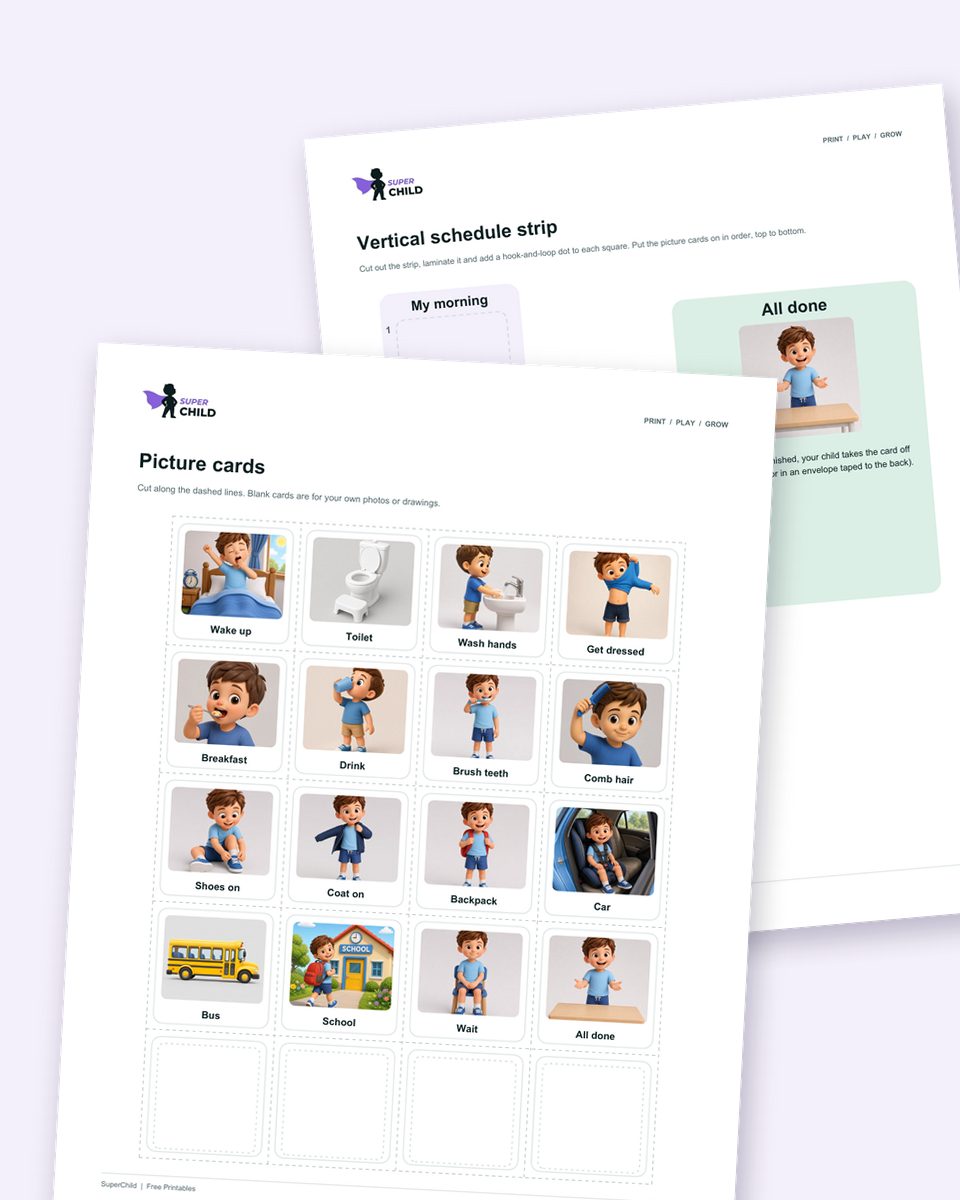
Free download3 PDFs
Get the free visual schedule pack
Morning and bedtime routines plus picture cards for the whole day, with strips, a parent guide and a log.
Sources
- Carol Gray Social Stories: what is a Social Story
- Dettmer, Simpson, Myles and Ganz (2000), The use of visual supports to facilitate transitions of students with autism, Focus on Autism and Other Developmental Disabilities
- AFIRM: Visual Supports, an evidence-based practice module (UNC Frank Porter Graham)
- National Clearinghouse on Autism Evidence and Practice: evidence-based practices report
Cite this page
Citation (APA style)
SuperChild. (2026). Transition social story: “When It Is Time to Stop and Go,” plus the toolkit that makes it work. Retrieved from https://superchild.ai/blog/transition-social-story
Link for your website
<a href="https://superchild.ai/blog/transition-social-story">Transition social story: “When It Is Time to Stop and Go,” plus the toolkit that makes it work</a> (SuperChild)