

On this page
The personal space social story, page by page
The story has 12 short pages: what personal space is, that everyone has it, how big it is, how people feel when someone is too close, asking before a hug, and three things the child can do. Eight pages describe; only three coach.
Copy the text into a notebook or a slideshow and add a picture or a photo to each page. Put your child’s name on page 2. Each page holds one idea, so a child who takes in only a page or two still gets something whole.
Read it as written for the first week. Change words only to make them truer for your child: if hugs are not a thing in your family, swap page 7 for high fives.
- Page 1 (cover): My Space Bubble
- Page 2: My name is ___. I have a body. The space around my body is called my personal space.
- Page 3: Everyone has personal space. My mom has personal space. My friends and my teacher have personal space too.
- Page 4: Personal space is about as big as my arm. Some people call it a space bubble.
- Page 5: Most people feel comfortable when others stay about one arm away. When someone stands very close, people may feel squished or worried.
- Page 6: Sometimes I want to be close to someone I like. That is a warm feeling.
- Page 7: Hugs are very close. Usually people ask first: “Can I have a hug?” The other person can say yes or no. Both answers are okay.
- Page 8: When I talk with a friend, I can stand one arm away. From there I can see my friend’s face and hear their words.
- Page 9: At school, children sit and line up with a little space between them. The space helps everyone move safely.
- Page 10: If someone is too close to me, I can say “Space, please,” or take a step back.
- Page 11: Giving people space is a kind thing to do. It helps friends feel calm when we play.
- Page 12: I have my space bubble, and other people have theirs. I can keep my bubble and they can keep theirs.


Why the story describes more than it directs
Carol Gray, who created Social Stories in 1991, asks writers to describe at least twice as much as they coach. A story full of rules reads like a correction; a story that explains what happens and why gives the child information they can use on their own.
Gray’s criteria split sentences into two kinds. Describing sentences say what is true: where we are, what usually happens, what other people think or feel. Coaching sentences suggest what the child can do. The formula is simple: count both, and the describing ones should be at least double. The story above has eight describing pages and three coaching ones (pages 8, 10 and 12), well inside the rule.
Autistic children often miss the unwritten reason behind a social rule. “Don’t stand so close” is a rule with no reason; page 5 gives the reason (people feel squished), which helps the child apply it at the bus stop and in grandma’s kitchen. Gray also recommends a patient, positive voice: “I can” in place of “I must,” and words like “usually” and “sometimes” so the story stays true when a classmate stands close at circle time.
- First person
- “I,” “my” for younger children, so the story is about them. Third person (“Sam has a space bubble”) suits older readers.
- Literal accuracy
- “Most people feel comfortable” in place of “everyone hates it.” Your child will test every word against real life.
- One idea per page
- A picture and one or two sentences. More text hides the point.
- Positive coaching
- “I can take a step back,” never “I will not touch.” Name the behavior you want to see.
How big is personal space? Teaching arm’s length
For a young child, personal space with friends, teachers and classmates is about one arm long, roughly 1.5 to 2 feet. Family hugs and holding hands are closer, and only with a yes. Strangers get more, about two arms.
Abstract distances mean little to a 5-year-old, so give the space a shape: a hula hoop around the waist, a stretched arm. Many teachers also teach three rings: a hug ring for family who say yes, a talk ring of one arm for friends and teachers, and a stranger ring of two arms for people you don’t know.
Keep it simple for children under 6 or with limited language: one rule, one arm. Add the three rings once one arm is solid.

A school version and a home version
Keep pages 1 to 6 and 11 to 12 the same, and swap the middle pages for the places your child actually struggles: carpet time, lines and the playground at school; siblings, hugs and visitors at home.
Teachers can photograph the real carpet squares and line spots; parents can use photos of the sofa, the front door and the people who visit. Read the school book on school mornings and the home book on weekends.


Three personal space activities for autism
Practice the distance with your child’s body, in short games of 5 minutes: blow bubbles, walk inside a hula hoop, and do the one-arm check. Reinforce every time your child stops at the right spot.
Play each one a few times a week for two or three weeks, and praise the exact thing your child did: “You stopped one arm away. Perfect space.” Children who work for tokens can earn one per good stop on a token board.
- 1Bubble spaceBlow one big bubble and say, “That’s a space bubble. If we bump it, it pops.” Then each of you pretends to be inside a bubble and walks around the room without popping the other’s. Use it later as a shared word: “Mind my bubble.”
- 2Hula hoop walkYour child stands inside a hula hoop held at the waist and walks up to you, a sibling or a classmate until the hoop touches. That is the space. Do it 5 times, then try it without the hoop and check with the hoop afterward.
- 3The one-arm checkYour child walks toward you, stops, and stretches one arm straight out to the side and then forward. Fingertips just reaching your shoulder means good space. Practice with a teacher, a peer and a sibling so the skill does not belong to one person.

Adapting the story for a nonverbal child
For a child who doesn’t speak or understands few words, shorten each page to three to six words, use real photos, and teach a single picture or AAC button for “space, please.” Act the story out more than you read it.
A nonverbal child may understand far more than they can say, or far less, so match the words to what they understand, not to their age. “Arm away. Good space.” is a complete page. A photo of your child inside the hoop makes a better page 4 than any drawing.
Give your child a way to ask for space too. A “stop” picture card on a keyring, a page in their PECS book, or a “space, please” button on their device lets them protect their own bubble. If your child uses a speech device, see our AAC guide for adding new words.
When a social story is not enough
A social story helps a child who doesn’t know the rule. It does little for a child who knows it but seeks deep pressure, acts on impulse, or gets something they want by crowding people. Those need a different plan.
Research on Social Stories shows real but modest effects, best when the story comes with practice and reinforcement. If your child can recite page 4 and still leans on classmates, ask why. A child who crashes into people for the pressure may need a sensory diet from an occupational therapist: tight hugs from a parent who agrees, a weighted lap pad, heavy work. A child who crowds people to get attention or a toy needs a better way to ask, which a behavior analyst can find and teach (see our ABA therapy guide).
Track it so you know whether it works: tally “too close” moments in one daily routine for a week before you start and for three weeks after, on a simple ABA data sheet. Fewer tallies means keep going; no change after three weeks means change the plan.
Free download1 ZIP · 94 packs
All 94 printable skill packs, free
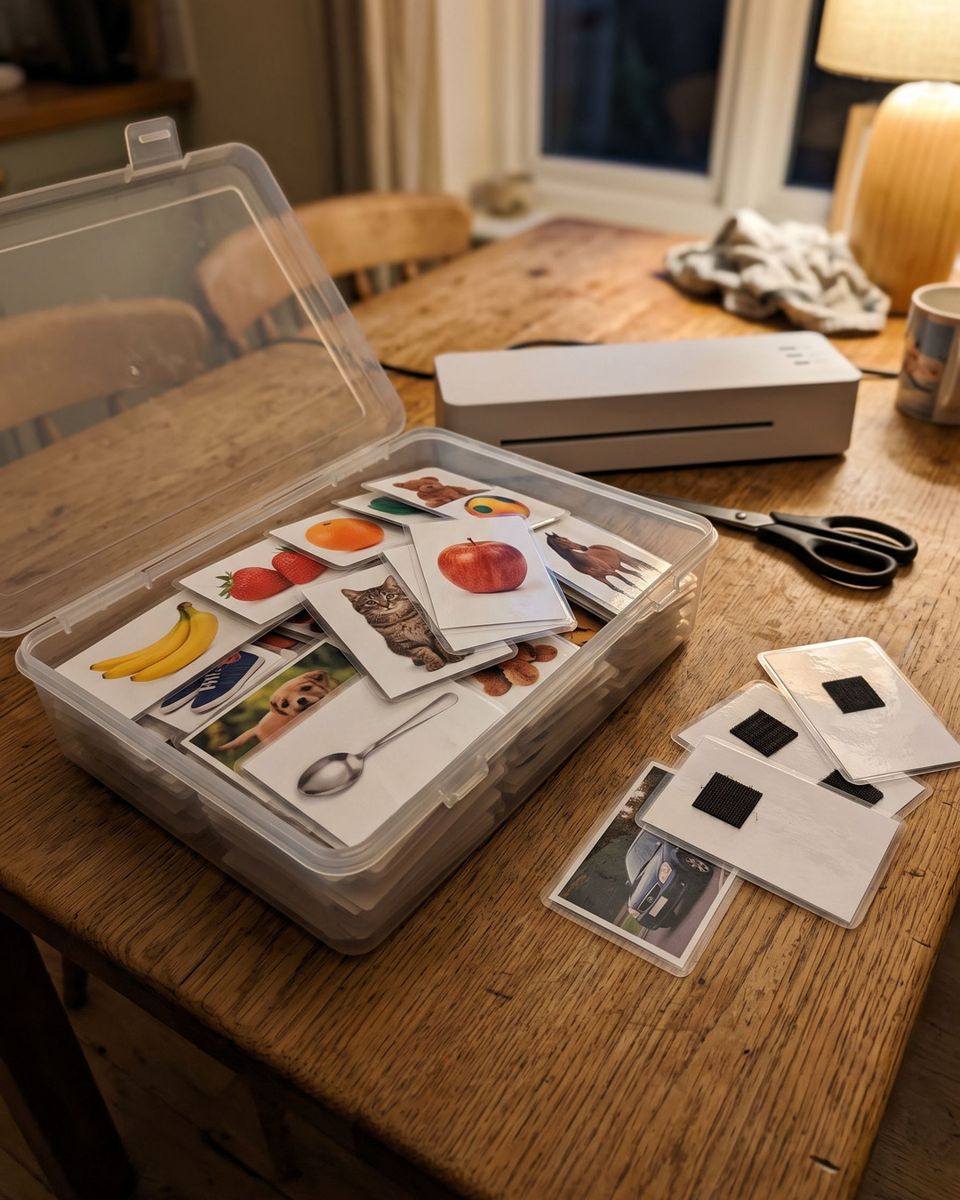
Listening, matching, math, reading and more, one skill per pack, each with an adult guide, practice rounds and a log.
Sources
- Carol Gray Social Stories: what is a Social Story
- Kokina and Kern (2010), Social Story interventions for students with autism spectrum disorders: a meta-analysis, J Autism Dev Disord
- AFIRM: Social Narratives, an evidence-based practice module (UNC Frank Porter Graham)
- National Clearinghouse on Autism Evidence and Practice: evidence-based practices report
Cite this page
Citation (APA style)
SuperChild. (2026). Personal space social story: the full story, page by page, and how to teach it. Retrieved from https://superchild.ai/blog/personal-space-social-story
Link for your website
<a href="https://superchild.ai/blog/personal-space-social-story">Personal space social story: the full story, page by page, and how to teach it</a> (SuperChild)