
What do sequencing activities teach?
Picture sequencing activities teach a child to look at a few pictures of one routine or event and decide what happens first, next and last. Ordering pictures is a step toward retelling events and following routines independently. Sequencing also gives you and your child shared words for time: first, next, then, last.
A correct response is the cards on the mat in the right order, left to right. Your child doesn’t have to say anything. If they talk, you can ask “What happened first?” after the cards are down. If they don’t, you say the words while your child points. Either way, they hear the order words.
3 step sequencing pictures: six everyday routines
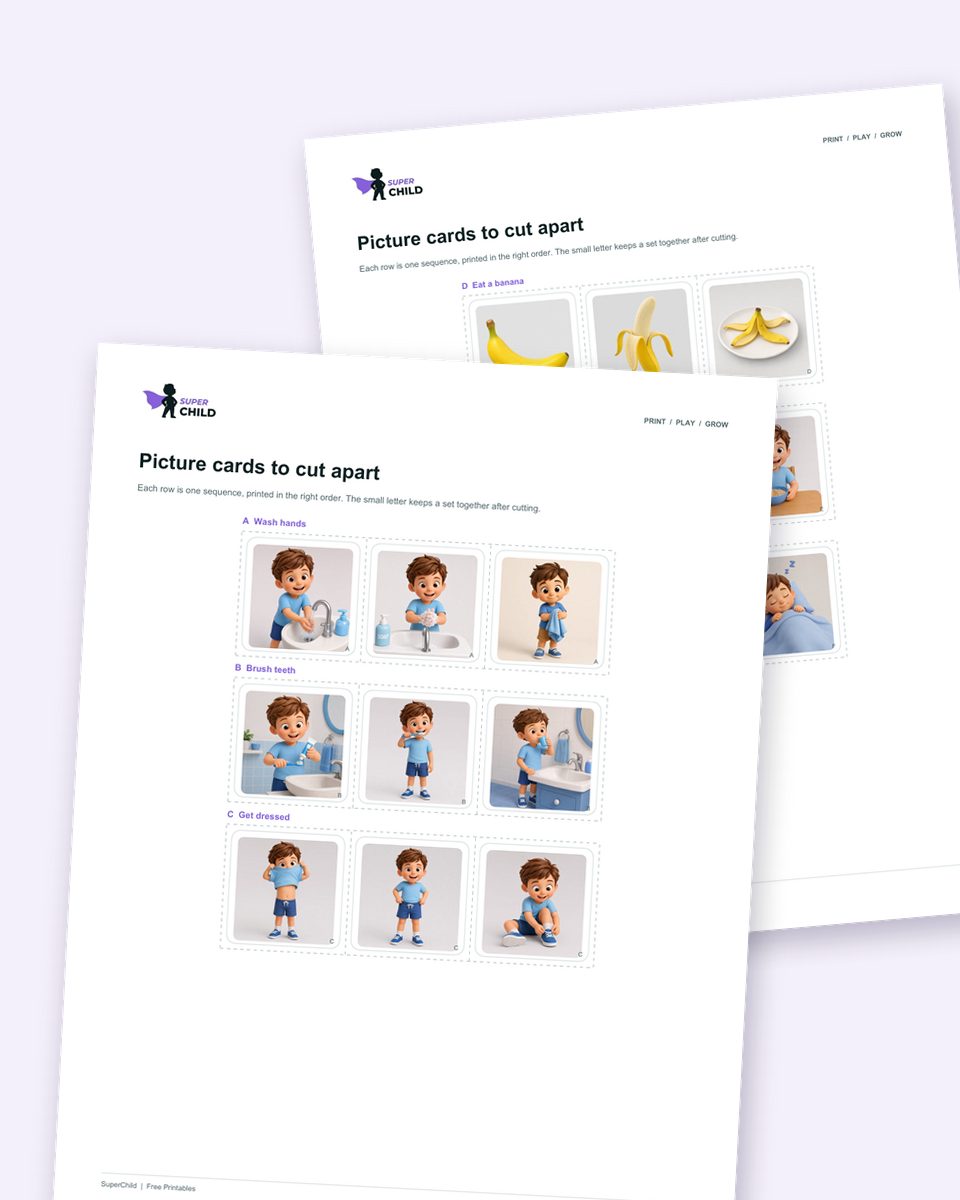
The first pack, Sequencing Pictures: 3-Step Everyday Routines, has six 3-step sequences of familiar routines and a sequencing mat with three squares: First, Next, Last. Below are the six sequences, with the short words the adult guide gives you for each step, so you can see exactly what your child will order.
- A. Wash hands: wet hands, soap and scrub, dry
- B. Brush teeth: toothpaste on, brush, rinse
- C. Get dressed: shirt, shorts, shoes
- D. Eat a banana: whole banana, peel it, eaten (just the peel)
- E. Have cereal: pour cereal, pour milk, eat
- F. Go to bed: pajamas, story, sleep
Four-step picture sequencing activities
The 4-step picture sequencing pack, Sequencing Pictures: 4-Step Stories, is for when three steps are easy. It has six sequences of four pictures and a mat with four squares: First, Next, Then, Last. Some sequences are routines your child knows, and some are small stories about how things change.
If you act out the balloon story with a real balloon, an adult blows it up and holds it. Keep uninflated or broken balloons away from your child and throw pieces away straight away.
- A. Grow a flower: plant the seed, water it, a sprout grows, a flower
- B. Make a sandwich: bread, add cheese, add the top, cut it
- C. Blow up a balloon: flat balloon, blow a little, big balloon, tie a string
- D. Wash hands: soap, scrub, rinse, dry
- E. Get ready in the morning: wake up, get dressed, breakfast, backpack on
- F. Have cereal: pour cereal, pour milk, eat, all done
Start with two cards, not three
A sequencing activity is easiest with two cards: the first and the last step of a routine your child does every day, like washing hands. Two cards make the idea of order clear before the middle step adds a real choice. Add the middle card once your child places two cards correctly without help.
Each card has a small letter, so a set stays together after cutting. During teaching, put the first card down for your child and ask “What comes next?” On the next turn give less: point to the First square only. Keep your eyes off the card that comes next, because children follow your gaze.
Sequencing their own day
The best sequencing activity is your child’s own day. Do the real routine with the cards on the counter: peel a real banana next to the Eat a banana cards, or brush teeth with the Brush teeth cards on the sink. Photos of your child doing a routine are often the most motivating set.
The same cards work as a short visual schedule printable on the bathroom wall, and the social stories for autism tell a longer sequence, like a haircut, in the same first-next-last order.
Use the same short words every time, at the table and in the bathroom. When your child hears “first, next, last” in both places, the words start to mean something beyond the cards.
Reading the sequencing log
The sequencing log has a line per set (A to F) with I for independent, H for helped and X for not yet, plus a column for whether your child told the story. Mostly I? Try the set in a new place or with another adult. Some help needed? Keep the set and make one thing easier, like fewer cards.
Repeated errors or upset? Go back to two cards and teach again when your child is calm.
A good result shows your child can order these familiar pictures. It does not test retelling a new story. Your child’s speech therapist can tell you whether sequencing is a good goal right now and what comes after it.
How to do a sequencing activity with your child
To do a picture sequencing activity, lay the cards out in order yourself and tell the routine in a few words: “First, wet hands. Next, soap and scrub. Last, dry.” Then shuffle the same cards, put them below the sequencing mat and say “Put them in order.” Keep it to 3 to 5 minutes and end on something fun.
- Print the cards and mat in color at actual size (on A4, choose fit to page), cut the cards apart and laminate the mat if you can.
- Pick a routine your child does every day, like washing hands, and start with only the first and last cards.
- Show the sequence once in order, using the exact words from the adult guide: first, next, last.
- Shuffle the same cards, put them below the mat and say “Put them in order.” Wait, and keep your eyes off the card that comes next.
- If your child needs help, put the first card down and ask “What comes next?” On the next turn, only point to the First square.
- Add the middle card, then 4-step stories, once your child orders the set without help, and log each set as I, H or X.