Free printables

Token board printable: free 3, 5 and 10 token boards with star tokens and reward cards

This free token board printable gives you everything you need to make waiting visible for your child: three boards (3, 5 and 10 tokens), 56 star tokens, 20 reward cards and a choice board. A token board shows your child how close they are to something they want. Each star is earned for a small, clear behavior, and when the board is full the reward comes straight away. The PDF also has a two-page adult guide and a log so you can see when it is time to move up a board.

By Ab Advany, founder of SuperChild · Published · Updated

Prefer your own pictures? Make your own token board

Free download

Get the 2 packs as PDF

Three quick answers and the PDFs open right here.

I am a

By getting the files you agree to our privacy policy. We’ll also send occasional practice tips; unsubscribe anytime.

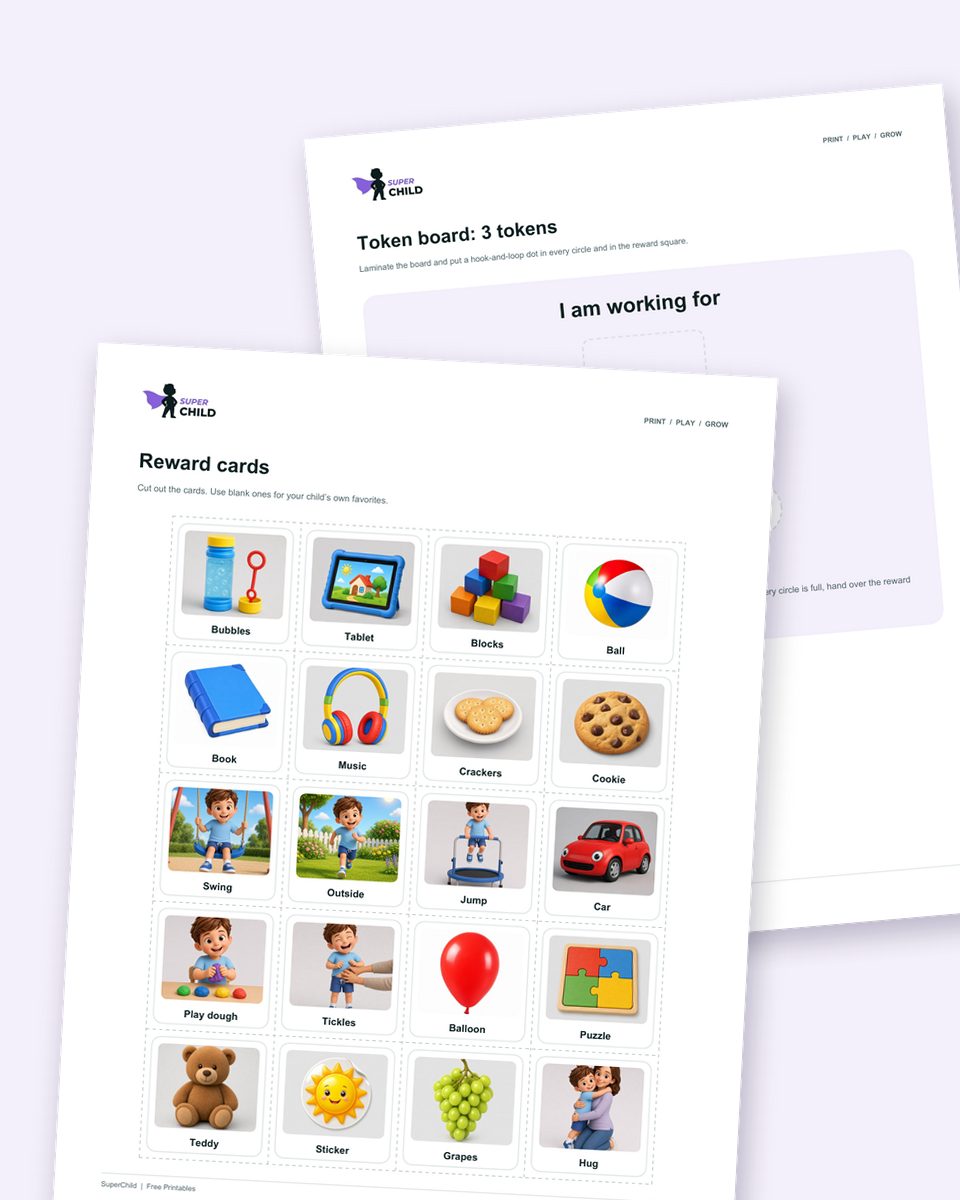
Token board printable PDF for autism: a sheet of 20 reward cards in front of a 3-token board with an “I am working for” square

What is a token board?

A token board is a strip of empty circles with a square for a reward. Your child does something you asked, a token goes in a circle, and when every circle is full the reward on the board comes straight away. The tokens bridge the gap between “good job” now and the reward a little later.

Token boards are a common tool in ABA and in classrooms. They are used for things that are hard right now: sitting at the table, a haircut, tidying up, a set of practice cards.

This page is the ready-made printable. Prefer to customize? Make your own token board with your child’s own reward photo and any number of tokens from 3 to 10 in the free token board maker.

What’s in the free token board printable PDF

The free token board printable is an 11-page color PDF in US Letter size. It has three token boards with 3, 5 and 10 tokens, 56 star tokens, 20 reward cards, a choice board and a log page. Every board has an “I am working for” square for the reward card and a short reminder of how to use it.

  • Three token boards: 3 tokens, 5 tokens and 10 tokens.
  • A page of 56 star tokens to cut out. Keep a few spare: they get lost.
  • 20 reward cards: bubbles, tablet, blocks, ball, book, music, crackers, cookie, swing, outside, jump, car, play dough, tickles, balloon, puzzle, teddy, sticker, grapes and hug, plus blank cards for your child’s own favorites.
  • Safety notes for the adult: an adult blows up and holds the balloon; keep uninflated or broken balloons away from your child and throw pieces away straight away. Cut grapes lengthwise into quarters and follow your child’s feeding plan.
  • A choice board, “I want to work for...”, with room for two or three reward cards.
  • A log page for each board your child works through.

How many tokens should a token board have?

A token board should start with three tokens, given quickly so the reward comes within a minute or two. A child who has never used a token board has to learn that the stars lead somewhere, and that lesson needs a short, sure path to the reward.

Move to 5 tokens, and later to 10, only when your child fills the board easily and calmly. The log gives you a simple rule: board filled easily three times in a row? Ask for a little more per token, or move up a board. Board left unfinished? Go back to fewer tokens, an easier task or a reward your child wants more. Change one thing at a time.

Rules that keep a token board fair

A token board only works if your child can trust it. Never take away a token your child has earned, and always hand over the reward as soon as the board is full, even if the session was hard. Drinking, meals, the toilet, comfort and a break are never something to earn.

If your child is upset or in pain, stop and help first, then make the task smaller.

If the board stops working, the reward is usually the first thing to check. What your child wants changes from day to day, sometimes from hour to hour. Offer a fresh choice before you blame the board.

Token boards in ABA: use the same system at home

A token board at home works best when it matches the one your child’s BCBA or therapist uses in sessions: the same number of tokens, the same kind of praise and the same rules. Your child then sees one system at home and in therapy, not two.

Bring the log to your next session so the team can see which boards your child fills and which ones stall. As a skill becomes easy, use the board for something new and keep praise for the old skill. Over time, the skill can stand on its own, with your praise instead of the stars.

How to use a token board with your child

To use a token board, let your child pick the reward first and put its card in the “I am working for” square. Give a star right after each small, clear behavior and say what your child did. When the last circle is full, hand over the reward straight away, every time, and start again.

  1. Print the boards and tokens in color, cut them out and laminate them. Put a hook-and-loop (Velcro) dot in every circle and on the back of every star, and keep the reward cards in an envelope.
  2. Start with the 3-token board and a short task your child can do, such as one finished task box per star.
  3. Put two or three reward cards on the choice board. Your child points to one, and it goes in the “I am working for” square.
  4. Right after the behavior, put a token on the board and say what your child did: “You sat down. Star!” Count down out loud as the board fills: “Two more stars, then bubbles.”
  5. When the board is full, hand over the reward straight away, even if the session was hard. Never take away a token your child has earned.
  6. Write on the log page whether the board was filled. After three easy full boards in a row, ask for a little more per token or move up to the 5-token board.

In the download

2 printable packs, each with an adult guide, the boards and cards to cut out, and a log.

  • Token Boards: 3, 5 and 10 Tokens

    Your child earns star tokens for small, clear steps and gets the reward they chose when the board is full.

  • First-Then Board and Cards

    Your child sees two pictures, the task first and the favorite thing right after, for quick moments a full board is too much.

Fill in the short form at the top and the PDFs are yours.

Need different cards or your own photos?

The printable is a ready-made set with stars and 20 reward cards. To use your child’s own reward photos or labels, the free token board maker lets you pick or upload pictures, add labels and download a PDF or PNG.

Make your own token board

For BCBAs, RBTs and teachers

This token board printable sets up a simple token economy: stars act as conditioned reinforcers, paired with specific praise and exchanged for a backup reinforcer the child picks on a choice board right before the session. The parent guide starts on a 3-token board with a dense schedule and rules out response cost.

Thinning is done one change at a time, by asking for more per token or by moving to the 5- and 10-token boards, and the backup reinforcer is always delivered when the board is full.

The log records activity, tokens on the board, whether the board was filled and the reward chosen, which gives you a rough home record of preference and schedule tolerance. It does not replace a preference assessment. If your program uses a specific token board format, tell the family so the home board matches. RBTs running token economies can check the terms behind them, from conditioned reinforcers to schedule thinning, with the free RBT practice test.

Common questions

How many tokens should a token board have?
Start with three, given quickly so the reward comes within a minute or two. Move to five and then ten only when your child fills the board easily and calmly, for example three times in a row. If the board is left unfinished, go back to fewer tokens.
What can I use as tokens?
The pack has 56 star tokens to cut out and laminate. Some families use a picture of their child’s favorite character instead, which can make the tokens more interesting; the token board maker lets you pick a different token picture. What matters is that the tokens are easy to see and clearly connected to the reward.
Should I take a token away for bad behavior?
No. The guide in this pack says never take away a token your child has earned. Losing stars makes the board unpredictable, and a token board only works if your child can trust it. If you have questions about behavior, talk to your child’s BCBA.
What if my child won’t work for the reward?
Check the reward first. Let your child pick from two or three reward cards on the choice board right before you start. Also check that the task is short and that the board isn’t too long for now.
What is the difference between a token board and a first-then board?
A first-then board shows one task and one reward: “First shoes, then outside.” A token board asks for several small steps before the reward and shows progress as the stars fill up. Many children learn with the first-then board printable before they use a token board.
Is a token board the same as a reward chart?
Not quite. A reward chart, a common term in UK and Australian homes and schools, usually collects stickers over days or a week. A token board is faster: a few tokens within minutes, then the reward. For young autistic children, a short token board is usually the better place to start, at home, in a SEN classroom or in therapy.

Practice without the printing

The same practice on a tablet, with every answer recorded.

SuperChild runs short daily practice from the goals your child’s therapist picks, and keeps the data for you. The therapist sees every answer.