
What is a task box in special education?
A task box is a small box with one activity inside, like matching or sorting cards, that a child starts, works through and finishes alone. The goal of a task box is not the skill inside it. The goal is doing a whole task without an adult prompting each step, and knowing when it is done.
That is why the tasks in these packs are ones your child can learn quickly: matching identical pictures, sorting into three clear groups, counting to ten.
Every box has a clear end. When the cards are gone, the task is finished. Your child puts the box in a “finished” basket and gets something they enjoy. No one has to say “you’re done”, because the box already shows it.
Task boxes for special education: the three free packs
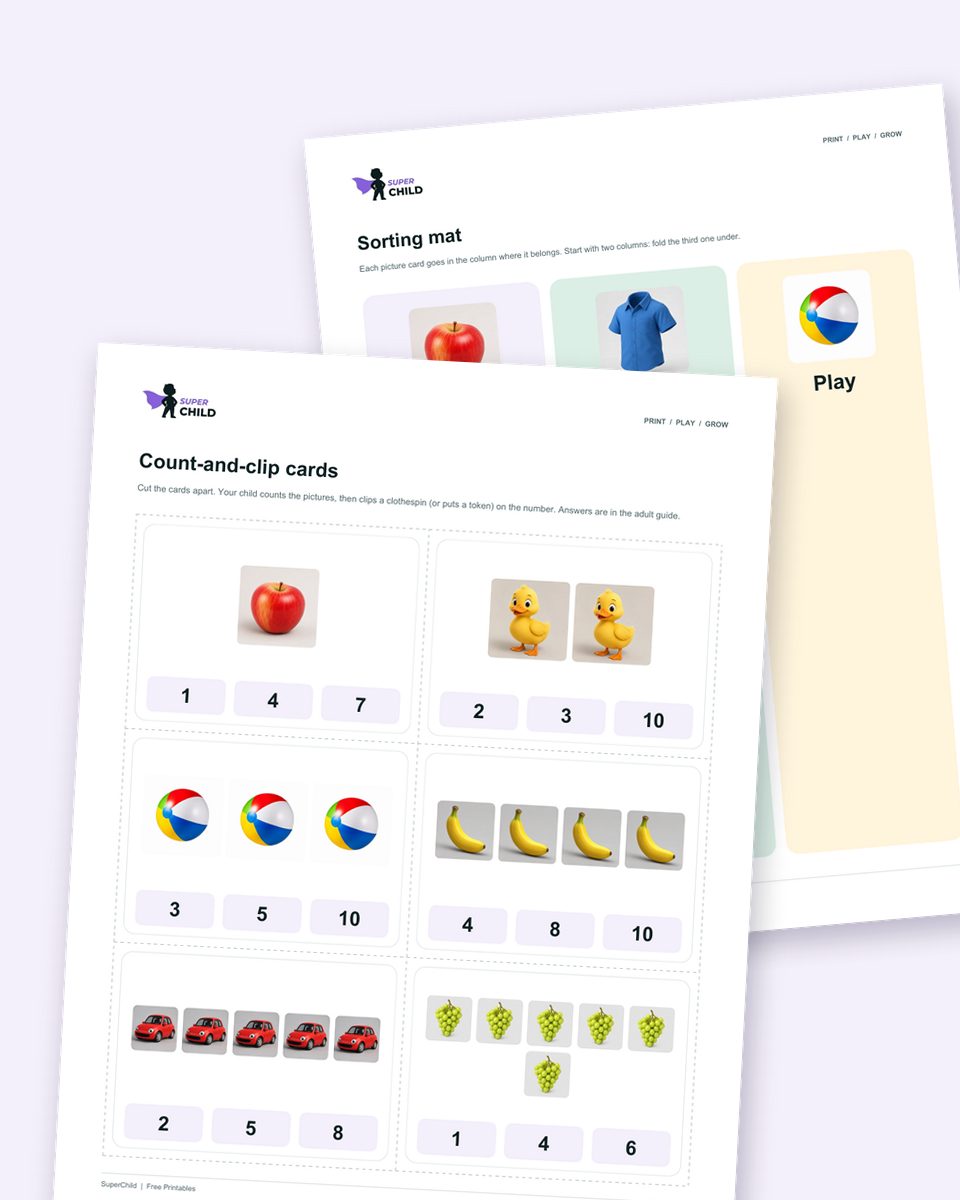
The three free task box packs are Picture Matching, Sort Eat, Wear, Play and Count and Clip 1-10. Each task box pack has a cover, two pages for the adult on setting up and fading help, the printed cards and boards, an adult guide with the answers and a log for every session.
- Picture Matching: 12 pictures on base boards, two to a board, and 12 matching cards. Your child sticks each card on the identical picture: apple, banana, ball, book, car, spoon, sock, hat, chair, bike, cow and duck.
- Sort Eat, Wear, Play: a 3-column sorting mat and 24 picture cards, eight in each group. Eat includes banana, pizza and toast. Wear includes sock, mitten and boot. Play includes kite, bubbles and puzzle.
- Count and Clip 1-10: 20 cards, each with 1 to 10 pictures (apples, ducks, balls, toy cars and more) and three numbers. Your child counts and clips a clothespin on the right number. Each number from 1 to 10 appears twice.
- Want more practice on the skills inside the boxes? The matching activities for autism and math activities for autism pages teach them at the table first.
Start small: the first version of each task box
Start every new task box smaller than the finished version, so your child gets it right from the first try. A small box teaches the routine of starting, working and finishing before the task itself gets harder. Add cards one or two at a time, and only once the small version is quick and easy.
For matching, put out one base board (two pictures) and two cards. For sorting, fold the third column under and use four cards that are clearly different, like a banana and a sock. For counting, use only cards up to 3 and let your child touch each picture as they count. Add more once the small version is easy.
How do you set up a task box work system?
A task box work system is a fixed layout: boxes to do on the left, the work space in the middle and a finished basket on the right. Your child takes the task from the left, does it in the middle and puts it away on the right. The same layout every time tells your child what comes next.
If you use more than one box in a session, line them up on the left in the order you want them done. When the left side is empty and everything is in the finished basket, work time is over. Follow it with something your child enjoys.
Teach the task box first, then step back
A new task box is not an independent task box yet. Show your child how the task works once or twice at the table, then let them try while you help as little as possible. For matching, hand your child a card and point to the base board.
Once they get it, put the cards in a small cup and let them work through the box alone.
Then move your help. Help from behind instead of from the front, so your child looks at the task and not at you. Then help from a little further away. The point of a task box is that your child can do it without you in the middle. The log has a column for exactly that: finished without an adult, yes or no. If your child’s team wants session data in their own format, a free ABA data sheet does the same job.
More task box ideas for autism and special ed
Once your child knows the routine, a task box can hold almost anything with a clear beginning and end. Pick tasks your child has already learned with help, so the box is practice in working alone, not a new lesson. Only use items too big to fit in your child’s mouth, and stay nearby.
A few task box ideas using things you probably have:
- Drop large pom-poms or jar lids through a slot cut in a box lid.
- Sort spoons and forks into two cups.
- Match pairs of socks, or lids to small containers.
- Put clothespins around the rim of a paper plate.
- Thread large wooden beads onto a thick shoelace.
- Sort large colored blocks into two or three bowls.
When to rotate task boxes
Rotate task boxes when one becomes easy and quick: an easy box is a good independent-work box, so keep it in the rotation for days your child needs an easy win. Swap in a new one now and then so there is always something to learn.
If you see the same mistakes again and again, or your child gets upset, go back to fewer pictures and teach it again when your child is calm.
How to make task boxes for special ed
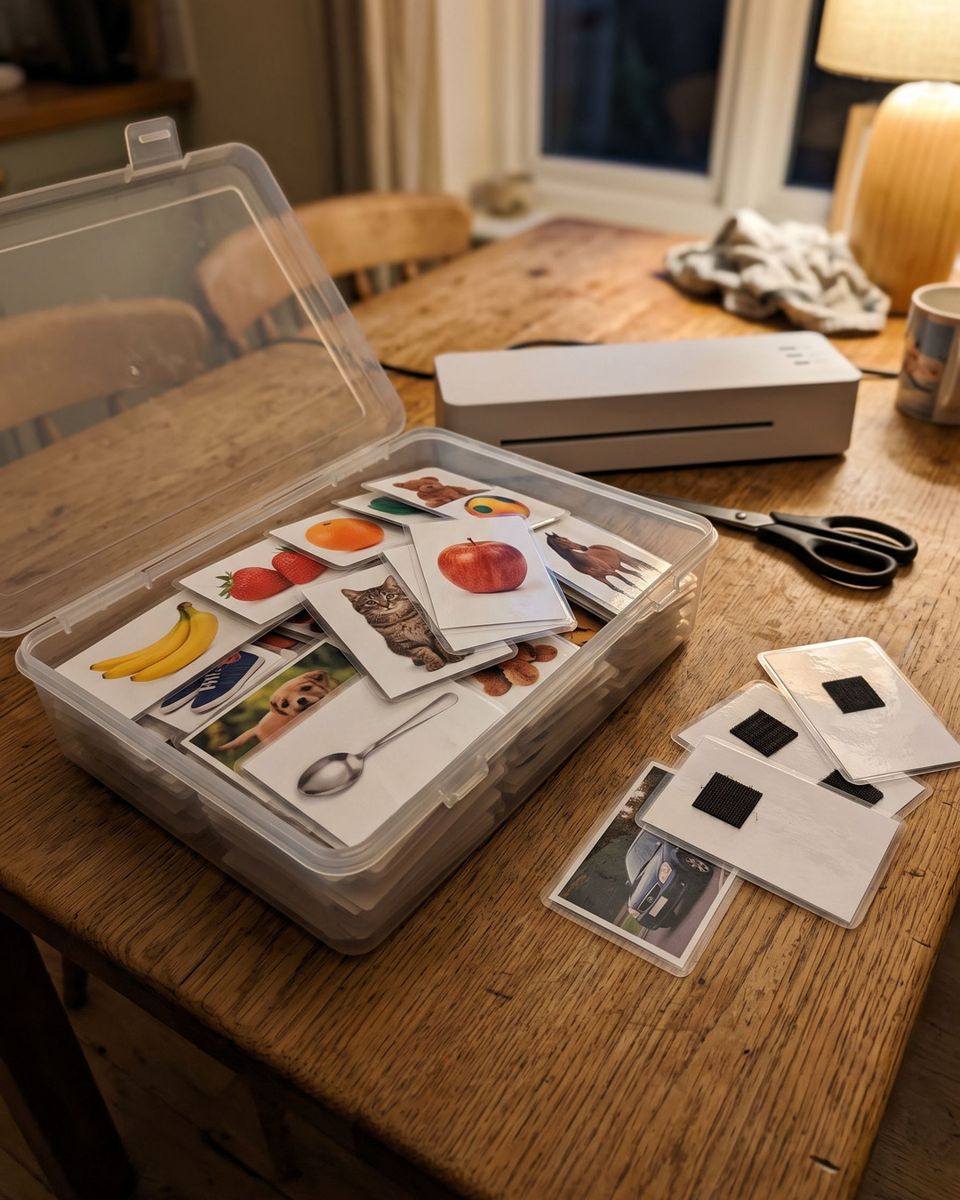
To make task boxes for special ed, print the cards in color, laminate them, add hook-and-loop dots, and put everything for one task in its own box with a picture of the task on the lid. Teach each box at the table first, then set it on the left of a left-to-right work system.
- Print the task box packs in color at actual size (on A4, choose fit to page), and cut out the base boards and cards.
- Laminate the boards and cards, or cover them with clear tape, and put a hook-and-loop dot on each card and each empty square.
- Put everything for one task in one box with a lid, and stick a picture of the task on the lid so your child can tell the boxes apart. Count-and-clip needs a few clothespins; a large counter works too.
- Make the first version small: one matching board and two cards, two sorting columns and four very different cards, or count-and-clip cards up to 3.
- Show the task once or twice at the table, then help less on each turn, from behind your child rather than in front.
- Set up the work system: boxes to do on the left, work space in the middle, a finished basket on the right, then something your child enjoys.