
What is a core word board?
A core word board is a low-tech AAC (augmentative and alternative communication) board that shows a small set of high-frequency words, such as I, you, want, more, go, stop, not, help, like and all done, in a fixed grid with a picture for each word. The child points to words to say something, and the adult points to the same words while talking.
Core words are the small group of words that make up most of what people say, in every place and with every person. A study of what toddlers said in preschool found that a small set of words, including I, no, yes, my, want, it, that, go, you, what, on, in, here, more, out, off and help, did much of the work (Banajee, Dicarlo and Stricklin, 2003). A board of snacks only lets a child ask for snacks. A board of core words lets a child ask for more, tell you to stop, say a toy is broken or say "not that one".
How to make a core word board
To make a core word board, pick a grid size, keep or change the core words, choose a color style and print the board on US Letter in landscape. Start small: the 12-word board holds the words most early AAC users need, and every word keeps its place when you move up to 24, 36 or 48 words.
- Pick a size. Start with 12 or 16 words for a child who is new to pictures, or 24 to 36 words for a child who already points to pictures.
- Check the words. Tap any square to change its word, picture or color. Swap two squares with the arrows, but try to settle the layout before your child starts using it.
- Turn on the fringe row if you want a line of favorite things under the core words, such as juice, bubbles or Mom. Your own photos work best there.
- Choose the color style: filled squares in the Modified Fitzgerald Key colors, a colored border only (saves ink), or no colors.
- Download the PDF or PNG, or print straight from the page. Laminate the board or slide it into a sheet protector.
- Put copies where your child spends time, such as the kitchen table, the car and the play area, and use the board yourself when you talk to your child.
What is a low-tech AAC device?
A low-tech AAC device is any communication aid without a battery: a printed core word board, a PECS-style picture book, a choice board or an alphabet board. It costs a few cents to print, works in the bath and at the pool, and a grandparent or substitute teacher can use it the first time they see it.
High-tech AAC devices, such as a dedicated speech-generating device or a tablet with an AAC app, speak the words out loud and hold thousands of words. Many families use both: the device for most of the day and a laminated board for the bath, the beach, the car and the day the battery runs out. If the board and the device show the same words in the same places, your child does not have to learn two systems. The AAC for autism guide compares the options, costs and funding.
The colors: the Modified Fitzgerald Key
The colors on this board follow the Modified Fitzgerald Key as described by Goossens’, Crain and Elder (1992), the color code used on most printed core boards. Each word class has its own color, so a child and an adult can find the kind of word they need at a glance.
- Yellow: people and pronouns (I, you, he, she, we, that).
- Green: verbs, the action words (want, go, help, eat, open).
- Blue: descriptors, the describing words (more, big, good, again).
- Orange: nouns, the things (juice, ball, toilet). These are mostly in the fringe row.
- Pink: social words (yes, no, please, hi, all done).
- White: little words such as prepositions and negatives (in, on, up, not).
- Purple: question words (what, where, who). This is a common extension of the key; some teams leave questions white.
 People and pronounsI, you, he, she
 Verbs (actions)want, go, help, eat
 Descriptorsmore, big, hot, again
 Nouns (things)juice, ball, toilet
 Social wordsyes, no, hi, all done
 Questionswhat, where, who
 Little wordsin, on, up, not
Why words keep their place
Every word on this board has a fixed spot. "Want" is always second in the top row, "help" is always under it. The smaller boards are the top-left corner of the 48-word board, so when your child moves up from 12 words to 24, the first 12 stay exactly where they were.
That stability is called motor planning: after enough practice, a child reaches for "more" without searching for it, the way you type a familiar word without looking at the keys. Moving words around, or making a new board every week, throws that learning away. Add words in the empty places of a bigger board instead of reshuffling the old ones.
How to model on a core word board
Modeling, also called aided language input or aided language stimulation, means you point to the words on the board while you talk to your child. Children learn to speak by hearing thousands of words before they say their first one, and they learn a core board the same way: by seeing it used long before they use it themselves. A 2018 meta-analysis found aided modeling effective for children who use AAC (Biggs, Carter and Gilson).
- Point to one or two key words while you say the whole sentence: "Let’s GO outside." "You want MORE bubbles?"
- Model during things your child already loves: snack, bubbles, the swing, bath time. Those moments give you lots of reasons to say more, stop, go and all done.
- Do not ask your child to point or test them ("Show me MORE"). Model, pause and wait a few seconds with an expectant look, and accept any response.
- Respond to any touch of the board as if it was meant. If your child touches "stop", stop, then model the word back: "STOP. OK, we stop."
- Model more than one kind of word: refusing (not, stop), commenting (like, look, that), and asking (what, where), as well as requesting.
- Keep the board within reach all day, not only at the therapy table. A board in a drawer cannot be used.
The first 12 and 24 core words
The 12-word board starts with words that do the most for a young child: I, want, go, more, you, help, stop, not, that, like, look and all done. With those, a child can ask, direct, refuse, comment and finish. The 24-word board adds he, open, turn, again, eat, drink, play, make, up, down, in and on.
These are a starting point. Your child’s speech-language pathologist (SLP) may swap a word for one your child needs right now. Keep the swaps in the same place on every copy of the board.
A core word board is for your child to say anything, including no and stop. Honor those words when your child uses them, even when you cannot do what they ask, and tell them what will happen instead.
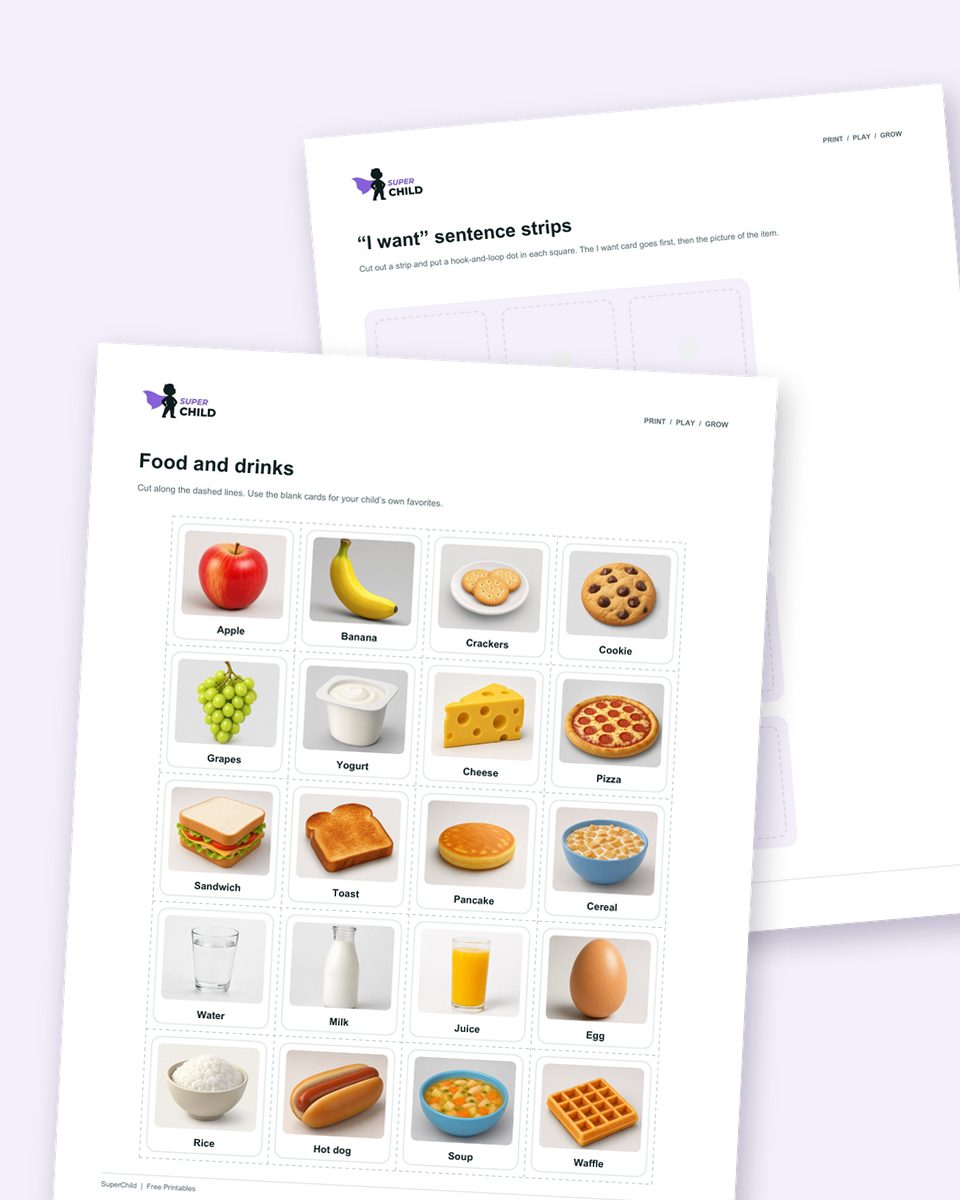
Free download2 PDFs
Get the free picture exchange starter book
A starter book with request cards and an “I want” sentence strip, plus a first-then board, ready to print.