


What are PECS cards?
"PECS cards" is what most people call the picture cards a child hands to an adult to ask for something: a picture of juice to get juice, a picture of bubbles to get bubbles. The child gives the card, and the adult gives the item straight away and names it. The cards are a form of low-tech AAC (augmentative and alternative communication) for children who do not talk yet, or not reliably.
PECS itself, the Picture Exchange Communication System, is a specific teaching protocol developed by Andy Bondy and Lori Frost and a trademark of Pyramid Educational Consultants. The cards from this maker are PECS-style picture exchange cards: they work with PECS, with other picture exchange programs, and as cards for a visual schedule or a first-then board. If your child’s team uses the PECS protocol, follow their training for how the cards are taught.
How to make PECS cards
To make PECS-style picture cards, pick the pictures of things your child wants most, choose a card size and border color, and print the page with cut lines. Laminate the sheet, cut the cards out and put a Velcro dot on the back of each one. Two inches is the usual size for a first book; 1.5 inches fits more cards in a book later on.
- Watch your child for a day and list what they reach for, point at or bring you: a snack, a drink, bubbles, the tablet, the swing.
- Pick those pictures here, by category or by search, or add a photo of the real thing (your child’s own cup, their favorite crackers).
- Choose the card size. 2 or 2.5 inches is easiest to pick up for a first card; 1.5 inches fits 35 cards on a page for a bigger book.
- Keep the words on the cards. The adult reads the word out loud when the child hands it over, so everyone says the same thing.
- Pick a border color, or color the borders by word type so people, actions and things look different. Turn on sentence strips if your child is ready to build "I want" sentences.
- Print the PDF on card stock, laminate the sheet, cut along the dashed lines, round the corners and put a Velcro dot on the back of each card.
The six phases of PECS, in brief
PECS teaches communication in six phases. Each phase builds on the one before, and a child moves on when the current step is easy and spontaneous.
- Phase I, how to communicate: the child picks up a single picture and hands it to a communication partner in exchange for something they want. A second adult gives physical prompts from behind, and fades them quickly.
- Phase II, distance and persistence: the child travels to the book and to the partner to make the exchange, with different people and in different places.
- Phase III, picture discrimination: the child chooses between two or more pictures, starting with something they like and something they do not.
- Phase IV, sentence structure: the child builds "I want" plus a picture on a sentence strip and hands over the whole strip.
- Phase V, answering "What do you want?": the child answers the question with a sentence strip.
- Phase VI, commenting: the child uses strips such as "I see", "I hear" and "I have" to comment, not only to ask.
- IExchange one picture

- IIGo further, ask anyone

- IIIChoose between pictures

- IVBuild “I want …”

- VAnswer “What do you want?”

- VIComment: “I see …”

How to use picture exchange cards at home
Start with one card for one thing your child loves, with the real thing in sight but out of reach. When your child hands you the card, give the item right away and name it: "Bubbles!" Keep each turn small, a few bubbles or one cracker, so there are many chances to ask again.
- Wait for your child to start. Do not say "Give me the card" or "What do you want?" in the first phase; the point is for your child to start the exchange.
- Accept the card from any position and respond within a second or two. Speed teaches that the card works.
- Add a second card only when the first exchange is easy, then teach choosing between two.
- Keep cards for help, break, drink and all done in the book from the start. Those are never earned.
- Create reasons to ask: snacks in a clear box, toys on a shelf, one puzzle piece at a time.
- Keep every other way your child already communicates, like reaching, leading you by the hand, sounds and words. Cards add to them.
Velcro, lamination and a PECS book
Print on card stock (65 to 110 lb) so the cards stay flat. Laminate the whole sheet before you cut, then cut along the dashed lines and leave a thin clear edge so the seal holds. 3 mil pouches are flexible; 5 mil cards are stiffer and easier for small hands to pick up. A corner rounder stops sharp corners.
Put one side of a Velcro dot on the back of every card and the other side on the strips of the book, and keep it the same way round on every card. A PECS book is usually a small three-ring binder with Velcro strips on the cover and on a few inside pages. The PECS book printable has a ready-made cover, “I want” strips and a request log.
Drinks, the toilet, help, a break and comfort are never something your child has to ask for in the right way. Respond to every attempt to ask for them, card or no card.
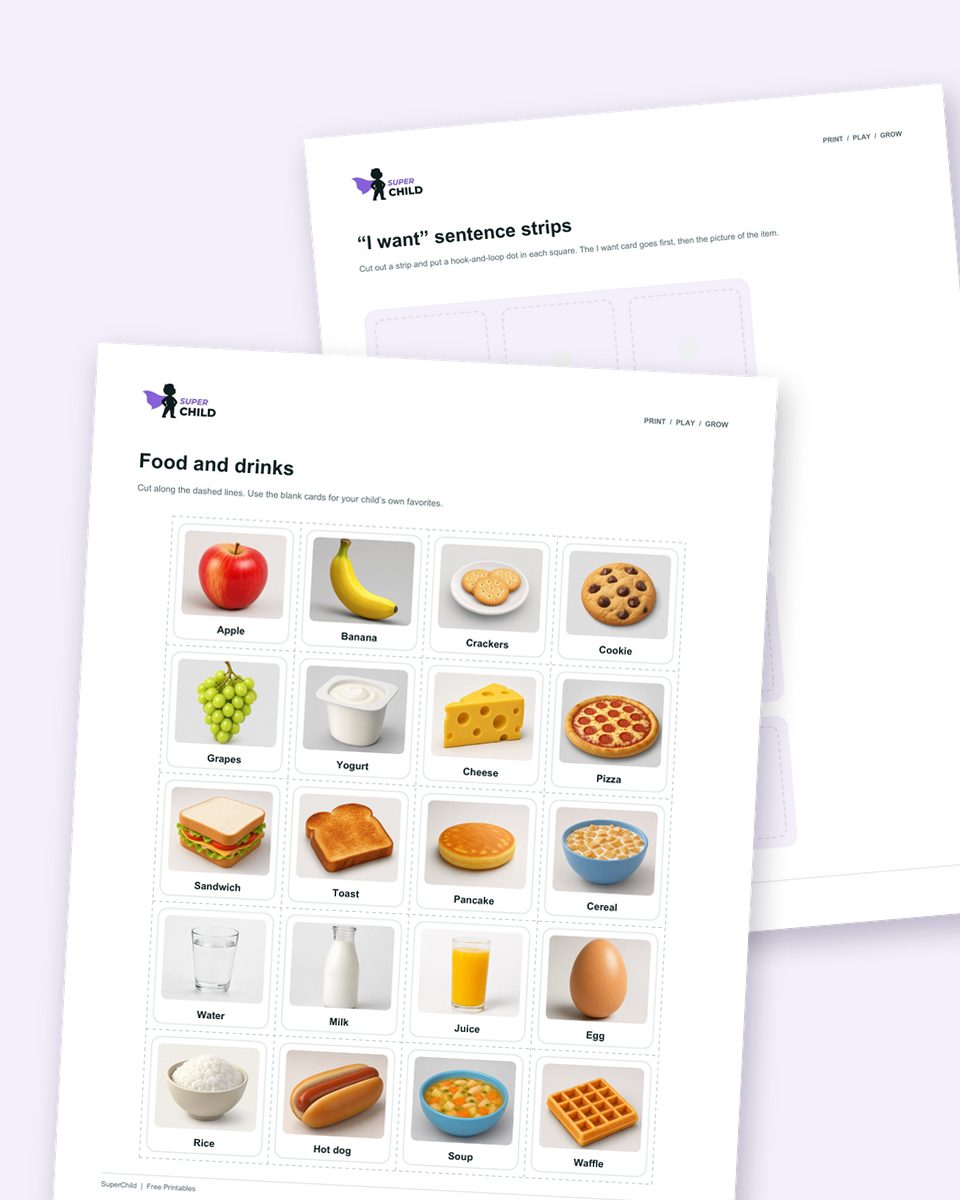
Free download2 PDFs
Get the free picture exchange starter book
A starter book with request cards and an “I want” sentence strip, plus a first-then board, ready to print.