On this page
- What does autism speech therapy work on? It depends on the profile
- What a 30 to 45 minute speech therapy session looks like
- Evidence-based autism speech therapy techniques, in plain words
- Sample goals for speech therapy for autism
- How ABA and speech therapy work together
- How many hours of speech therapy does an autistic child need?
- What to practice at home between sessions
What does autism speech therapy work on? It depends on the profile
Autism speech therapy targets your child’s next step: a dependable way to request for a child who doesn’t talk yet, two-word phrases for an emerging talker, flexible speech in place of echolalia, and conversation for a child who speaks in sentences.
An SLP starts with an evaluation: tests where a child can do them, a sample of what your child says in play, and your report from home. Most children fit roughly into one of four starting profiles, and they move from one to the next.
Under all four sit the same building blocks: joint attention, imitation, play, understanding words, and why a child communicates. Many autistic children talk mostly to request, so commenting and asking questions often need direct teaching. If your child is under 3 with no diagnosis yet, start with our speech delay guide.


What an SLP usually targets first, by communication profile
Nonverbal or minimally verbal
- What you might see
- Few or no words; leads you by the hand to get things
- First targets
- A reliable way to request (PECS, signs, a device), joint attention, imitation
Emerging words
- What you might see
- 10 to 50 single words, mostly to ask for things
- First targets
- Verbs and two-word phrases (“more juice”), commenting
Echolalic
- What you might see
- Repeats lines, sometimes with meaning (“Want a cookie?” to ask for one)
- First targets
- Decoding scripts, modeling short mix-and-match phrases
Verbal, social-language differences
- What you might see
- Talks in sentences but monologues and misses turns
- First targets
- Conversation turns, wh-questions, storytelling
| Profile | What you might see | First targets |
|---|---|---|
| Nonverbal or minimally verbal | Few or no words; leads you by the hand to get things | A reliable way to request (PECS, signs, a device), joint attention, imitation |
| Emerging words | 10 to 50 single words, mostly to ask for things | Verbs and two-word phrases (“more juice”), commenting |
| Echolalic | Repeats lines, sometimes with meaning (“Want a cookie?” to ask for one) | Decoding scripts, modeling short mix-and-match phrases |
| Verbal, social-language differences | Talks in sentences but monologues and misses turns | Conversation turns, wh-questions, storytelling |
Speech therapy for nonverbal autism
Speech therapy for a nonverbal autistic child gives them a way to communicate now, usually AAC such as PECS, signs or a speech device, while building joint attention, imitation, play and sounds on purpose.
Roughly a quarter to a third of autistic children are still minimally verbal when they start school. Many learn to speak later, and all can learn to communicate. The SLP picks a system that fits your child’s motor skills, teaches it in motivating moments like snack or bubbles, and models it all day.
AAC does not reduce speech, and many children say more words once they have a dependable way to be understood. Read our AAC for autism guide, or start with a PECS book printable.
What a 30 to 45 minute speech therapy session looks like
A session for a young autistic child is mostly play: a short warm-up to connect, 20 to 30 minutes of practice on two or three goals inside activities the child loves, a few minutes with a book or table task, and the last 5 minutes coaching the parent on one thing to do at home.
The SLP sets up moments where your child wants something, like a wind-up toy or a snack in a closed jar, and teaches the target right then. Each goal gets 20 to 40 chances per session, tallied as independent or prompted. Here is a 45-minute session for a 4-year-old working on two-word requests and “what” questions.


Evidence-based autism speech therapy techniques, in plain words
The best-supported techniques are naturalistic approaches such as JASPER and Enhanced Milieu Teaching, PECS and aided language modeling for children who use AAC, and parent coaching such as Hanen More Than Words. PROMPT is a touch-cue method for children who also have motor speech difficulties.
SLPs mix techniques to fit the profile. Here is what each looks like in the room.
- Naturalistic teaching (NDBI, Enhanced Milieu Teaching)
- Teaching inside play and routines: follow the child’s lead, create a reason to communicate, wait, model, and hand over what they asked for. Rated evidence-based by the National Clearinghouse on Autism Evidence and Practice.
- JASPER
- Joint Attention, Symbolic Play, Engagement and Regulation. The adult plays face to face at the child’s level and builds shared attention. In a 2014 trial with minimally verbal 5 to 8 year olds, adding a speech device led to more spontaneous communication.
- PECS
- The Picture Exchange Communication System. The child hands over a picture to get what they want, then builds to sentence strips (“I want cookie”) over six phases.
- Aided language modeling
- The adult points to symbols on the child’s board or device while talking: “You want MORE BUBBLES.” AAC users need the same flood of examples speaking children hear.
- PROMPT
- Touch cues on the jaw, face and lips to guide sounds. It suits children with motor speech problems such as apraxia; research in autism is still small.
- Hanen More Than Words
- A parent program: group sessions plus home visits where an SLP films you playing with your child and coaches you.
Sample goals for speech therapy for autism
Good autism speech therapy goals say what the child will do, how often, with how much help and where, for example: “Using pictures, words or a device, Leo will request 10 different preferred items without prompts in 4 out of 5 opportunities at home and school.”
A goal like “improve expressive language” can’t be measured. Ask for goals written so you could check them yourself. These starting points are grouped by profile.
- Nonverbal: “Will hand over a picture or press a device button to request a preferred item in 8 out of 10 opportunities across 3 sessions.”
- Emerging words: “Will combine two words (‘more juice,’ ‘open box’) to request, comment or protest 15 times in a 30-minute session.”
- Echolalic: “Will use a short self-made phrase in place of a familiar script to request or protest in 4 out of 5 opportunities.”
- Verbal: “Will answer what, where and who questions about a short picture story with 80% accuracy.” Our WH questions printables fit this one.
- Verbal: “Will keep a conversation going for 3 back-and-forth turns on a topic a peer chooses in 3 out of 4 opportunities.”
How ABA and speech therapy work together
ABA and speech therapy work best when the behavior analyst and the SLP agree on the same communication goals and the same AAC system: the SLP leads on language, AAC and speech sounds, and the ABA team gives the child many more practice opportunities on those targets each week.
An ABA program often runs 10 to 30 or more hours a week, so those hours should practice the SLP’s language targets. ABA uses Skinner’s terms: a mand is a request, a tact a label, an intraverbal an answer, and listener responding is understanding. The VB-MAPP uses those words; SLPs say expressive and receptive.
Trouble starts when the SLP introduces a device while ABA accepts only spoken words, or models “more bubbles” while ABA drills “I want bubbles please.” Ask for one shared target list, one AAC system and a call between providers every few months.
How many hours of speech therapy does an autistic child need?
There is no single right number. Most young autistic children see an SLP once or twice a week for 30 to 60 minutes, sometimes more at the start, and what moves progress most is how many practice chances happen at home and school on top of that.
The amount depends on age, profile and who provides the service. Ask how progress will be measured every 8 to 12 weeks; if a goal stays flat for three months, the plan needs to change.
Typical speech therapy amounts for young autistic children, by setting
Early Intervention (under 3)
- Typical amount
- 30 to 60 min, 1 to 2 times a week
- What it looks like
- At home, coaching the parent in routines
Preschool or school IEP
- Typical amount
- 60 to 120 min a month, varies widely
- What it looks like
- Pull-out sessions, in class, or both
Private clinic
- Typical amount
- 30 to 60 min, 1 to 3 times a week
- What it looks like
- One-on-one, parent often in the room
Hanen More Than Words
- Typical amount
- 8 group sessions and 3 video coaching visits
- What it looks like
- The parent learns and practices daily
| Setting | Typical amount | What it looks like |
|---|---|---|
| Early Intervention (under 3) | 30 to 60 min, 1 to 2 times a week | At home, coaching the parent in routines |
| Preschool or school IEP | 60 to 120 min a month, varies widely | Pull-out sessions, in class, or both |
| Private clinic | 30 to 60 min, 1 to 3 times a week | One-on-one, parent often in the room |
| Hanen More Than Words | 8 group sessions and 3 video coaching visits | The parent learns and practices daily |
Common US patterns. Your child’s team sets the amount.
What to practice at home between sessions
Pick one target from therapy, one or two daily routines and five to ten minutes a day. Set up a reason to communicate, wait at least 5 seconds, model the word or symbol once, and give your child what they asked for as soon as they try.
Practice rides on things you already do: snack, bath, dressing, the car. The week plan spreads one target over five routines. For listening skills, our following directions printables give you picture cards.
- 1Ask the SLP for this week’s targetOne word, sign or device button, and how much help your child needs.
- 2Choose two routinesSnack and bath work well: both hold things your child wants.
- 3Create the needCrackers in a clear box your child can’t open, or bubbles with the lid on.
- 4Wait, then model onceCount to 5. If nothing comes, say or point to “open” once, then wait again.
- 5Reward the tryAny close attempt gets the thing right away: “Open! Crackers.”
- 6Tally what you heardA tick sheet on the fridge tells the SLP what works.


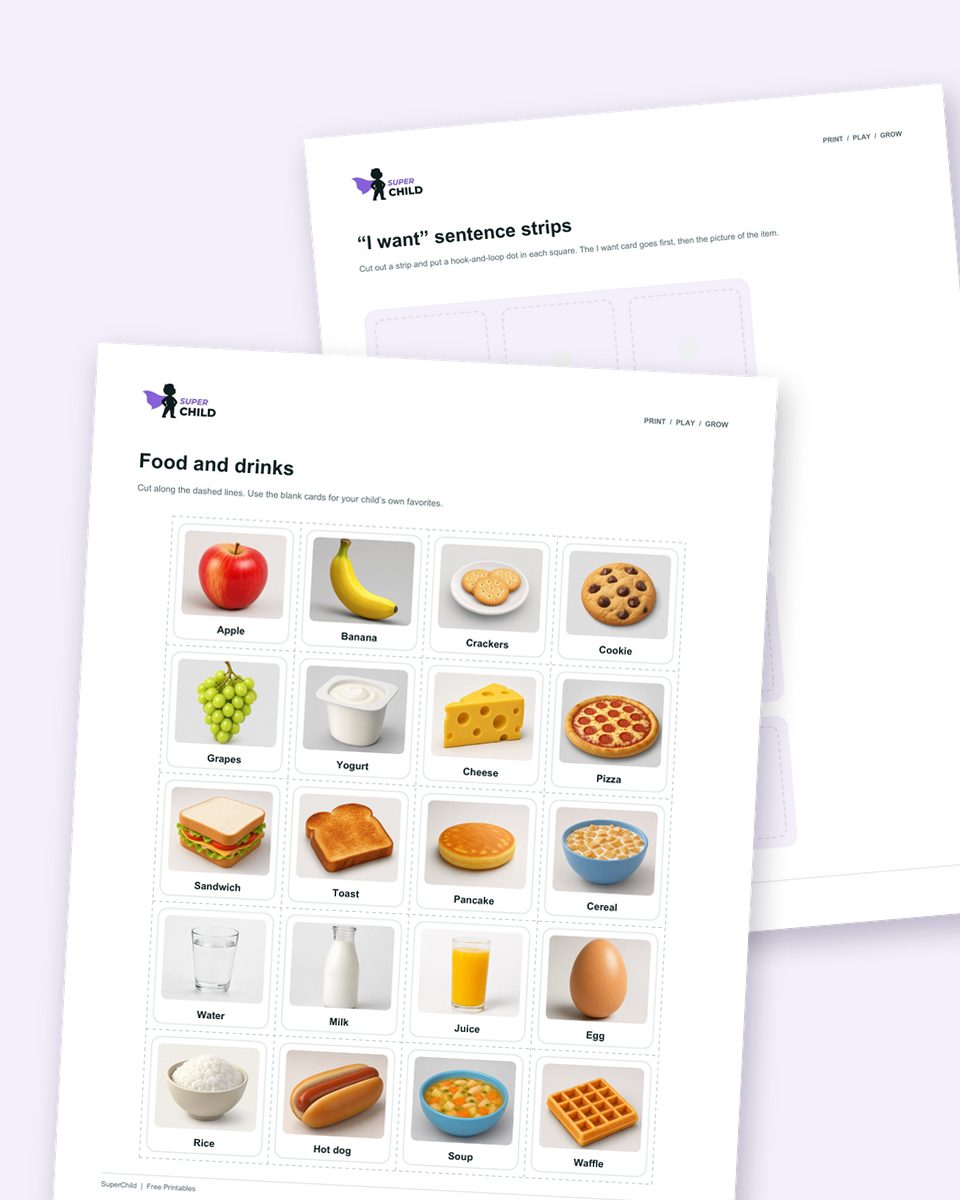
Free download2 PDFs
Get the free picture exchange starter book
A starter book with request cards and an “I want” sentence strip, plus a first-then board, ready to print.
Sources
- ASHA Practice Portal: Autism
- NCAEP: Evidence-Based Practices for Children, Youth, and Young Adults with Autism (2020)
- Tager-Flusberg and Kasari: Minimally verbal school-aged children with autism spectrum disorder (Autism Research, 2013)
- ASHA Practice Portal: Augmentative and Alternative Communication
- The Hanen Centre: More Than Words program
Cite this page
Citation (APA style)
SuperChild. (2026). Autism speech therapy: what an SLP works on, and how to help at home. Retrieved from https://superchild.ai/blog/autism-speech-therapy
Link for your website
<a href="https://superchild.ai/blog/autism-speech-therapy">Autism speech therapy: what an SLP works on, and how to help at home</a> (SuperChild)