
On this page
What is level 3 autism?
Level 3 autism is the highest of the three support levels in the DSM-5-TR, the manual used to diagnose autism. It means “requiring very substantial support”: the child has major difficulty with social communication, finds change very hard, or both, and needs help with most parts of the day.
A clinician gives a level for two areas: social communication, and restricted and repetitive behaviors. Your child can be level 3 in one and level 2 in the other.
Levels can move. The American Speech-Language-Hearing Association (ASHA) notes that support needs vary by setting and change over time. A level helps services decide how much support to give. It says very little about who your child is.
Is level 3 the same as severe autism or profound autism?
“Severe autism” is an everyday phrase that usually means level 3. “Profound autism” is a term proposed in 2021 by the Lancet Commission for autistic people with a significant intellectual disability, very limited language, or both, who are likely to need an adult nearby at all times.
When CDC researchers applied that definition to the records of 8-year-olds with autism, about 27 in 100 met it.
Profound autism isn’t in the DSM, and people disagree about it. Some families say it finally names what their child needs. Some autistic adults worry it will be used to separate people. Use whichever words get your child the right support.
Level 3 autism symptoms: what a day can look like
Daily life with level 3 autism often involves very limited speech, broken sleep, safety risks such as wandering, strong sensory reactions, and behavior that is the child’s way of communicating.
Your child may have a few of these or most of them.
- Communication
- Many children at level 3 use few or no words. Your child may pull you by the hand to the fridge, or use a picture or a device. Understanding is often patchy. “Shoes on” works at the door and gets a blank look in the kitchen.
- Sleep
- Late nights. Awake at 3 a.m. Sleep problems are common in autism. Your pediatrician can check for causes like reflux or seizures.
- Safety
- In a large parent survey, about half of autistic children had tried to leave a safe place at least once after age 4. Door alarms, an ID bracelet and a plan with the neighbors help.
- Sensory
- Noise, light, a clothing label or certain foods can be unbearable. Other children go looking for strong input: spinning, pressing, chewing. Our sensory activities for autism give calm ways to meet those needs.
- Behavior that communicates
- Hitting, screaming, biting or self-injury usually say something your child can’t say another way: “too loud,” “I hurt,” “I don’t want that.” A BCBA can help find the reason.
Can a child with level 3 autism still learn?
Yes. Children with level 3 autism keep learning throughout childhood. They need smaller steps, more repetition, and pictures alongside words.
Week to week it can look like nothing is moving. Over months it’s easier to see.
Pictures do a lot of the work. A visual schedule shows what happens next. A first-then board makes one hard step easier to accept: first car seat, then music.
AAC means any way to communicate besides speech: signs, picture cards, a speech device. In a review of AAC studies, none of the children talked less afterwards, and most said a little more. Our AAC for autism guide explains where to start.
- Small steps: one new word or skill at a time.
- Repetition: the same word many times a day, in many places.
- Routine: same time, same seat, same start and end.
- Help that fades: show the answer, then wait a moment longer each time before you help.


How do I teach words if my child doesn’t talk?
Build understanding first. Say one everyday word, put out two or three pictures or objects, and let your child touch the one you named. Your child doesn’t have to say anything.
Understanding a word and saying it are different skills, and one doesn’t bring the other by itself. Our article on receptive and expressive language explains the difference.
If a wrong answer brings a loud “no,” a red cross or a buzzer, many children stop trying. So show the right one gently, say the word, and go again.
- 1Pick three wordsChoose things your child meets every day: cup, shoe, apple. Keep the same three for a week.
- 2Start with two or three choicesPut out the real cup and one other object, or two or three picture cards. Say “cup” once, clearly.
- 3Help before a mistake happensAt first, point to the cup as you say it. Over the next days, wait a second or two before you point.
- 4Keep it shortFive minutes is enough. Stop while your child is still calm.
- 5Take it into the daySay the word when the real thing shows up: the cup at dinner, the shoe at the door.
A wrong tap, with no red and no buzzer
How do we keep going as a family?
Burnout is common in parents of children with high support needs. Respite care, other parents and time for siblings all count as part of your child’s care. Your child needs you to last.
Many parents run a home program too: cutting cards at night, data sheets after work. You’re allowed to do less of it. Five minutes a day that you can keep up beats a big plan that falls apart in week two.
- Respite: a trained person cares for your child while you take a short break. In the US, the ARCH National Respite Network has a locator.
- Other parents: parents of children with high support needs, local or online, have the practical answers, from sleep to dentists.
- Siblings: regular one-to-one time, even 15 minutes, and simple words for what their brother or sister needs.

What should I ask my child’s BCBA, SLP and OT?
Ask each one for two or three targets to practice at home, how to do it in five minutes, and what to do when your child gets upset.
A behavior analyst (BCBA) helps with learning and behavior. A speech-language pathologist (SLP) works on communication, including AAC. An occupational therapist (OT) helps with sensory needs, eating and dressing. You see the nights and weekends they don’t, so tell them what you notice. Two more questions to bring:
- “How much help should I give, and when do I wait?”
- “What should I write down so you can see how it went?”
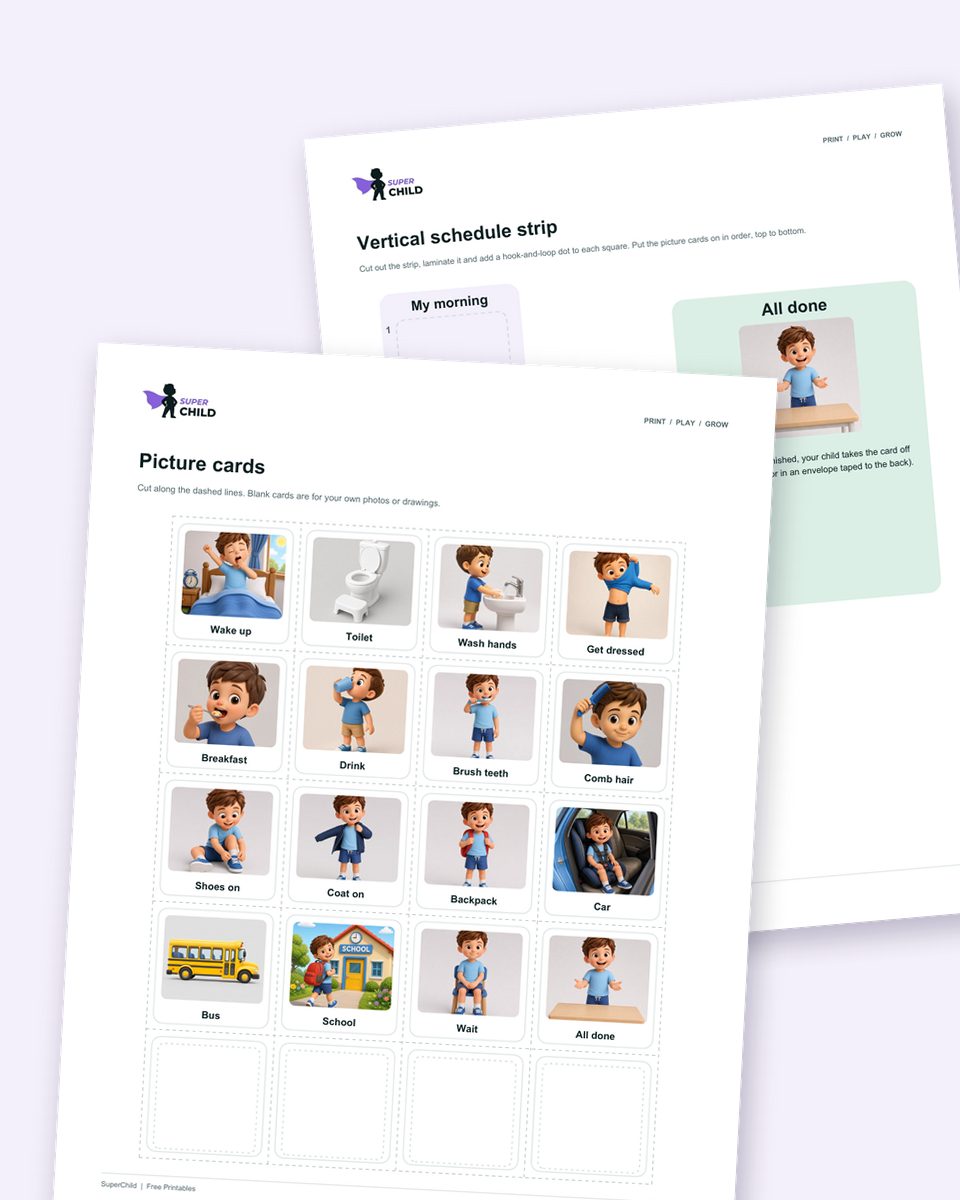
Free download1 PDF · 25 pages
Get the free visual schedule printable
Morning and bedtime routines plus picture cards for the whole day, with strips, a parent guide and a log.
Sources
- ASHA Practice Portal: Autism (DSM-5-TR severity levels of support)
- Lord et al.: The Lancet Commission on the future of care and clinical research in autism (Lancet, 2022; online 2021)
- Hughes et al.: The prevalence and characteristics of children with profound autism, 15 sites, United States, 2000-2016 (Public Health Reports, 2023)
- Anderson et al.: Occurrence and family impact of elopement in children with autism spectrum disorders (Pediatrics, 2012)
- Millar, Light and Schlosser: The impact of AAC intervention on the speech production of individuals with developmental disabilities (JSLHR, 2006)
- ASHA Practice Portal: Augmentative and Alternative Communication
- NIDCD: Autism spectrum disorder, communication problems in children
- ARCH National Respite Network and Resource Center
Cite this page
Citation (APA style)
SuperChild. (2026). Level 3 autism: what it means and how your child keeps learning. Retrieved from https://superchild.ai/blog/level-3-autism
Link for your website
<a href="https://superchild.ai/blog/level-3-autism">Level 3 autism: what it means and how your child keeps learning</a> (SuperChild)