
On this page
- What is global developmental delay?
- What are the signs of global developmental delay?
- What causes it, and which tests come next?
- Global developmental delay vs autism: is it the same thing?
- Who do I call first?
- What can I do at home today?
- Global developmental delay and speech: where do I start with words?
What is global developmental delay?
Global developmental delay is the term doctors use when a child under 5 is clearly behind in two or more areas of development. It describes how your child is doing now. Tests of learning ability aren’t reliable before about age 5, so the label is a placeholder and your child will be looked at again later.
Doctors look at five areas: big movements, hands and fingers, speech and language, thinking and play, and social and self-care skills. Behind in just one is a delay in that area, such as a speech delay. Behind in two or more, and the word “global” gets added.
It affects about 1 to 3 in every 100 young children. Some catch up a lot. Others are later found to have an intellectual disability (in the UK, a learning disability), autism, or a genetic condition. Nobody can tell you which at the first appointment.


What are the signs of global developmental delay?
The signs are skills that come much later than in most children, in more than one area.
One late skill doesn’t make a delay. Most parents notice a pattern, like a 2-year-old who isn’t walking well, has two or three words, and doesn’t point to what he wants. Write down what you see, with dates, and bring the list to the doctor.
- Big movements: sits, crawls or walks much later than other children.
- Hands and fingers: can’t pick up small things with finger and thumb, stack two blocks or hold a crayon.
- Speech and language: doesn’t respond to their name, doesn’t understand “where’s your shoe?”, has few or no words.
- Thinking and play: doesn’t copy you, doesn’t explore toys, no pretend play like feeding a teddy.
- Social and self-care: little interest in other children; needs full help to eat, drink from a cup or take off socks.
What causes it, and which tests come next?
Causes include genetic differences, problems before or around birth, and some rarer medical conditions, but often no single cause is found. The usual first tests are hearing and vision checks and a genetic blood test called a chromosomal microarray.
No cause found? That’s hard to hear when you came for an answer. It doesn’t change the help your child gets, because help is based on what your child needs.
- Hearing test
- Every child with a language delay needs one. Even mild hearing loss, or fluid after ear infections, slows understanding.
- Eye check
- Poor vision can hold back play and learning.
- Chromosomal microarray
- A blood test for missing or extra pieces of genetic material, the first genetic test in US and UK guidance.
- Fragile X test
- The most common inherited cause of learning disability, often tested at the same time.
- Other tests when needed
- Blood tests or a brain MRI, usually only when the history or exam points that way.
Global developmental delay vs autism: is it the same thing?
No. Global developmental delay is about learning skills later in several areas. Autism is about how a child connects, communicates and takes in the world. They often go together.
A child with GDD may be keen to share things with you and just be slower to learn. An autistic child may walk early and know every letter, yet not answer to their name. In a large CDC study of 8-year-olds, about 38 in 100 autistic children with an IQ test also had an intellectual disability.
If you also notice little eye contact, no pointing to share, or strong routines, ask for an autism assessment too.
How the two differ, how they overlap and what an assessment looks at is in global developmental delay or autism?.
Global developmental delay, autism and intellectual disability compared
What it describes
- Global developmental delay
- Behind in two or more areas
- Autism
- Differences in social contact, communication and sensory processing
- Intellectual disability
- Lasting difficulty with learning and everyday skills
Is it a cause?
- Global developmental delay
- No, a description
- Autism
- A diagnosis
- Intellectual disability
- A diagnosis
Can it change?
- Global developmental delay
- Yes, often reassessed
- Autism
- Lifelong, with growth
- Intellectual disability
- Lifelong, with growth
| Global developmental delay | Autism | Intellectual disability | |
|---|---|---|---|
| What it describes | Behind in two or more areas | Differences in social contact, communication and sensory processing | Lasting difficulty with learning and everyday skills |
| Is it a cause? | No, a description | A diagnosis | A diagnosis |
| Can it change? | Yes, often reassessed | Lifelong, with growth | Lifelong, with growth |
A child can have more than one of these at the same time.
Who do I call first?
In the US, call your state’s early intervention program (for children under 3) and your pediatrician. You don’t need a referral. In the UK, start with your health visitor or GP, who can refer you to a community paediatrician and therapists.
In the US, early intervention is called Part C. The evaluation is free, and services are free or low cost depending on your state. You can say: “I’m worried about my child’s development and I’d like an evaluation.” From age 3, your local public school district takes over.
In the UK, a community paediatrician, often at a child development centre, looks at your child as a whole. Many areas let parents refer to speech and language therapy directly, so ask.
Waiting lists can be months long. Ask to go on the cancellation list and get the hearing test done. Keep a short diary of new skills and worries, with dates. Short videos on your phone help too.
What can I do at home today?
Pick one small goal and practice it for a few minutes inside things you already do, like snack or bath. Children with GDD do learn. They need more repetition and smaller steps.
If your child has a therapist, ask which goals matter most.
- 1Choose one goalDrink from an open cup. Point to the banana. Pull off a sock. One at a time is calmer for both of you.
- 2Make it smallerBreak the task into tiny steps. Let your child do the last step first. Add a step when that one gets easy.
- 3Short and oftenThree minutes, several times a day, beats one long session.
- 4Help, then fadeShow it, guide with your hand, or point. When it works, help a little less next time.
- 5Show with picturesPictures make the day easier to follow. Try a visual schedule or a first-then board.
Small steps that grow
Global developmental delay and speech: where do I start with words?
Most children with GDD are also late with speech. Start with understanding. Name everyday things, give your child the chance to point or hand them to you, and use the same word every time.
A child who hands you the cup when you say “cup” knows that word, even if he can’t say it yet. Our article on receptive and expressive language explains the difference.
Use real things: an apple, a shoe, a cup. Hold up two, name one, and wait. When two is easy, offer three. A sign or a point counts as an answer.
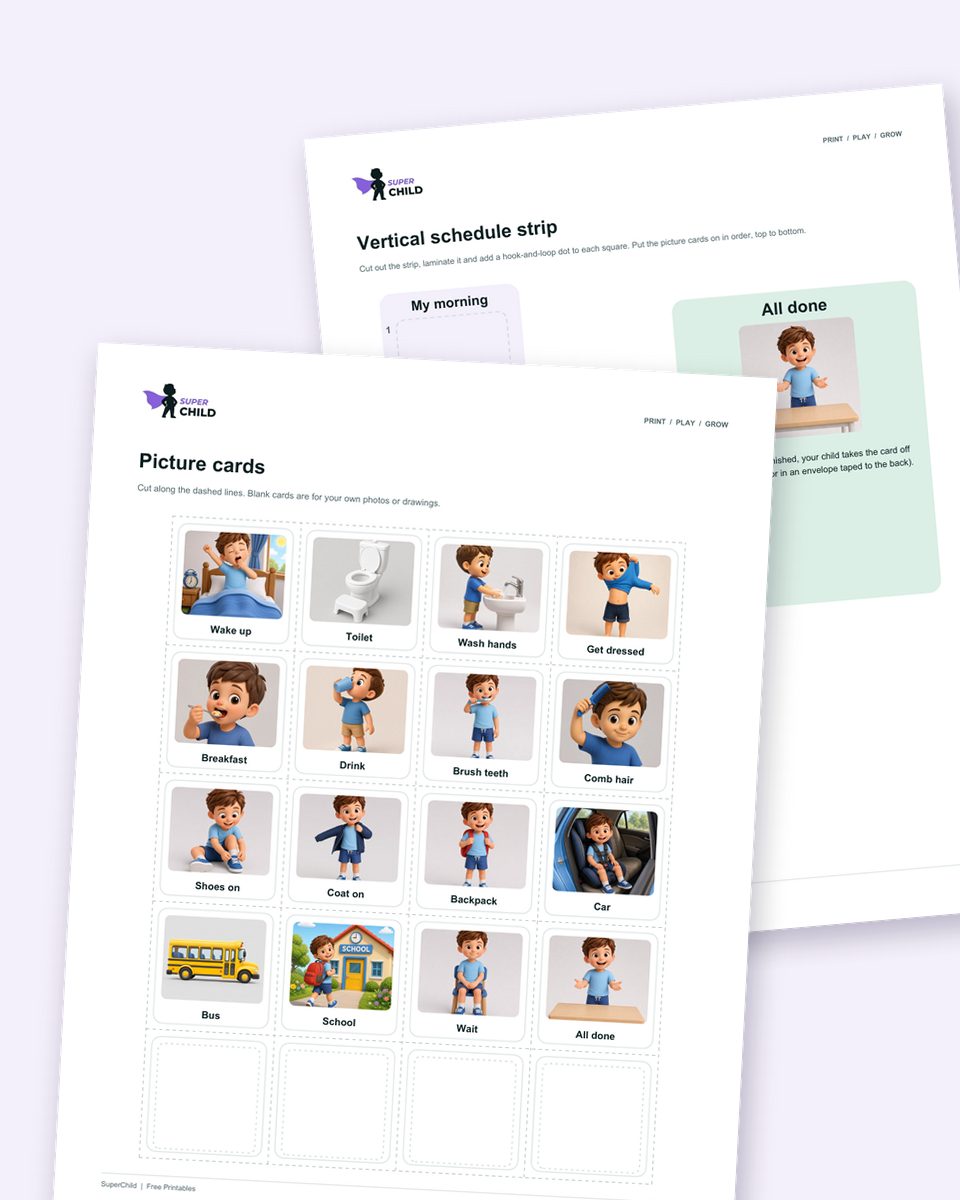
Free download1 PDF · 25 pages
Get the free visual schedule printable
Morning and bedtime routines plus picture cards for the whole day, with strips, a parent guide and a log.
Sources
- Moeschler and Shevell, American Academy of Pediatrics: Comprehensive evaluation of the child with intellectual disability or global developmental delays (Pediatrics, 2014)
- Mithyantha et al.: Current evidence-based recommendations on investigating children with global developmental delay (Archives of Disease in Childhood, 2017)
- Miller et al.: Chromosomal microarray is a first-tier clinical diagnostic test for individuals with developmental disabilities (American Journal of Human Genetics, 2010)
- CDC: Early intervention, Learn the Signs. Act Early.
- CDC: Developmental milestones
- ECTA Center: Part C state early intervention coordinators
- NHS: Learning disabilities, getting support
- NHS: Your baby’s health and development reviews
- NICE: Autism spectrum disorder in under 19s, recognition, referral and diagnosis (CG128)
- Maenner et al.: Prevalence and characteristics of autism spectrum disorder among children aged 8 years, ADDM Network 2020 (CDC MMWR, 2023)
Cite this page
Citation (APA style)
SuperChild. (2026). Global developmental delay: what the doctor meant, and what you can do now. Retrieved from https://superchild.ai/blog/global-developmental-delay
Link for your website
<a href="https://superchild.ai/blog/global-developmental-delay">Global developmental delay: what the doctor meant, and what you can do now</a> (SuperChild)