


On this page
- Is global developmental delay the same as autism?
- Why do they look so alike in a toddler?
- Can a child have global developmental delay and autism?
- Can global developmental delay turn into autism?
- What do the assessments look at?
- Delay, autism or both: what do I do at home now?
- What should I ask at the next appointment?
Is global developmental delay the same as autism?
No. Global developmental delay describes how far along a child under 5 is: clearly behind in two or more areas, such as moving, talking, play and self-care. Autism describes how a child connects: social communication works differently, and there are repetitive patterns or unusual reactions to sound, touch or change.
A child with GDD alone is often keen to be with you. He brings you the ball and laughs at peekaboo, only later than his cousin did. An autistic child may stack blocks and climb like any 2-year-old, yet not look up at his name or point at the dog to show you.
Autism doesn’t depend on how fast a child learns. Some autistic children are behind in many areas. Others read early and still struggle to take turns in play.
Our article on global developmental delay explains the term, the usual tests and who to call.
Global developmental delay and autism side by side
What it describes
- Global developmental delay
- Skills arrive late in two or more areas
- Autism
- Social communication develops differently, with repetitive patterns or sensory differences
Sharing and contact
- Global developmental delay
- Usually there, at a younger level: shows you things, copies you
- Autism
- Less sharing than you would expect, even next to the child’s other skills
Play
- Global developmental delay
- Like a younger child’s play
- Autism
- Often repetitive: lining up, spinning wheels
| Global developmental delay | Autism | |
|---|---|---|
| What it describes | Skills arrive late in two or more areas | Social communication develops differently, with repetitive patterns or sensory differences |
| Sharing and contact | Usually there, at a younger level: shows you things, copies you | Less sharing than you would expect, even next to the child’s other skills |
| Play | Like a younger child’s play | Often repetitive: lining up, spinning wheels |
A summary in everyday words. A child can fit both columns.
Why do they look so alike in a toddler?
Because the first thing most parents notice is the same: few words. A late talker could have a hearing problem, a language delay, a global delay, autism, or more than one of these. The clues that separate them are small and social.
In a study of toddlers who had all failed an autism screening, what set the autistic toddlers apart most clearly was joint attention: sharing a moment with another person.
Leave the word count aside for a week and watch the sharing at home.
- Pointing to show. Your child points at the bus so you will look too. Pointing to get the cracker is a request.
- Bringing things to show you. Holding up a toy and looking at your face.
- Following your point. You say “look, a cat” and point. Your child looks at the cat.
- Answering to their name. Most of the time, with hearing checked.
- Copying and back-and-forth. Waving back, rolling a ball to and fro.


Can a child have global developmental delay and autism?
Yes, and it is common. Doctors diagnose autism alongside a delay when social communication is below what you would expect for the child’s general developmental level. Both labels then go on the report.
In the CDC’s latest count of 8-year-olds, about 40 in 100 autistic children with test results also had an intellectual disability. Before age 5, that slower learning is usually described as a global delay.
Having both gives the team a fuller picture: how fast your child learns, and how to reach him. See also level 3 autism.
Can global developmental delay turn into autism?
No. A delay doesn’t become autism. But a child first described as delayed can later be diagnosed as autistic too, once the signs are easier to see. The autism was already there.
This happens fairly often. In a study that followed toddlers through repeated evaluations, about 1 in 4 of the children who ended up with an autism diagnosis had not been identified as autistic at their first visit.
A delay is easier to see early. Judging social communication takes a longer look. UK guidance for clinicians says an autism diagnosis can be uncertain in children under 24 months and in children whose developmental age is under 18 months.
Ask when your child will be looked at again, and put the date on the fridge. If you see the signs in the list above, ask for an autism assessment now.
What do the assessments look at?
A good assessment answers two questions: how far along your child is, and how your child connects. No single test decides it.
Bring short phone videos of play and mealtimes at home. Our early intervention guide explains what an evaluation is like.
- Your story
- First smiles, pointing, first words, any skills that were lost.
- Developmental testing
- Play-based tasks that show your child’s level in each area. This is where a global delay shows.
- Autism observation
- A clinician plays with your child in a set way and watches for sharing, gestures and repetitive behavior.
- Language
- What your child understands and what they say, looked at separately. See receptive vs expressive language.
- Hearing and medical checks
- A hearing test for every child with few words. Often a genetic blood test when there is a global delay.
Delay, autism or both: what do I do at home now?
The same things, whichever word ends up on the report. One small goal, a few minutes of practice inside your daily routines, pictures next to your words, and time to answer.
In the US, early intervention for children under 3 looks at the delay itself, so your child doesn’t need an autism diagnosis to start. Some therapies and insurance cover do ask for one, so get the assessment going while help begins.
- 1Choose one goalHand over the cup when you say “cup.” Pull off a sock. Point to the banana.
- 2Use the routines you already haveSnack, bath, shoes by the door. Say the same few words each time.
- 3Show it with picturesA visual schedule shows what comes next. A first-then board helps with one hard step.
- 4Build the sharingSit face to face. Copy what your child does with the blocks. Pause in a song and wait for a look before you go on.
- 5Practice understandingHold up two things, name one, and count to five in your head. A reach, a look or a point is an answer. If none comes, show the answer kindly and move on. Matching activities are a calm way to start.
What should I ask at the next appointment?
Ask what the team has looked at, what they haven’t, and when they will look again. You’re allowed to ask how sure they are.
Write the questions down before you go.
- “Have you looked at autism as well as the delay? If not, can you refer us?”
- “Is my child’s social communication at the level of the other skills, or behind them?”
- “When will you see my child again, and what would change the picture?”
- “Which one or two goals should we practice at home this month?”
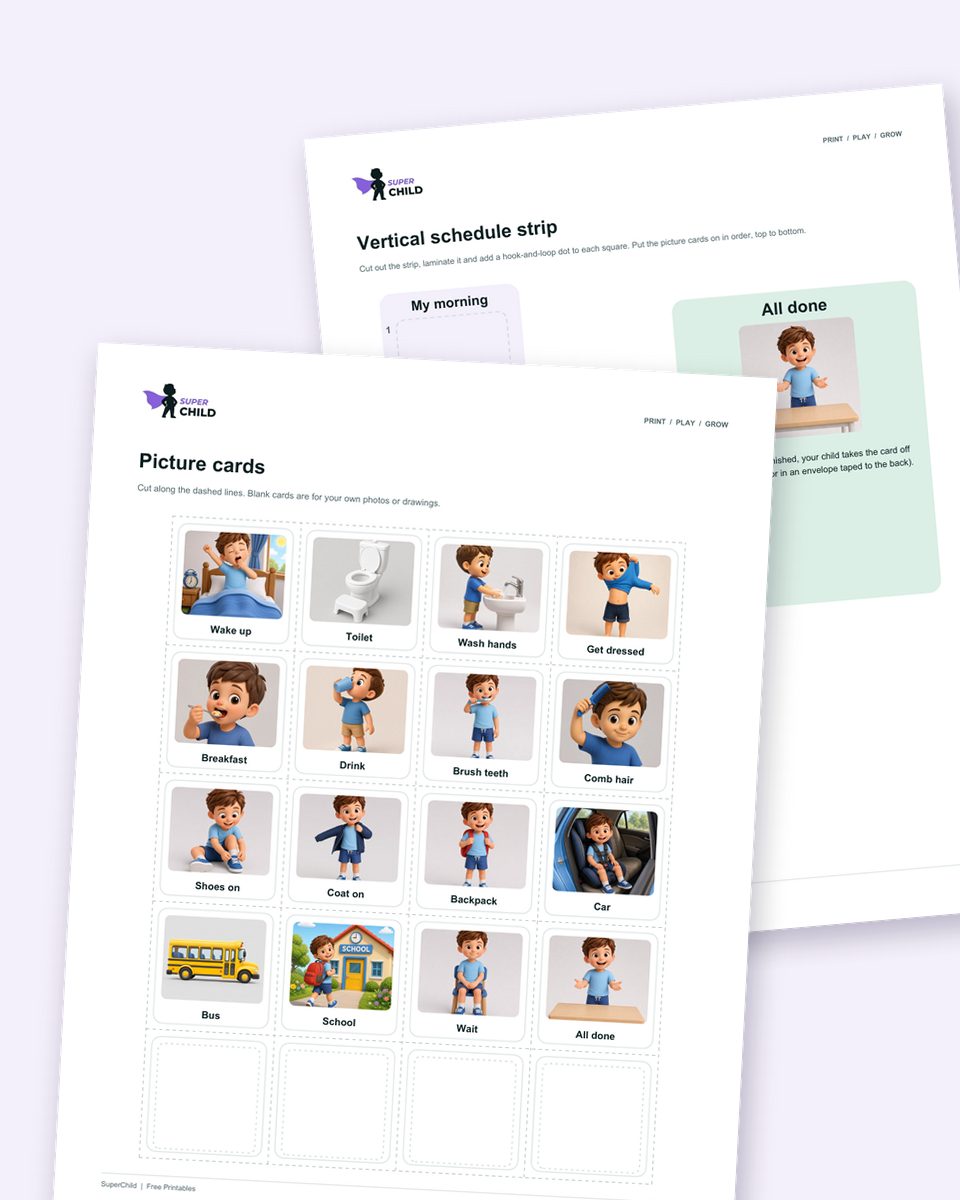
Free download1 PDF · 25 pages
Get the free visual schedule printable
Morning and bedtime routines plus picture cards for the whole day, with strips, a parent guide and a log.
Sources
- CDC: Clinical testing and diagnosis for autism spectrum disorder (DSM-5 diagnostic criteria)
- Moeschler and Shevell, American Academy of Pediatrics (2014). Comprehensive evaluation of the child with intellectual disability or global developmental delays. Pediatrics
- Hyman, Levy and Myers, American Academy of Pediatrics (2020). Identification, evaluation, and management of children with autism spectrum disorder. Pediatrics
- NICE: Autism spectrum disorder in under 19s, recognition, referral and diagnosis (CG128), recommendations 1.5.7 to 1.6.1
- Ventola et al. (2007). Differentiating between autism spectrum disorders and other developmental disabilities in children who failed a screening instrument for ASD. J Autism Dev Disord
- Pierce et al. (2019). Evaluation of the diagnostic stability of the early autism spectrum disorder phenotype in the general population starting at 12 months. JAMA Pediatrics
- Thurm, Farmer, Salzman, Lord and Bishop (2019). State of the field: differentiating intellectual disability from autism spectrum disorder. Frontiers in Psychiatry
- Shaw et al. (2025). Prevalence and early identification of autism spectrum disorder among children aged 4 and 8 years, ADDM Network 2022. CDC MMWR
Cite this page
Citation (APA style)
SuperChild. (2026). Global developmental delay or autism? How they differ and how they overlap. Retrieved from https://superchild.ai/blog/global-developmental-delay-vs-autism
Link for your website
<a href="https://superchild.ai/blog/global-developmental-delay-vs-autism">Global developmental delay or autism? How they differ and how they overlap</a> (SuperChild)