On this page
- What is task analysis in ABA?
- 8 task analysis examples, with the chaining choice for each
- Types of task analysis: forward, backward and total task chaining
- How to write a task analysis, and how to validate it
- Prompting and prompt fading within a chain
- How to take task analysis data
- Mastery and generalization
What is task analysis in ABA?
Task analysis is the process of breaking a complex skill into a sequence of smaller, teachable steps, each one a clear action with a visible end. In ABA the list of steps becomes a behavior chain, where finishing one step is the cue for the next.
The steps are only half of it. A usable task analysis also names the instruction that starts the chain (the SD, for example “Time to brush your teeth”), the materials, the chaining method, the prompt codes you will record and the mastery criterion. That is what turns a list into a teaching plan an RBT can run the same way every day.
Task analysis is one of the core teaching methods in ABA therapy, next to discrete trial training and natural environment teaching, and it is how most self-care, classroom and home routines get taught.
8 task analysis examples, with the chaining choice for each
Long routines with a natural, rewarding end, like brushing teeth, putting on shoes or a T-shirt, are usually taught with backward chaining. Short routines the child meets many times a day, like handwashing, toileting or packing a bag, fit total task chaining. Forward chaining fits routines whose first steps are useful on their own, like getting out a snack.
These are starting points for a young learner, not fixed protocols. Each one opens pre-filled in the task analysis maker, where you can edit the steps and print them with a matching data sheet.
Eight sample task analyses with instruction, number of steps and chaining method
Brushing teeth
- Instruction (SD)
- “Time to brush your teeth”
- Steps
- 14
- Chaining
- Backward
- Why this method
- Long chain, and the child finishes every time.
Washing hands
- Instruction (SD)
- “Wash your hands”
- Steps
- 11
- Chaining
- Total task
- Why this method
- Short, practised many times a day.
Putting on a T-shirt
- Instruction (SD)
- “Put your shirt on”
- Steps
- 7
- Chaining
- Backward
- Why this method
- Pulling it down is easiest and ends the task.
Using the toilet
- Instruction (SD)
- “Time to go potty”
- Steps
- 11
- Chaining
- Total task
- Why this method
- Every step is needed at every visit.
Making a snack
- Instruction (SD)
- “Make your snack”
- Steps
- 9
- Chaining
- Forward
- Why this method
- Early steps are useful on their own.
Packing a backpack
- Instruction (SD)
- “Pack your bag”
- Steps
- 7
- Chaining
- Total task
- Why this method
- Steps the child can already do one by one.
Putting on shoes
- Instruction (SD)
- “Put your shoes on”
- Steps
- 8
- Chaining
- Backward
- Why this method
- Closing the strap is the favorite, final step.
Cleaning up toys
- Instruction (SD)
- “Clean-up time”
- Steps
- 7
- Chaining
- Total task
- Why this method
- Repeating steps get many turns per session.
| Routine | Instruction (SD) | Steps | Chaining | Why this method |
|---|---|---|---|---|
| Brushing teeth | “Time to brush your teeth” | 14 | Backward | Long chain, and the child finishes every time. |
| Washing hands | “Wash your hands” | 11 | Total task | Short, practised many times a day. |
| Putting on a T-shirt | “Put your shirt on” | 7 | Backward | Pulling it down is easiest and ends the task. |
| Using the toilet | “Time to go potty” | 11 | Total task | Every step is needed at every visit. |
| Making a snack | “Make your snack” | 9 | Forward | Early steps are useful on their own. |
| Packing a backpack | “Pack your bag” | 7 | Total task | Steps the child can already do one by one. |
| Putting on shoes | “Put your shoes on” | 8 | Backward | Closing the strap is the favorite, final step. |
| Cleaning up toys | “Clean-up time” | 7 | Total task | Repeating steps get many turns per session. |
Mastery criterion for most: 100% of steps independent across 3 consecutive sessions; 5 for toileting, backpack and clean-up.
Brushing teeth task analysis (14 steps, backward chaining)
Brushing teeth breaks into 14 steps: pick up the brush, wet it, add a pea-sized amount of toothpaste, brush four sides and the front for a count of 10 each, spit, rinse and put the brush away. Teach the last step first.
Fourteen steps is a lot for a four-year-old. You do steps 1 to 13 together and the child puts the brush in the cup alone, so every session ends with “I did it”. Once that step is independent across three sessions, the target moves to step 13, spitting. The counts of 10 give each brushing step a visible end you can score. Open the brushing teeth task analysis.


Handwashing task analysis (11 steps, total task chaining)
Handwashing breaks into 11 steps: water on, hands under, one push of soap, rub palms, rub backs, rub between fingers, rinse, water off, take a towel, dry, put the towel away. Teach all 11 every time.
A child washes hands six to ten times a day, so total task chaining uses every one of those chances: prompt only the steps the child cannot do yet, and score all of them. The usual sticking points are the soap pump (one push, not five) and rubbing between the fingers. Open the handwashing task analysis.
Toileting, dressing, snack and backpack examples
Using the toilet runs 11 steps from walking in to washing hands, with 4 pre-counted squares of paper and wiping front to back. It is taught total task at scheduled times, with a potty training visual schedule on the wall. Putting on a T-shirt is 7 steps; teach pulling it down first, then the arms, then the head, with a shirt one size up. Putting on shoes with one Velcro strap is 8 steps, ending with the strap the child likes to close.
Making a snack (9 steps, bread and a soft spread with a blunt knife) is the forward chaining example: getting a plate and the bread out are useful on their own, which suits a learner who loses interest before the end. Packing a backpack (7 steps) works with a photo checklist inside the flap, and cleaning up toys (7 steps) with a visual timer and a first-then board: first clean up, then snack.
Types of task analysis: forward, backward and total task chaining
Forward chaining teaches step 1 first and adds steps in order. Backward chaining teaches the last step first and works toward the start, so the learner always finishes the task. Total task chaining teaches every step in every session, prompting only where needed.
In forward and backward chaining you move to the next step only when the current target meets criterion, and the adult completes or fully prompts the steps not yet being taught. Research comparing forward and backward chaining with young children found both effective, with no consistent winner on speed, and children differed in which they preferred (Slocum and Tiger, 2011). Choose by routine and learner, then let the data decide.
- Pick backward when the chain is long, the last step is rewarding or obvious (shoes on, brush in cup) and the learner tires before the end.
- Pick total task when the routine is short, happens many times a day, or the learner can already do several steps.
- Pick forward when the first steps are useful alone, or the learner gets most of the chain right but stalls early.
How to write a task analysis, and how to validate it
Write the steps by watching a competent person do the task, doing it yourself while you note each action, and then sizing the steps to the learner: smaller steps for a beginner, larger ones where the learner already has the skill.
Most task analyses that fail in session were written at a desk, with steps too big or out of order for the real bathroom.
- 1Define the outcomeWrite what “done” looks like: teeth brushed, brush in the cup, water off.
- 2Watch a competent personWatch a peer or parent do the routine in the real setting and write every action in order.
- 3Do it yourselfRun through the routine with the same sink, soap and towel, and notice steps you skipped on paper.
- 4Make each step observableOne action, one visible end. “Rinse hands until the soap is gone” can be scored; “wash well” cannot.
- 5Check it against the learnerTake baseline: give the SD, wait 5 seconds per step and note what the learner already does. Split steps they fail, merge steps they own.
- 6Add the planChoose the chaining method, the prompt codes and the mastery criterion, then print the step list with the data sheet.
Prompting and prompt fading within a chain
Within a chain, give the least help that still gets the step done, fade it as soon as the learner succeeds, and save the big reinforcer for the end of the chain. Most-to-least prompting with a short time delay keeps errors low on new steps.
A common sequence on a new step is full physical, then partial physical, model, gesture and finally no prompt. With least-to-most prompting you wait 3 to 5 seconds, then step up one level at a time. Avoid repeating the verbal SD at each step: if you say “now turn off the water” every day, the child learns to wait for you. Point or tap instead, because gestures fade more easily than words.
Praise briefly between steps if you need to, but deliver the real reinforcer when the chain ends: the favorite song after shoes are on. A token board helps for longer chains. Picture sequences from the visual schedule maker are a prompt that is allowed to stay.
How to take task analysis data
Score every step in every session with a prompt code, then calculate the percentage of steps done independently: steps scored I divided by total steps, times 100. Graph that percentage per session.
Score the first trial of the day for the cleanest picture of what the learner does on their own. In forward and backward chaining, also note the current target step, because that is what decides when you move on. When the percentage stalls for three or four sessions, look at the data by step: the same step scored M or PP each day usually needs splitting or a different prompt.
Mastery and generalization
A common mastery criterion is 100% of steps independent across 3 consecutive sessions, or 5 for daily routines like toileting. After mastery, check the routine in a new place, with a new adult and new materials, and again two to four weeks later.
A child who brushes perfectly at the clinic sink and freezes at the bathroom at home has not mastered brushing teeth. Plan for that from the start.
- Teach with at least two adults and in the real setting as early as you can.
- Vary materials on purpose: a different towel, soap, or pair of shoes.
- Send the same step list home or to class; visual schedule printables keep everyone using the same pictures.
- Run maintenance probes at 2 and 4 weeks; if the score drops, go back to the last prompt level that worked.
- For independent work in class, task boxes practise the same idea: a clear start, steps and a clear finish.
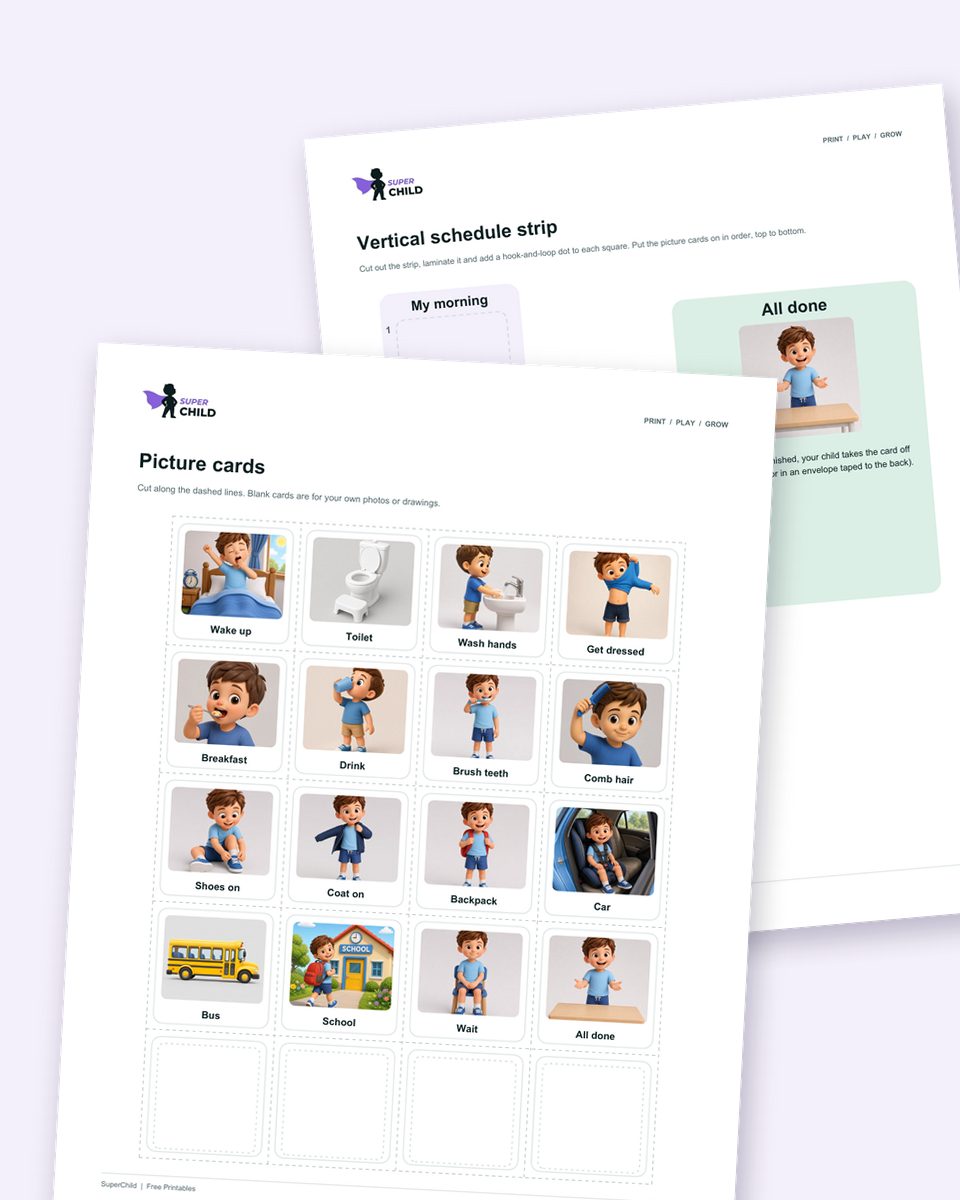
Free download1 PDF · 25 pages
Get the free visual schedule printable
Morning and bedtime routines plus picture cards for the whole day, with strips, a parent guide and a log.
Sources
- Cooper, Heron & Heward: Applied Behavior Analysis, 3rd edition (Pearson, 2020), chapter on chaining
- Slocum & Tiger: An assessment of the efficiency of and child preference for forward and backward chaining (Journal of Applied Behavior Analysis, 2011)
- Behavior Analyst Certification Board: Registered Behavior Technician (RBT)
Cite this page
Citation (APA style)
SuperChild. (2026). Task analysis in ABA: worked examples, chaining and data. Retrieved from https://superchild.ai/blog/task-analysis-aba
Link for your website
<a href="https://superchild.ai/blog/task-analysis-aba">Task analysis in ABA: worked examples, chaining and data</a> (SuperChild)