Free task analysis maker

Task analysis maker: ready routines, chaining and a data sheet

Start from one of eight daily routines or type your own steps, choose forward, backward or total task chaining, and see which step to teach first. The step list and a task analysis data sheet print together, ready for tomorrow’s session. For BCBAs, RBTs, teachers and the parents they coach.

  • Runs in your browser
  • Free, no account
  • Print-ready PDF after a short form
Start from a routine

Set out first: Toothbrush, toothpaste with an easy flip cap, a cup, a step stool if the sink is high.

Skill and steps

One observable step per line, in order, up to 40. Edit any routine to fit the learner and the bathroom, kitchen or classroom you use.

Chaining
Teach the steps by

Backward chaining: complete the early steps with the learner and teach the last step first, then work backward.

Why this method for brushing teeth: Fourteen steps is long for a young learner. Backward chaining lets the child finish the routine every time, and putting the brush away is a natural end point.

Data sheet

Use initials or a code, not a full name.

Paper

Task analysis: Brushing teeth

14 steps, backward chaining, 3 pages

Steps

  1. 1Pick up toothbrush
  2. 2Turn on cold water
  3. 3Wet toothbrush
  4. 4Turn off water
  5. 5Open toothpaste
  6. 6Squeeze pea-sized toothpaste onto brush
  7. 7Put cap back on toothpaste
  8. 8Brush top teeth, left side (count to 10)
  9. 9Brush top teeth, right side (count to 10)
  10. 10Brush bottom teeth, left side (count to 10)
  11. 11Brush bottom teeth, right side (count to 10)
  12. 12Brush front teeth (count to 10)
  13. 13Spit into sink
  14. 14Rinse toothbrush and put it in the cuptaught first

Teaching order

  • Phase 1: Teach step 14. You complete steps 1 to 13 with them.
  • Phase 2: Teach step 13. You complete steps 1 to 12 with them. Learner does step 14 on their own.
  • Phase 3: Teach step 12. You complete steps 1 to 11 with them. Learner does steps 13 to 14 on their own.
  • Phase 4: Teach step 11. You complete steps 1 to 10 with them. Learner does steps 12 to 14 on their own.
  • … one step per phase, 14 phases in all.

The link keeps the skill, steps and chaining method. Learner and month are left out.

Print preview: step list, then the data sheet

Task analysis: Brushing teethBackward chainingInstruction (SD)"Time to brush your teeth"Mastery criterion100% of steps independent across 3 consecutive sessionsSteps1.Pick up toothbrush2.Turn on cold water3.Wet toothbrush4.Turn off water5.Open toothpaste6.Squeeze pea-sized toothpaste onto brush7.Put cap back on toothpaste8.Brush top teeth, left side (count to 10)9.Brush top teeth, right side (count to 10)10.Brush bottom teeth, left side (count to 10)11.Brush bottom teeth, right side (count to 10)12.Brush front teeth (count to 10)13.Spit into sink14.Rinse toothbrush and put it in the cup (taught first)How to teach itBackward chaining: complete the early steps with the learner and teachthe last step first, then work backward.Move to the next phase when the target step meets the mastery criterion.Phase 1: Teach step 14. You complete steps 1 to 13 with them.Phase 2: Teach step 13. You complete steps 1 to 12 with them. Learner doesstep 14 on their own.Phase 3: Teach step 12. You complete steps 1 to 11 with them. Learner doessteps 13 to 14 on their own.… and so on, one step per phase, 14 phases in all.Prompt codes for the data sheetI = IndependentG = GesturalV = VerbalM = ModelPP = Partial physicalFP = Full physicalStart with the least help that still gets the step done, fade it as soon as thelearner succeeds, and praise or reinforce at the end of the chain, not afterevery step.Free task analysis maker · superchild.ai/free-tools/task-analysis-makerPage 1 of 3Task Analysis Data SheetBackward chaining, prompt level per stepLearner:Observer:Month of:Skill:Brushing teethSD / instruction:"Time to brush your teeth"Mastery criterion:100% of steps independent across 3 co...Backward chaining: complete the early steps with the learner and teach the last step first, then work backward.#Step12345678910Date1Pick up toothbrush2Turn on cold water3Wet toothbrush4Turn off water5Open toothpaste6Squeeze pea-sized toothpaste onto brush7Put cap back on toothpaste8Brush top teeth, left side (count to 10)9Brush top teeth, right side (count to 10)10Brush bottom teeth, left side (count to 10)11Brush bottom teeth, right side (count to 10)12Brush front teeth (count to 10)13Spit into sink14Rinse toothbrush and put it in the cupFree task analysis maker · superchild.ai/free-tools/task-analysis-makerPage 2 of 3Task Analysis Data Sheetcontinued#Step12345678910DateSteps independent% independentPrompt codes:I= IndependentG= GesturalV= VerbalM= ModelPP= Partial physicalFP= Full physical% independent = steps scored I / total steps x 100.Free task analysis maker · superchild.ai/free-tools/task-analysis-makerPage 3 of 3
Embed this tool on your siteFree for clinic sites, school pages, blogs and course pages. Paste one snippet; it stays up to date.

HTML embed code

<iframe src="https://superchild.ai/embed/task-analysis-maker" title="Task analysis maker by SuperChild" width="100%" height="1300" style="border:0" loading="lazy"></iframe><p style="font-size:13px">Free <a href="https://superchild.ai/free-tools/task-analysis-maker">Task analysis maker</a> by SuperChild</p>

Works in WordPress (Custom HTML block), Squarespace (Code block), Wix (Embed code) and most site builders. The tool runs in your visitors’ browsers, with no account needed. Please keep the credit line under the frame.

How to make a task analysis

A task analysis lists the steps of one routine in the order a competent person does them, each small enough to teach and score on its own. Build it here in five steps.

  1. Pick the routine closest to what you want to teach, such as brushing teeth or washing hands, or choose Write your own.
  2. Edit the steps so they match the learner and the place: the sink they use, the soap they have, the order your family or classroom follows. Keep one observable action per line.
  3. Choose the chaining method. The maker suggests one for each routine and shows which step is taught first and what you do with the rest.
  4. Add the learner’s initials, the month and the number of sessions for the data sheet, and set the mastery criterion.
  5. Download or print the PDF: the step list with the teaching order on page 1, the task analysis data sheet with prompt codes after it.

What is a task analysis in ABA?

A task analysis breaks a routine such as handwashing into small, observable steps in order, so each step can be taught, prompted and measured on its own. The steps are then taught as a chain: each finished step is the cue for the next one, and the whole routine ends in something worth doing it for.

For the full explanation with worked examples of every routine in this maker, read task analysis in ABA. The ABA basics behind it are in the ABA therapy guide.

Forward, backward or total task chaining?

All three methods use the same task analysis. They differ in which step you teach first and who does the other steps meanwhile.

  • Backward chaining: you help through every step except the last, and teach the last step first. The learner finishes the routine every time, so it suits long routines with a clear end, like brushing teeth, putting on a T-shirt or putting on shoes.
  • Forward chaining: you teach step 1 first and help with the rest, then add step 2 once step 1 is mastered. It suits routines whose early steps are useful on their own, like getting things out for a snack.
  • Total task chaining: the learner does every step every session, with prompts only where needed. It suits short routines the learner practises many times a day, such as washing hands, toileting and packing a backpack, and learners who can already do some steps.
  • Whichever you choose, prompt the least that still gets the step done and fade it quickly. The prompt codes on the data sheet (I, G, V, M, PP, FP) make the fading visible.

How to write good steps

The quality of a task analysis is in the size of the steps. Too big and the learner gets stuck between them; too small and the chain gets long and slow to teach.

  • Watch a competent person do the task, or do it yourself, and write down every action. Then compare with how the learner’s family or classroom does it.
  • Start each step with a verb you can see: turn, pick up, push, pull. “Brush teeth well” is not a step; “brush bottom teeth, left side (count to 10)” is.
  • Split a step the learner keeps missing into two, and merge steps they always do together.
  • Put the materials in the same place every time while teaching. A visual schedule of the steps on the wall helps many learners fade off adult prompts.

How to take task analysis data

Score every step every session with the level of help the learner needed: I for independent, then the prompt used (gestural, verbal, model, partial physical, full physical). Divide the steps scored I by the total steps for the percentage independent, and graph it per session.

The maker prints the same task analysis data sheet as the ABA data sheet generator, with up to 15 session columns. Plot the percentages with the ABA graph maker to see whether the chain is moving or one step is stuck.

A common mastery criterion is 100% of steps independent across three consecutive sessions. After mastery, check the routine at another sink, with another adult and again two to four weeks later.
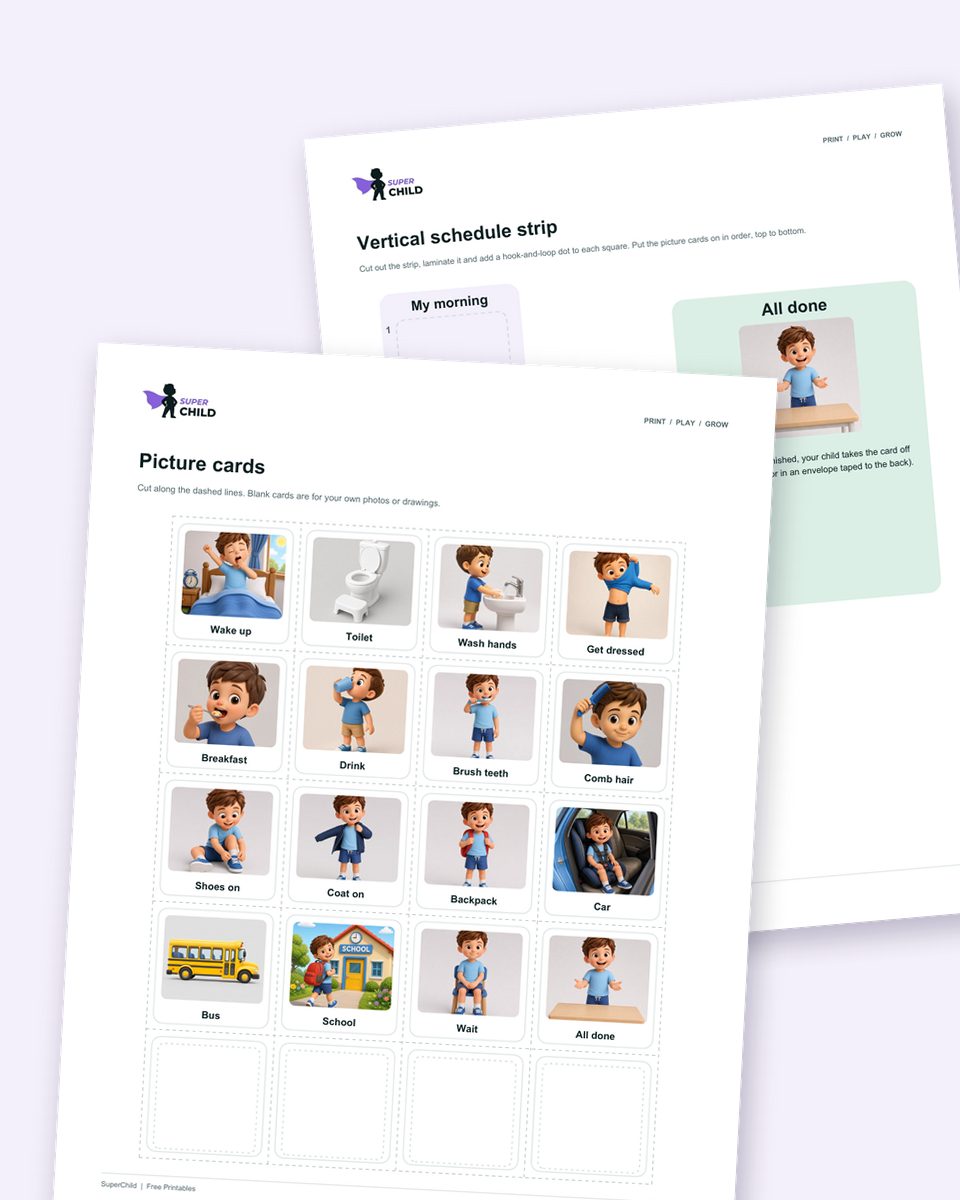
A morning routine visual schedule strip next to picture cards for wake up, toilet and get dressed

Free download1 PDF · 25 pages

Get the free visual schedule printable

Morning and bedtime routines plus picture cards for the whole day, with strips, a parent guide and a log.

Cite this page

Citation (APA style)

SuperChild. (2026). Task analysis maker: ready routines, chaining and a data sheet. Retrieved from https://superchild.ai/free-tools/task-analysis-maker

Link for your website

<a href="https://superchild.ai/free-tools/task-analysis-maker">Task analysis maker: ready routines, chaining and a data sheet</a> (SuperChild)

FAQ

Questions about the task analysis maker

What is a task analysis example?
Handwashing in 11 steps: turn on water, put hands under the water, push soap pump once, rub palms together, rub backs of hands, rub between fingers, rinse, turn off water, take a towel, dry hands, hang the towel back. The maker has this and seven more routines ready to edit.
Which chaining method should I use?
Backward chaining for long routines with a satisfying end, forward chaining when the first steps are useful on their own, and total task chaining for short routines the learner practises many times a day or already partly knows. The BCBA makes the final call for each learner.
How many steps should a task analysis have?
As many as the learner needs, usually between 6 and 15 for a young child’s daily routine. Split a step the learner keeps missing, and merge steps they always do together.
Can parents use this task analysis maker?
Yes. Pick the routine, change the steps to match how your family does it, and print the step list. If your child has a BCBA or therapist, ask them which chaining method and prompts to use so home and therapy match.
Is the task analysis maker free?
Yes. Building the task analysis and seeing the steps, the teaching order and the data sheet on screen is free with no account. The print-ready PDF asks for your first name, email and role once.

Keep exploring

For BCBAs and clinic teams

Practice that records its own trial-by-trial data.

SuperChild turns your VB-MAPP, ABLLS-R and custom targets into short tablet practice for the children you support. Every trial is saved for you, and you decide what happens next.