


On this page
Can I teach my nonverbal child to talk?
Not directly. Speech can’t be pulled out of a child, and pushing “say it” often makes a child go quiet. What you can teach is the word itself: what it means, how to ask for it without speaking, and how it sounds. That is worth having whenever speech comes.
Parents make a real difference here. In a review of 18 studies, children’s understanding and use of language both improved when parents were taught to use language strategies at home.
Whether speech will come is a different question. Our article on nonverbal autism goes through what the research says.


Which first words should I choose?
Choose about ten words your child already cares about and meets every day: two or three favorite foods or drinks, a favorite toy, shoes, bath, a person or pet, and the small words “more,” “all done” and “help.” Leave colors, shapes, letters and numbers for later.
A good first word passes three checks.
Write your ten on the fridge and keep them for two or three weeks. Everyone uses the same word for the same thing: “cup” stays “cup,” not “your drink.”
- Your child wants it
- Crackers, bubbles, the toy car, going outside. A child works hardest for a word that gets them something.
- You can touch it or do it
- Cup, shoe, ball, bath, up, open. Your child can see what the word points at.
- It comes up every day
- A word that appears at every snack gets practiced without anyone planning it.


Should my child understand a word before saying it?
Usually, yes. Children tend to understand a word before they use it, and a child can show understanding without speaking: by looking, pointing, giving or tapping a picture. Teach and check understanding first, and count it as real progress.
Put a cup and a shoe on the table. Say “cup.” Keep your hands in your lap and don’t look at the cup. If your child reaches for it, that word has gone in.
If your child reaches for the wrong one, slide the cup a little closer and say “cup” again. No “no,” no sigh. Start with two things and go to three when two is easy.
Understanding a word, asking for the thing and saying the word are separate skills. One doesn’t automatically bring the next. Our article on receptive vs expressive language explains why.
How do I say a word so it sticks?
Say one clear word at the moment your child is looking at the thing. Show it at the same time with the object, a gesture, a picture or the button on an AAC device. Then wait about five seconds without talking. Whatever your child does next, a look, a reach, a sound, counts as their turn.
“Do you want to put your shoes on so we can go to the park?” is fifteen words. Your child has to find the one that matters. “Shoes” is one.
Showing the word while you say it is called modelling. A review of 28 studies found it helped people who use AAC understand more and express more.
Parents often worry that pictures will replace speech. In a review of the research, speech went down in none of the children, and most said a little more. Our AAC for autism guide covers cards, boards and devices, and the PECS book printable is a way to start.

What activities work, routine by routine?
The best activities for a nonverbal autistic child are the routines you already have. Snack, bath, shoes, play and a picture book each come with two or three words built in. Start with one routine and add the others over a few weeks.
- 1Snack: cracker, apple, moreHold up two things: “cracker” in one hand, “apple” in the other. A reach is an answer. Hand it over and say the word again. Empty plate: “all done.”
- 2Bath: water, duck, towelSay “water” as you turn the tap, every time. Hold the duck by your face, say “duck,” and wait before you let it swim.
- 3Shoes: shoes, on, outSay “shoes” by the door and see if your child looks or walks toward them. “On” as each foot goes in. “Out” as the door opens.
- 4Play: car, go, upHold the car at the top of the ramp, say “ready, set…” and pause. A look, a wiggle or a sound gets “go!”
- 5Picture book: dog, ball, bedChoose a book with one clear picture per page. Point and name: “dog.” After a few days, ask “where’s the dog?” and wait.


Why does my child know the card but not the real thing?
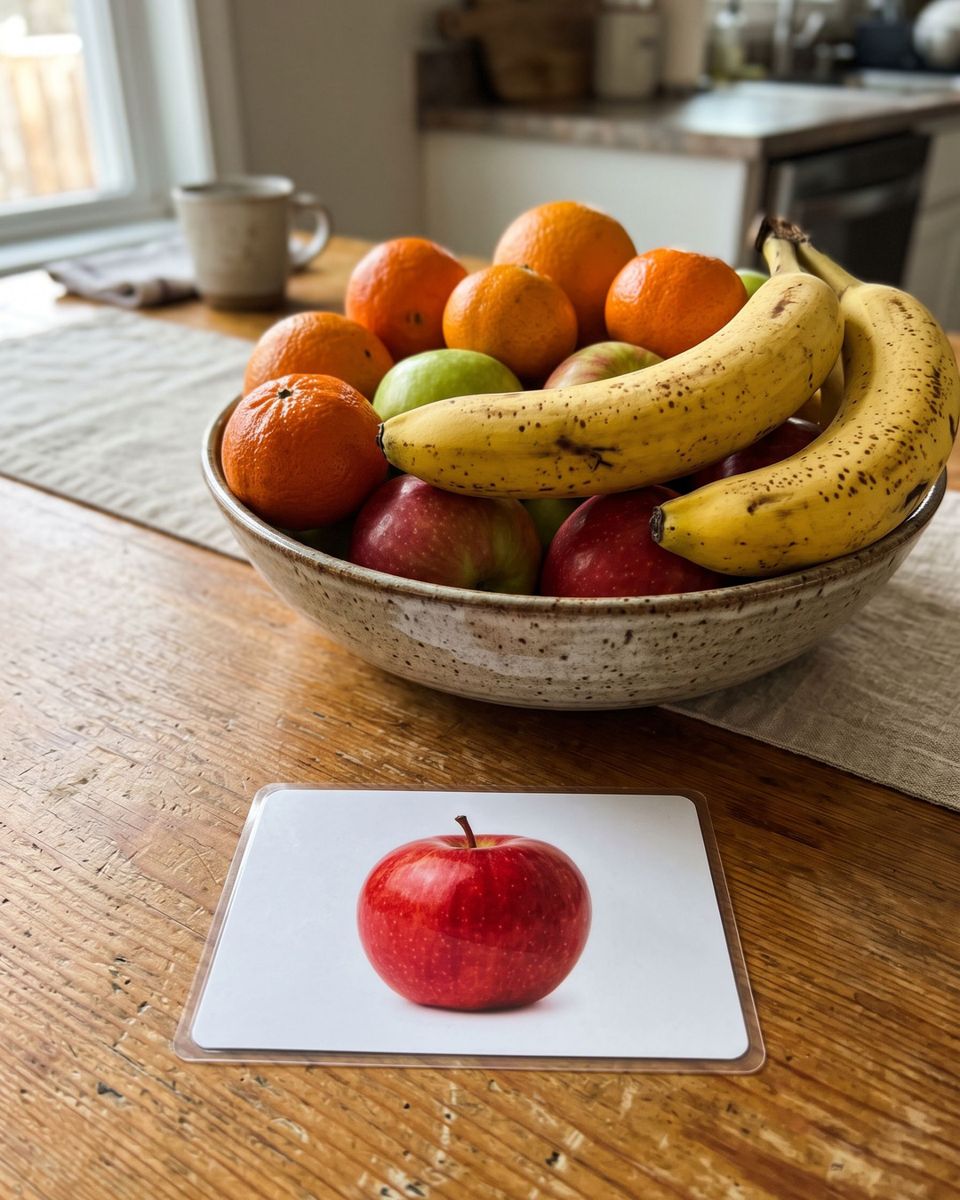
Because your child may have learned that one picture, in that one spot. Many autistic children need help carrying a word over to other examples. Use the word on the real object, in different rooms, with different people, and on things that look a bit different.
A child finds “apple” on the card every time, then walks past the apples in the fruit bowl. Parents tell us this often.
So take the word around the house. The red apple on the card, the green one in the bowl, a slice on the plate. Each time, the same word. Let other people say it too.
How long should we practice each day?
A few minutes at a time, several times a day, inside routines that happen anyway. Stop while your child is still calm.
If your child turns away or pushes the cards off the table, stop and try a smaller step later.
Running a home program by hand wears parents out. You’re allowed to keep it small: ten words, five routines, no data sheet.
A speech-language pathologist can tell you which words and which kind of help fit your child, and can set up AAC properly. See our article on autism speech therapy and the early intervention guide.
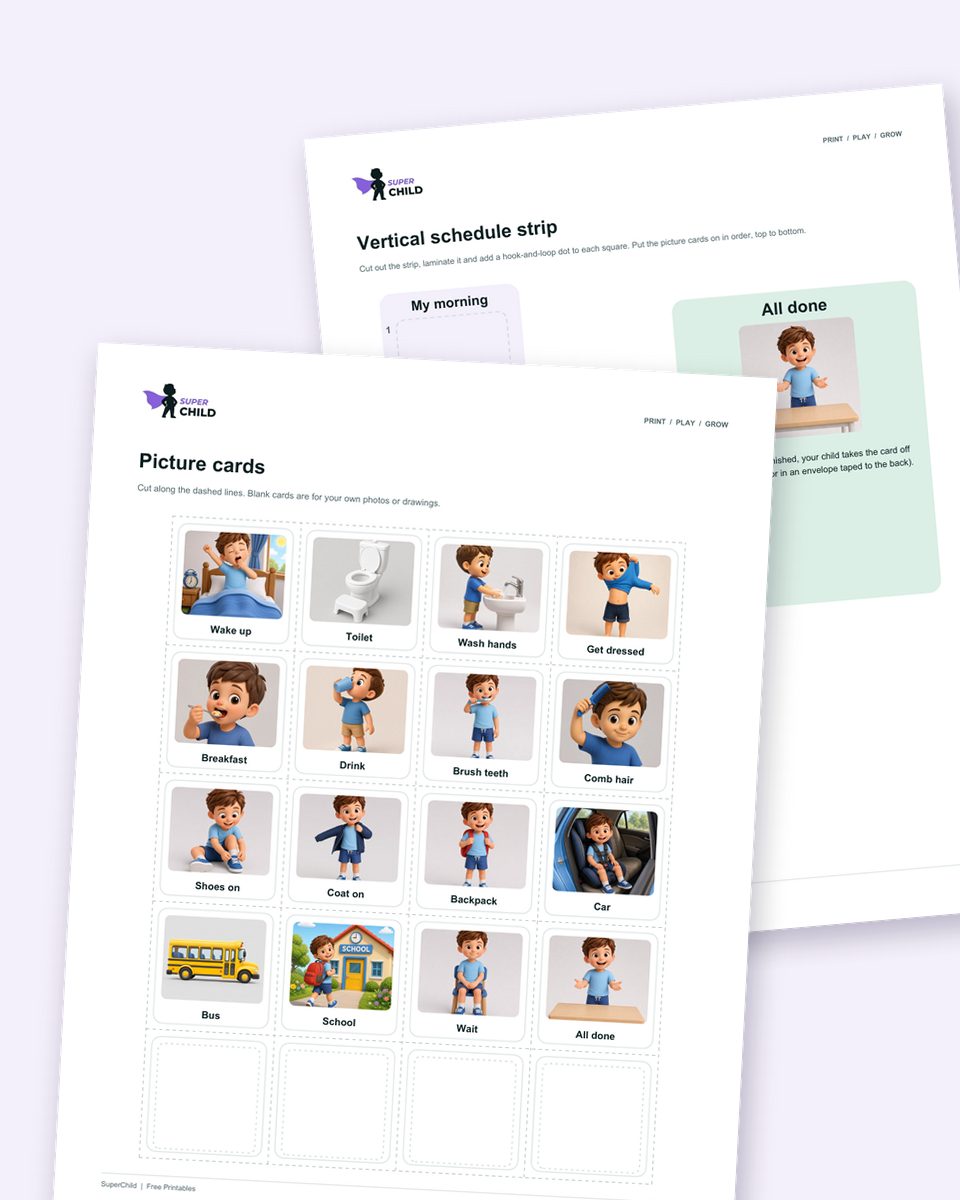
Free download1 PDF · 25 pages
Get the free visual schedule printable
Morning and bedtime routines plus picture cards for the whole day, with strips, a parent guide and a log.
Sources
- Roberts and Kaiser (2011). The effectiveness of parent-implemented language interventions: a meta-analysis. Am J Speech Lang Pathol
- O’Neill, Light and Pope (2018). Effects of interventions that include aided AAC input on the communication of individuals with complex communication needs: a meta-analysis. JSLHR
- Millar, Light and Schlosser (2006). The impact of AAC intervention on the speech production of individuals with developmental disabilities: a research review. JSLHR
- NIDCD: Speech and Language Developmental Milestones
- ASHA Practice Portal: Augmentative and Alternative Communication
Cite this page
Citation (APA style)
SuperChild. (2026). How to teach a nonverbal child first words at home, one routine at a time. Retrieved from https://superchild.ai/blog/teach-nonverbal-child-words-at-home
Link for your website
<a href="https://superchild.ai/blog/teach-nonverbal-child-words-at-home">How to teach a nonverbal child first words at home, one routine at a time</a> (SuperChild)