What is an intraverbal?
An intraverbal is a verbal response controlled by another person’s words, where the answer does not repeat those words and no matching object is in view. Saying “meow” when asked “What does a cat say?” is an intraverbal.
The term comes from Skinner’s Verbal Behavior. What sets an intraverbal apart from the other operants is its trigger. A tact answers something the child sees, a mand is driven by something the child wants, and an echoic copies the words exactly. An intraverbal answers words with different words, which is why it carries most of everyday conversation.
Intraverbals usually come after a child has a solid set of mands, tacts and listener skills. A child who cannot yet name a cow when looking at one will struggle to answer “What says moo?” with nothing in front of them. That is why the domain starts at Level 2 and leans on vocabulary the child already uses in other ways. For the basics of verbal operants and how fill-ins fit in an ABA program, see our ABA therapy guide.
Teams often underestimate how much intraverbal skill a typical school day asks for. Circle time, story questions, “What did you do this weekend?” and simple social chat all rely on it, so this domain is a strong predictor of how well a child copes in a classroom.
- Counts as intraverbal
Mom sings “Twinkle, twinkle, little…” and pauses
The child says “star”
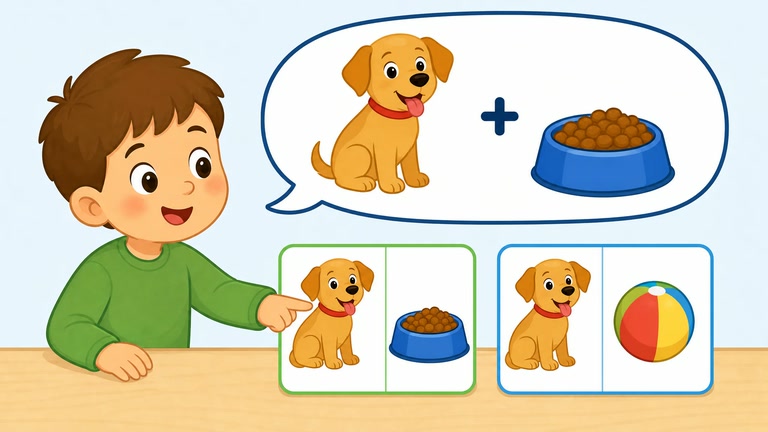
The child completed a familiar phrase from words alone. Song and phrase fill-ins are usually the first intraverbals a child learns.
- Not intraverbal
The teacher holds up a picture of a star and asks “What is it?”
The child says “star”
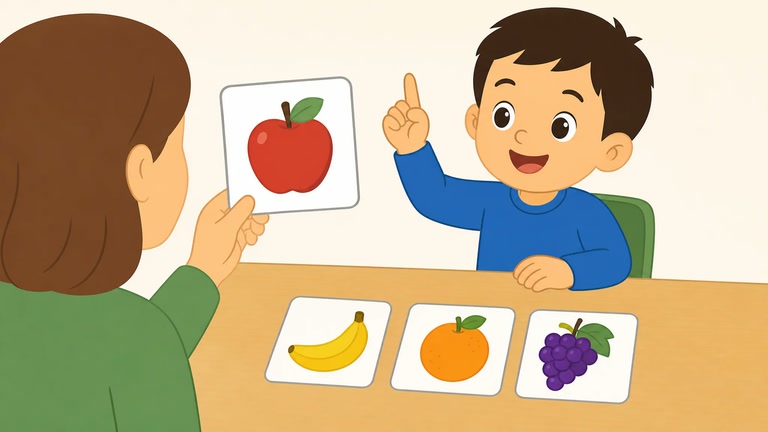
The picture controls the answer, so this is a tact. Take the picture away to test the intraverbal.
- Counts as intraverbal
Grandpa asks “What’s your name?” at the park
The child answers with their first name
Answering a personal question from words alone, with someone new, is a functional intraverbal.
- Not intraverbal
The therapist asks “What do you drink?” and the child repeats “drink”
The child echoes the last word of the question
Repeating part of the question is an echoic, and often a sign the question is too hard for now.
- Counts as intraverbal
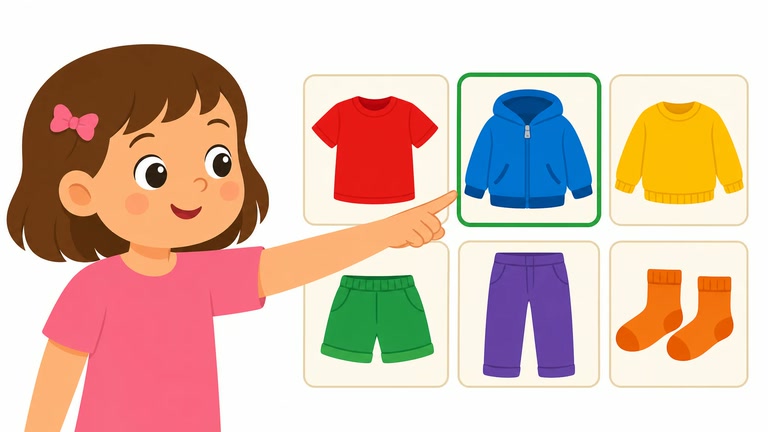
During car rides Dad asks “What do you wear on your feet?”
The child says “shoes” and adds “and socks”
A correct answer to a question about an item that is out of sight, with an extra related word, shows a flexible intraverbal.
- Not intraverbal
The child has learned “What’s your name?” only as one chained routine
The child gives their name to “How old are you?” too
The child is running a memorized routine and has stopped listening to the question. Mix questions and check that each one gets its own answer.
Intraverbal milestones, goals and activities by level
Each milestone area below is our own summary of a group of VB-MAPP milestones, with measurable practice goals, everyday activities and the sign that a learner is ready for the next step. Score the official protocol first; then use the area that matches.
Level 2 · 18–30 months
At Level 2 the child fills in songs, animal sounds and familiar phrases, then answers a few simple questions about themselves, such as their name and age. Most answers here are single words.
Milestones 6–8
Filling in songs, sounds and fun phrases
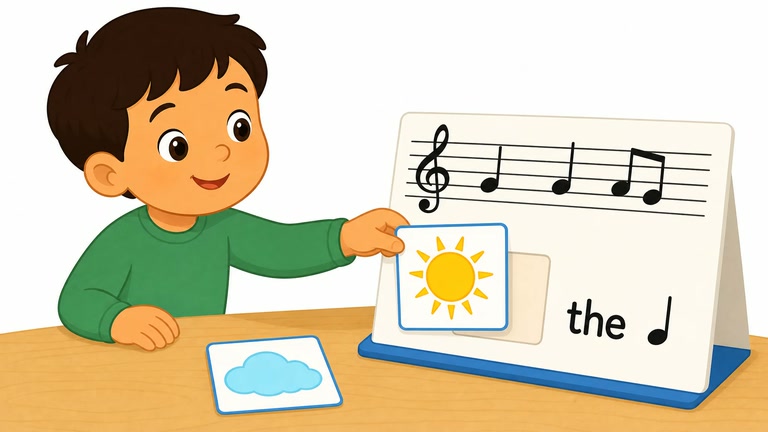
The child finishes lines of songs, animal sounds and familiar phrases (“ready, set…”) without a picture or object to help.
Practice goals
- Fills in the missing word in 10 familiar songs or rhymes on 80% of trials.
- Says or signs the sound for 8 animals when asked, without a picture, on 4 of 5 trials.
- Completes 10 everyday phrases (“shoes and…”, “ready, set…”) on 80% of trials.
Everyday activities
- Sing “Twinkle Twinkle Little…” and pause for the child to finish the line.
- Play “ready, set…” before rolling a ball, waiting for “go.”
- Use the tablet’s song and phrase fill-in trainings, then practice the same fill-ins vocally with the team.
Ready to move on: Ready when the child fills in new phrases and songs without pictures, with different people.
SuperChild trainings: Song and Phrase Fill-Ins: Picture Completion · Common Fill-Ins: Everyday Phrase Pairs · Common Fill-Ins: Clothing and Body Pairs
Open in the goal mapperMilestones 9–10
Answering simple questions about themselves
The child answers simple what and who questions, including their own name and everyday facts, without visual help.
Practice goals
- Answers “what’s your name?” and 4 other personal questions on 80% of trials with 2 adults.
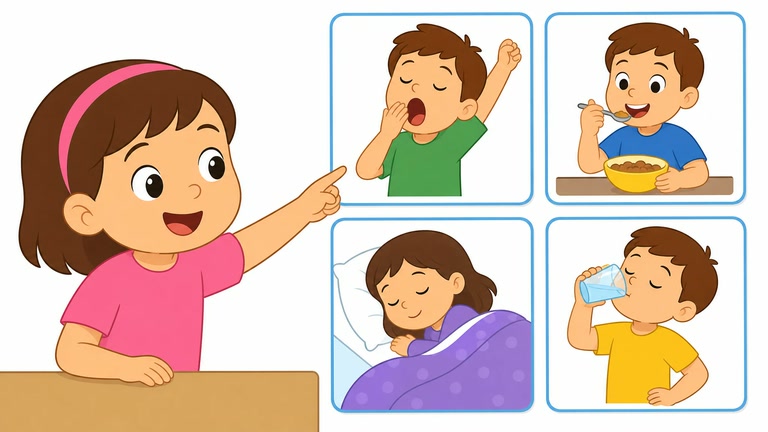
- Answers 15 simple what questions (“what do you sleep in?”) without a picture on 4 of 5 trials.
- Responds to at least 25 different fill-in or question targets across a cumulative list.
Everyday activities
- During circle time, ask each child “what’s your name?” and “how old are you?”
- In the car, play a question game: “what do you eat with?”, “what says moo?”
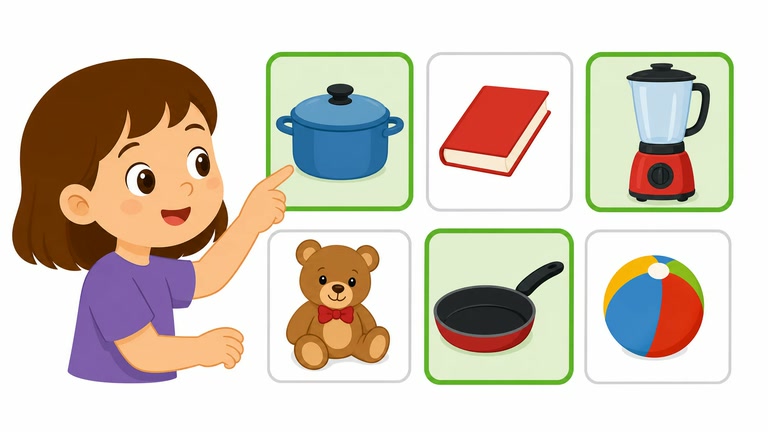
- Use the tablet’s home-and-kitchen fill-in training, then ask the same questions vocally at dinner.
Ready to move on: Look for answers given with new people and in natural moments, not only during teaching.
SuperChild trainings: Common Fill-Ins: Home and Kitchen Pairs
Open in the goal mapper
Level 3 · 30–48 months
At Level 3 the child answers what, where and who questions, names several members of a category when asked, and starts on why and how questions. Short back-and-forth exchanges on one topic become the target.
Milestones 11–13
Answering wh-questions and naming members of a group
The child answers what, where and who questions on many topics and can name several things that belong to a group (“tell me some animals”).
Practice goals
- Answers 25 different what, where and who questions without visual help on 80% of trials.
- Names 3 members of 5 different categories when asked on 4 of 5 trials.
- Gives 2 different answers to the same question (“what can you eat?”) on 80% of trials.
Everyday activities
- Play a category game in the car: take turns naming animals until someone runs out.
- At dinner, ask “where do you sleep?” and “who drives the bus?”
- Use the tablet’s two-part answer training, then practice vocal answers in conversation with the team.
Ready to move on: Ready when answers come quickly with varied wording and new questions.
SuperChild trainings: Two-Part Answers: Fruit, Actions, and Household
Open in the goal mapperMilestones 14–15
Why and how questions and short conversations
The child answers why and how questions, describes past events and keeps a short conversation going.
Practice goals
- Answers 10 why and how questions (“why do we wear coats?”) on 4 of 5 trials.
- Tells an adult 2 things about an event from earlier that day on 3 occasions.
- Keeps a 4-turn conversation going on a familiar topic on 80% of opportunities.
Everyday activities
- At pick-up, ask “what did you play today?” and follow up with “and then what?”
- During a picture-book read, ask “why is the boy sad?” and “how did they fix it?”
- Use the tablet’s why/how and conversational-question trainings, then hold short chats during snack with the team.
Ready to move on: Look for back-and-forth conversations with peers and family members.
SuperChild trainings: Causal Why and How Questions: Nature and Places · Conversational Questions: Everyday Exchanges
Open in the goal mapper
Intraverbal training in ABA, step by step
This procedure covers the early part of intraverbal teaching, from fill-ins to first questions. Studies comparing prompts suggest testing more than one prompt type with each child.
- 1Check the child already tacts and finds the targetBefore asking “What do you sleep in?” make sure the child can name a bed and find it when asked. Intraverbals go faster when the words already exist in the child’s other repertoires.
- 2Start with fill-ins the child enjoysPick songs, games and phrases the child loves (“Ready, set…,” “Old MacDonald had a…”). Pause at the last word and wait a few seconds before helping.
- 3Prompt with an echoic or a picture, then transferGive the answer for the child to repeat, or show a picture they can name. Then ask the same question again without help so the answer moves under the control of the words alone.
- 4Fade the prompt in small stepsUse a time delay, or give only the first sound of the answer, then less. Reinforce answers without help more strongly than prompted ones.
- 5Vary the question and mix targetsAsk “What says moo?” and “A cow says…” and “What sound does a cow make?” Interleave questions so the child listens to each one, which prevents memorized chains.
- 6Use them in real talkMove practiced questions into snack, car rides and play with different adults. A target is mastered when the child answers a new person in a new setting.
Common mistakes, and what to do instead
- Starting with open questions too early
- “What did you do at school?” is a hard intraverbal. Build from fill-ins to simple personal facts to category questions before tackling recall.
- Teaching rote scripts
- If every question is asked in the same order and wording, the child learns the sequence. Mix the order and the phrasing from the first week.
- Leaving the picture prompt in place
- A child who answers only when the picture is on the table is still tacting. Plan when and how the picture will disappear.
- Ignoring echoic answers
- If the child repeats the question back, the target is probably too hard or the prompt came too late. Drop back a step instead of drilling the same question.
How to measure intraverbal progress
Score each question on a cold probe at the start of the session as correct without help, prompted or incorrect, and track how many different questions the child answers each week. The trial sheet in our ABA data sheets works for both.
How it connects to the other domains
- Tact
Most early intraverbals use words the child can already name, so a big tact vocabulary feeds this domain.
- Echoic
An echoic prompt is the most common way to give the child an answer they can then say on their own.
- LRFFC (listener by function, feature & class)
Finding “the one you drink from” is the listener version of answering “What do you drink from?”, and many teams teach the two together.
- Social behavior & social play
Answering and asking questions with peers depends on a working intraverbal repertoire.
Printables and tools to practise with
- Free printableWh-questions for autismPrintable what, where and who question cards with picture supports you can fade.
- Free printableFeature, function and class activitiesCategory and function cards that help bridge listener work into intraverbal answers.
- Free printableYes/no questionsSimple question cards for early conversational answers.
- GuideABA therapy guideHow the verbal operants, fill-ins and other teaching formats fit into an ABA program.
Independent guide by SuperChild, not affiliated with the publisher or authors. Use the official protocol to administer and score.
Written from the publishers’ own materials and published research. Spotted an error? Email contact@superchild.ai and we’ll fix it.