
Autism experience · Communication and AAC
Words I Can’t Reach: what a choice board changes for a child who doesn’t speak
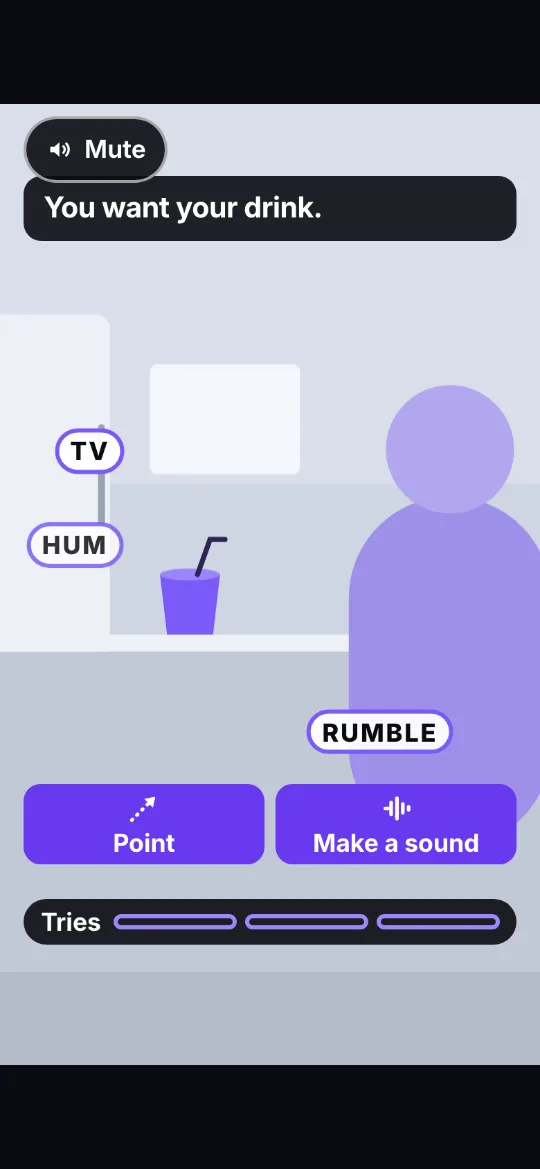
A choice board is a set of pictures a child can point to or tap to say what they want. In this 40-second game you are a young child who knows exactly what you want but has no words for it. You can point or make a sound, and every guess the adult makes is wrong. Then the same moment again, with a picture board.
40 seconds, on a phone or a computer
Communication and AAC · 40 seconds
Words I Can’t Reach
- A TV, a washing machine and a hum play at once, and build as you try. The Mute button stays at the top of the game.
- The screen changes slowly. Nothing flashes more than three times a second.
This is one child’s experience, not every autistic person’s.
Read instead of play
What happens in the game
- 1You are a young child and you want your drink. It is up on the counter, out of reach. The TV and the washing machine are on.
- 2You can point or make a sound, and that is all.
- 3The adult guesses kindly, and wrong: “Your shoes?” “The ball?” “Are you tired?” Then: “You know exactly what you want. You have no way to say it yet.”
- 4Then the same moment with a picture board: Drink, Ball, Bed. One tap on Drink. “Drink! Here you go.”
One tap, understood.
Why a child who says few words gets frustrated
Some young autistic children say few or no words. Clinicians call this minimally verbal. It describes speech today, not how much a child understands or how much they have to say.
Without a way to say “drink”, a child has to rely on adults guessing. When the guess is wrong again and again, frustration builds, and it can come out as crying, pulling or hitting. Much of that is communication with no other route.
A point or a sound can mean many things, and a busy, noisy room makes it harder still for an adult to read. A picture of the drink means one thing only.
What helps
What helps a child communicate without speech
AAC, augmentative and alternative communication, means any way to communicate besides speech: pictures, signs, gestures, a choice board or a device that speaks. Speech-language pathologists (speech and language therapists in the UK) recommend starting early; research has not found that AAC stops a child from learning to talk.
Start with a choice board
Two or three pictures of real things the child wants right now: drink, ball, bed. Hold it up, wait, and give what they tap. Make the pictures with our picture card maker.
Grow it into a core word board
Words such as more, stop, help and go work everywhere. Our core word board maker prints a low-tech AAC board.
Use the board yourself
Point to the pictures as you talk. Children learn a way to communicate by seeing it used, without being made to answer.
Fewer, shorter words
Turn off the TV, get down to the child’s level and say one or two key words: “Drink? Ball?”
Ask for an AAC assessment
A speech-language pathologist can find the right system for your child. Our AAC guide explains the options.
For parents
Worried, or just starting out?
You don’t need every answer to start. Our guide walks you through the first steps, from the first conversation with your doctor to small things you can do at home.
For professionals
Using this with families or a team?
Share a game with a family, a new colleague or a classroom team before you talk about sensory needs, AAC or visual supports. SuperChild gives young children short, playful practice every day, while you stay in charge.
FAQ
Questions about communication and aac
What is a choice board?
A choice board is a card or board with two or more pictures of things a child can choose from, such as drinks, snacks, toys or activities. The child points to or hands over a picture to say what they want. It is one of the simplest forms of AAC and works for children who don’t speak as well as for children who talk but find choosing hard.
What is AAC?
AAC stands for augmentative and alternative communication: every way to communicate besides speech. That includes gestures, signs, picture cards and choice boards, a core word board and tablets or devices that speak. Our AAC guide compares the options.
Will a choice board or AAC stop my child from talking?
Research has not found that it does, and speech-language pathologists recommend starting AAC early, with no skills a child must have first. Some studies found that children’s speech grew after they started using AAC, and AAC is worth it either way. Read more about nonverbal autism and what the research says about talking later.
What does minimally verbal mean?
Minimally verbal describes a child who uses few or no spoken words. It is not a type of autism or a forecast. Some children who say little at 3 or 4 talk more later; others keep using pictures, signs or a device, which is a full way to communicate.
Sources
- Hume K. et al. (2021). Evidence-Based Practices for Children, Youth, and Young Adults with Autism: Third Generation Review. Journal of Autism and Developmental Disorders.
- ASHA Practice Portal: Augmentative and Alternative Communication.
- National Autistic Society: Sensory differences.
- NICE guideline CG170: Autism spectrum disorder in under 19s, support and management.
Keep exploring
- HubAutism experience gamesThree 40-second games: one moment in a young autistic child’s day, and what helps.
- GuideAAC for autismWhat an AAC device is, low-tech to high-tech options with typical costs, how to get one funded, how to start at home and how PECS differs from other AAC.
- Free toolPECS-style picture card makerPicture exchange cards from food, drinks, toys, people and your own photos, in 1.5 to 3 inch sizes with cut lines, plus "I want" sentence strips.
- Free toolCore word board makerA printable core word board, the simplest low-tech AAC device: 12 to 48 core words with pictures in Modified Fitzgerald Key colors, an optional fringe row, every word in a fixed place.
- ArticleNonverbal autismWhat nonverbal autism means, how to check what your child understands, what the research says about talking later, and what to do at home.
- Free printablePicture exchange bookA free printable PECS-style book: 48 picture exchange cards, “I want” sentence strips, a cover and a request log, with a short guide for parents and SLPs.
- GuideSpeech delaySpeech delay or late talker?
Small steps, big progress
Daily practice for young children, with the professional in charge.
SuperChild gives young children short, playful practice every day, guided by an AI coach while their therapist, teacher or parent stays in charge.