
Autism experience · Routines and change
The Day Changed: why a change in routine is so hard for a young autistic child
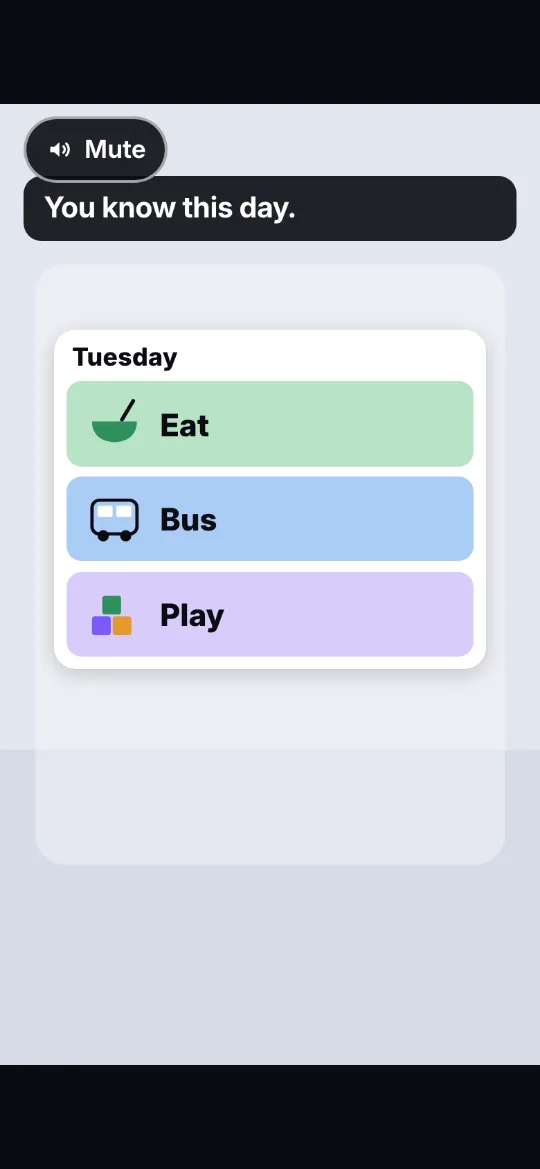
Many autistic children rely on routine: knowing what comes next makes the day safe to step into. In this 40-second game you learn a simple day of picture cards (eat, bus, play), and then, without warning, the bus is different and play is gone. Then the same day again, with a first-then board and a warning.
40 seconds, on a phone or a computer
Routines and change · 40 seconds
The Day Changed
- An engine and other sounds grow after the change, then calm down. The Mute button stays at the top of the game.
- The cards and colors change slowly. Nothing flashes more than three times a second.
This is one child’s experience, not every autistic person’s.
Read instead of play
What happens in the game
- 1Three picture cards show the day: Eat, Bus, Play. You go through it once, and it feels good: “You know this day.”
- 2On Tuesday, after Eat, the bus is a different color and the Play card is gone. “The bus is different. The Play card is gone. Nobody said.”
- 3For ten seconds the sounds build and nothing you tap answers.
- 4Then the same day, the same change, but this time you are told: “Today: a different bus.” A first-then board says “First: new bus. Then: play,” three dots count down, and the bus changes.
The game ends: “A first-then board, and being told in advance, make a changed day manageable.”
Why routine matters so much
For many autistic children, the world is easier to handle when it is predictable. A known order of events means less to process and less to worry about, so there is more room to play and learn.
A sudden change takes that away. A child who cannot yet ask “why is the bus different?” or “when is play?” has no way to find out what is happening. The distress that follows is often less about the bus and more about losing the map of the day.
Change is part of life, and children can learn to handle it. Warning in advance, in a form the child understands, often helps.
What helps
What helps with changes in routine
Visual supports show a child what is happening and what comes next, in pictures they can look at again and again.
A first-then board
Two pictures: what happens first, and what comes after it. Putting something the child likes second helps the change feel safe. In the UK it is often called a now and next board. Make one with our first-then board maker.
A visual schedule for the day
The day’s steps as pictures, in order, so the child can see what is coming. Build one with the visual schedule maker.
Warn before the change
Show the change on the schedule before it happens: swap the card, point to it, say it in one or two words. A visual timer or a countdown helps too.
A story about the change
For bigger changes, a short social story about transitions can be read together a few days ahead.
Keep the rest the same
When one thing changes, keep everything else as usual. A favorite activity after the change gives the child something to look forward to.
For parents
Worried, or just starting out?
You don’t need every answer to start. Our guide walks you through the first steps, from the first conversation with your doctor to small things you can do at home.
For professionals
Using this with families or a team?
Share a game with a family, a new colleague or a classroom team before you talk about sensory needs, AAC or visual supports. SuperChild gives young children short, playful practice every day, while you stay in charge.
FAQ
Questions about routines and change
Why do autistic children find changes in routine so hard?
Predictability helps many autistic children make sense of a busy world. A sudden change removes the map of the day, and a child who can’t yet ask questions has no way to find out what happens next. The stress shows in their behavior, not in words.
How do I prepare an autistic child for a change in routine?
Tell them before it happens, in a form they understand: change the picture on their visual schedule, use a first-then board, count down. Keep the rest of the day the same and plan something they like straight after the change.
What is a now and next board?
A now and next board is the UK name for a first-then board: two pictures, what happens now and what comes next. It helps a child move from one activity to another. You can make one with our first-then board maker by changing the headings to Now and Next.
What are visual supports for autism?
Visual supports are pictures, objects or written words that show a child what is happening, what to do or what comes next. Visual schedules, first-then boards, choice boards and timers are all visual supports, and a large 2021 review of autism research lists visual supports as an evidence-based practice.
Sources
- Hume K. et al. (2021). Evidence-Based Practices for Children, Youth, and Young Adults with Autism: Third Generation Review. Journal of Autism and Developmental Disorders.
- ASHA Practice Portal: Augmentative and Alternative Communication.
- National Autistic Society: Sensory differences.
- NICE guideline CG170: Autism spectrum disorder in under 19s, support and management.
Keep exploring
- HubAutism experience gamesThree 40-second games: one moment in a young autistic child’s day, and what helps.
- Free toolFirst-then board makerA first-then board, or a now and next board, with two pictures or your own photos, side by side or one above the other, ready to print.
- Free toolVisual schedule makerBuild a visual schedule (or visual timetable) for one routine or a whole day: the toilet, brushing teeth, a school morning. Pick pictures or add photos, reorder the steps, print and laminate.
- ArticleTransition social storyThe full “stop and go” story, a transition strip, and home and school scripts for the hard moments.
- Free printableFirst-then boardsFree first-then board printable PDF: a first-then board, a first-next-then board, 12 task cards, 12 reward cards and blank cards, with a short adult guide.
- Free printableVisual schedulesAutism visual schedule printables in one free PDF: morning and bedtime routines, 36 whole-day picture cards and strips.
- SuperChildFor parentsDaily practice at home that follows your child’s therapy plan.
Small steps, big progress
Daily practice for young children, with the professional in charge.
SuperChild gives young children short, playful practice every day, guided by an AI coach while their therapist, teacher or parent stays in charge.