


On this page
- What does it mean when a child understands but doesn’t talk?
- Why can a child understand words and not say them?
- Does my toddler really understand everything?
- How can I check what my child understands?
- When should I see the doctor or a speech therapist?
- What helps at home when a child understands but doesn’t talk?
What does it mean when a child understands but doesn’t talk?
It means your child’s understanding of words is ahead of their talking. Speech therapists call the first receptive language and the second expressive language. A gap between them is common in toddlers, and a child with few words and good understanding is often called a late talker.
You say “bath time” and your child is already on the stairs. You ask “where’s teddy?” and they bring him. But no “bath” and no “teddy” comes out. Maybe a sound, a point, a pull on your sleeve.
“Late talker” describes what you see today. It isn’t a diagnosis. Our speech delay guide explains how late talking and speech delay differ, and receptive vs expressive language goes deeper into the two sides.
Why can a child understand words and not say them?
Understanding a word and saying it are two different jobs. To understand “cup,” a child links a sound to a thing. To say it, they also have to find the word, plan the mouth movements and get the sounds out in order. The second job is harder, so it comes later.
Understanding starts early. In one study, babies of 6 to 9 months already looked at the right picture when a parent named an everyday thing. So some gap is normal. A gap that stays wide can have several reasons.
- A late start
- Some children simply talk late. Their understanding, play and gestures are on track.
- Hearing
- Fluid behind the eardrum after a cold can muffle speech for weeks. A child may hear enough to follow you and too little to copy the sounds.
- Planning speech movements
- In childhood apraxia of speech, which is rare, the brain knows the word but has trouble planning the movements to say it.
- Autism
- Some autistic children talk late or very little. Their understanding may be strong, or it may lean on routines more than it looks.
- A broader delay
- Sometimes understanding is behind too, in a way that’s easy to miss at home. See our article on global developmental delay.
Does my toddler really understand everything?
Maybe. Parents are usually right that their child understands a lot. But children are very good at reading the situation: the time of day, the coat in your hand, where you look. That can look just like understanding the words.
Think about “shoes on.” You say it by the door, at half past eight, with the shoes in your hand. Your child could do the right thing without hearing a single word.
It matters most for autistic children. In a study of 152 autistic preschoolers, understanding was, on average, further behind than talking. If your child is autistic and not speaking, read our article on nonverbal autism.
How can I check what my child understands?
Pick a few everyday words. Put real objects in front of your child, keep your hands still, look at your child and say the word once. Then do it again later with the objects in other places. If your child finds the right one each time, they know the word.
Do this in play, for a few minutes, when your child is rested.
- 1Choose five wordsThings your child sees every day: shoe, ball, banana, teddy, dog. Write them down.
- 2Put down real objectsThe shoe, the ball and the banana on the floor between you. Real things are easier than pictures.
- 3Give no cluesHands in your lap, no pointing. Keep your eyes on your child’s face, because your eyes give the answer away.
- 4Say it once, then wait“Where’s the shoe?” Count to five in your head. A look, a point, a touch or a grab all count.
- 5Move things and ask againRight once could be luck. Swap the objects around and ask later, or say “get your shoes” from the sofa, when the routine can’t help.
- 6Then try picturesWhen objects are easy, do the same with two or three picture cards, or in a picture book: “Where’s the dog?”
When should I see the doctor or a speech therapist?
Talk to your pediatrician and ask for a hearing test if your child has no words by 18 months, isn’t putting two words together by age 2, or doesn’t follow simple requests without gestures. Go sooner if your child loses words or skills. You don’t have to wait for a certain age to ask.
Does good understanding mean your child will catch up? It helps. In studies of late talkers, the children who understood well were more likely to catch up. Those are averages, so an SLP should still look at both sides.
In the US, children under 3 can be evaluated through Early Intervention at no cost. Our early intervention guide explains how to ask.
Also tell the doctor if your child:
- Doesn’t point to show you things, or doesn’t respond to their name.
- Doesn’t react to quiet sounds, or wants the TV very loud.
- Loses words or skills they had. Call the doctor right away for this one.
What helps at home when a child understands but doesn’t talk?
Talk about what your child is looking at, in short phrases. Offer choices, wait, and add one word to whatever your child gives you. Don’t ask them to “say it.” Gestures and pictures are welcome, and they don’t hold speech back.
In a review of 18 studies, children’s understanding and talking both improved when their parents were coached to use strategies like these.
- 1Say what they’re looking atYour child watches the dog. “Dog. Big dog.”
- 2Offer two choices“Banana or cracker?” A reach is an answer. Say the word as you hand it over.
- 3WaitPause before the last word of a song, or with the bubbles closed in your hand. Five slow seconds.
- 4Add one wordYour child points at the door. “Out. Go out.”
- 5Drop “say it”A child who is pushed to talk often goes quiet. Say the word yourself and move on.
- 6Use gestures and pictures tooA wave, a sign for “more,” a picture on the fridge. Research has not found that they stop speech. Our AAC guide shows how to start.
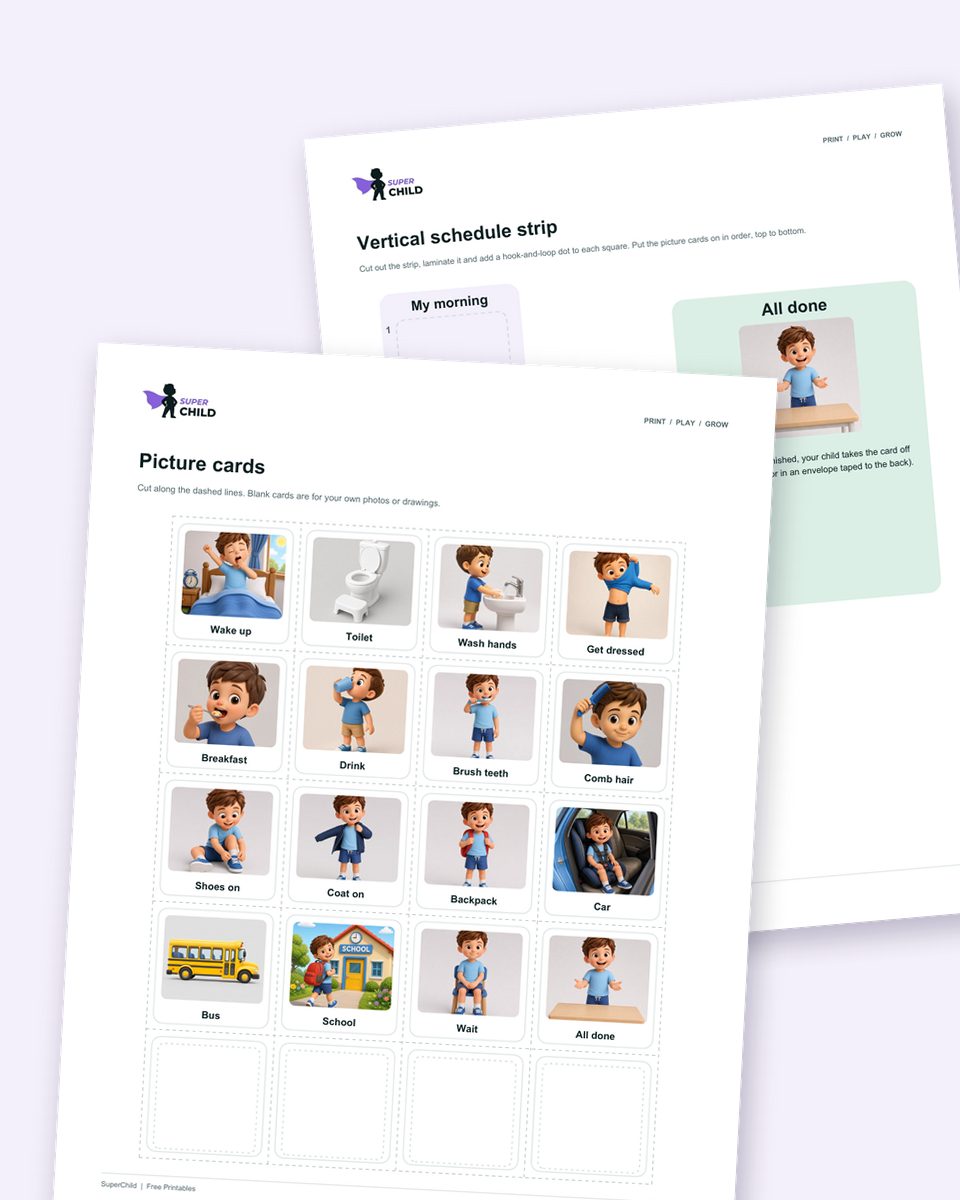
Free download1 PDF · 25 pages
Get the free visual schedule printable
Morning and bedtime routines plus picture cards for the whole day, with strips, a parent guide and a log.
Sources
- CDC: Developmental milestones, Learn the Signs. Act Early. (2022 revision)
- ASHA Practice Portal: Late Language Emergence
- Thal, Tobias and Morrison (1991). Language and gesture in late talkers: a 1-year follow-up. J Speech Hear Res
- Fisher (2017). A systematic review and meta-analysis of predictors of expressive-language outcomes among late talkers. JSLHR
- Bergelson and Swingley (2012). At 6-9 months, human infants know the meanings of many common nouns. PNAS
- Hudry et al. (2010). Preschoolers with autism show greater impairment in receptive compared with expressive language abilities. Int J Lang Commun Disord
- Roberts and Kaiser (2011). The effectiveness of parent-implemented language interventions: a meta-analysis. Am J Speech Lang Pathol
- Millar, Light and Schlosser (2006). The impact of AAC intervention on the speech production of individuals with developmental disabilities: a research review. JSLHR
- NIDCD: Speech and language developmental milestones
- NIDCD: Apraxia of speech
Cite this page
Citation (APA style)
SuperChild. (2026). My child understands but doesn’t talk: what it means and what helps. Retrieved from https://superchild.ai/blog/child-understands-but-doesnt-talk
Link for your website
<a href="https://superchild.ai/blog/child-understands-but-doesnt-talk">My child understands but doesn’t talk: what it means and what helps</a> (SuperChild)