
ESDM vs PEP-3: an intervention model versus a standardized test
The ESDM Curriculum Checklist and the PEP-3 are different kinds of tools. The Early Start Denver Model (ESDM) is a play-based intervention model for young autistic children, and its checklist sets teaching goals; the PEP-3 (Psychoeducational Profile, Third Edition) is a standardized assessment that compares a child’s profile with other children.
The ESDM is first of all an intervention model: a way of teaching young autistic children through play and everyday routines, with ABA teaching built into relationship-based interaction. The Curriculum Checklist is the tool that tells the team where to start and which goals to set.
The PEP-3 is a standardized assessment. It has a fixed way of administering items, a fixed scoring system and comparison data. It does not come with its own intervention model, though it grew out of the TEACCH program in North Carolina and is often used to plan TEACCH-style structured teaching.
In short: the ESDM checklist answers “what do we teach next in our ESDM program?” The PEP-3 answers “what does this child’s developmental and behavioral profile look like, compared with other children?”
What is the ESDM Curriculum Checklist?
The ESDM Curriculum Checklist is the assessment inside the Early Start Denver Model: a play-based checklist of skills in four developmental levels, roughly 12 to 48 months in the first edition, used to write short-term teaching objectives. The therapist scores the ESDM checklist mostly through play with the child, plus information from parents.
In the first edition (2010), the four levels follow typical development: roughly 12 to 18 months, 18 to 24 months, 24 to 36 months and 36 to 48 months. Within each level, skills are grouped by domain. The model is described for toddlers and preschoolers, from about 12 months. Guilford published a second edition of the book and checklist in 2025, for infants and young autistic children; check which edition your team uses.
From the results, the team writes a small set of short-term learning objectives, teaches them, and then reassesses. ESDM therapists come from several professions, including psychology, speech pathology and occupational therapy, and are certified in the model. In Australia the ESDM is widely offered in early intervention, including NDIS-funded programs.
- Communication
- Receptive and expressive communication, from following simple words to using phrases.
- Social skills and joint attention
- Sharing attention, taking turns and engaging with adults and peers.
- Imitation
- Copying actions with objects, gestures, facial movements and sounds.
- Cognition
- Matching, sorting and early concepts.
- Play
- Functional and, later, pretend play.
- Fine and gross motor
- Hand skills and whole-body movement.
- Behavior and personal independence
- Self-care such as eating, dressing and hygiene, and coping with routines.
What is the PEP-3?
The PEP-3 (Psychoeducational Profile, Third Edition) is a standardized assessment from the TEACCH tradition for children functioning between 6 months and 7 years. The PEP-3 has a performance part, where an examiner scores play-based tasks as passing, emerging or failing, and a caregiver report on problem behaviors, self-care and adaptive behavior.
Results are compared with a sample of autistic children and a sample of typically developing children. That gives developmental ages and a profile across areas. Administration usually takes about 45 minutes to 1.5 hours.
PEP-3 parts and subtests
Performance: communication
- Subtests
- Cognitive verbal/preverbal, expressive language, receptive language
Performance: motor
- Subtests
- Fine motor, gross motor, visual-motor imitation
Performance: maladaptive behaviors
- Subtests
- Affective expression, social reciprocity, characteristic motor behaviors, characteristic verbal behaviors
Caregiver report
- Subtests
- Problem behaviors, personal self-care, adaptive behavior
How do the ESDM and PEP-3 compare with the VB-MAPP?
The ESDM checklist, the PEP-3 and the VB-MAPP all cover early development, but their ranges and outputs differ. The ESDM checklist spans about 12 to 48 months and produces teaching objectives, the PEP-3 spans about 6 months to 7 years and produces a standardized profile, and the VB-MAPP spans 0 to 48 months and produces milestone and barrier scores.
For the ABA-based tools, see the VB-MAPP vs ABLLS-R vs PEAK vs AFLS comparison.
ESDM checklist, PEP-3 and VB-MAPP
Type
- ESDM checklist
- Curriculum checklist within a model
- PEP-3
- Standardized assessment
- VB-MAPP
- Criterion-referenced assessment
Roots
- ESDM checklist
- Developmental and relationship-based, with ABA
- PEP-3
- TEACCH
- VB-MAPP
- Skinner’s verbal behavior
Range
- ESDM checklist
- 4 levels, about 12 to 48 months
- PEP-3
- About 6 months to 7 years
- VB-MAPP
- 3 levels, 0 to 48 months
Output
- ESDM checklist
- Teaching objectives
- PEP-3
- Profile and developmental ages
- VB-MAPP
- Milestone scores and barriers
How do teams combine the ESDM checklist and the PEP-3?
Teams that combine the ESDM checklist and the PEP-3 usually let the PEP-3 describe a child’s developmental profile as part of a wider assessment, and let the ESDM checklist, or the VB-MAPP in ABA-oriented services, set the concrete teaching goals. Practice varies by country and service, so agree as a team which tool sets the goals.
A 3-year-old might have a PEP-3 at a diagnostic center, showing receptive language well ahead of expressive language. The early intervention team then uses the ESDM checklist to pick objectives, such as imitating two-step play actions or requesting with a word or sign, and practices them in play and routines. Table-top materials such as matching activities and a PECS book printable can support the cognition and requesting objectives between sessions.
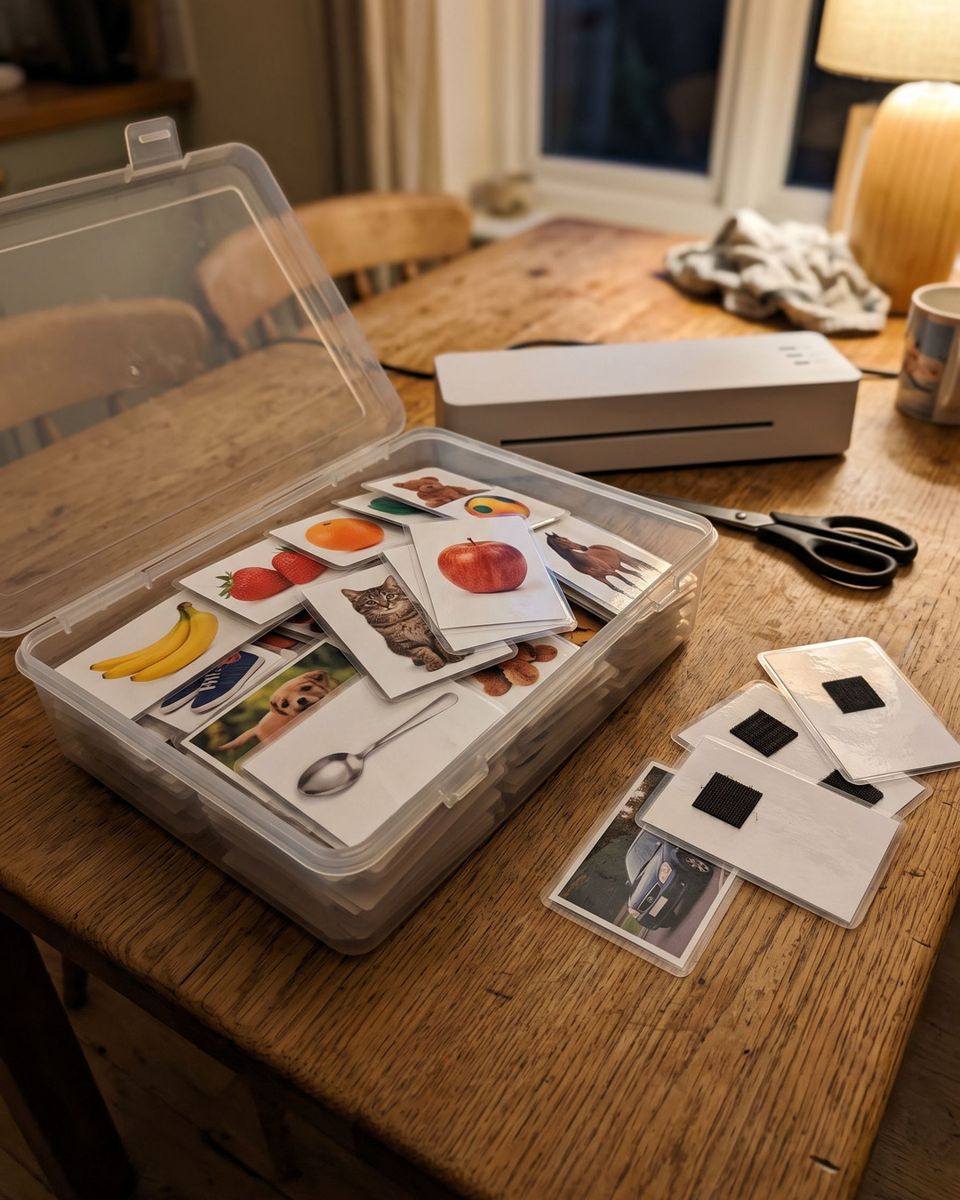
Free download1 ZIP · 94 packs
All 94 printable skill packs, free
Listening, matching, math, reading and more, one skill per pack, each with an adult guide, practice rounds and a log.
Sources
Cite this page
Citation (APA style)
SuperChild. (2026). The Early Start Denver Model (ESDM) Curriculum Checklist and the PEP-3. Retrieved from https://superchild.ai/assessments/esdm-and-pep-3
Link for your website
<a href="https://superchild.ai/assessments/esdm-and-pep-3">The Early Start Denver Model (ESDM) Curriculum Checklist and the PEP-3</a> (SuperChild)