At a glance
CentralReach and SuperChild compared on what each product does, as listed on their own sites in November 2026
Category
- CentralReach
- EMR and practice management for autism and IDD care
- SuperChild
- Child-facing practice software with a clinician dashboard
Main users
- CentralReach
- Clinic admins, BCBAs, RBTs, billing staff
- SuperChild
- The learner, with an adult nearby; the analyst reviews
Scheduling, billing, claims
- CentralReach
- Yes, with AI tools for schedules and claim checks
- SuperChild
- No
Session notes
- CentralReach
- Yes, with AI drafting and note auditing
- SuperChild
- No
Staff-run session data
- CentralReach
- CR Mobile App, offline use, EVV
- SuperChild
- No; records the child’s own tablet trials
Practice library for the child
- CentralReach
- Not listed on their site or App Store page
- SuperChild
- 342 trainings mapped to VB-MAPP and ABLLS-R
Data hosting
- CentralReach
- Not stated on the pages we checked
- SuperChild
- EU-hosted; GDPR, HIPAA, ISO 27001 and 9001
Sync with the other
- CentralReach
- None listed
- SuperChild
- None today
Price (as of Nov 2026)
- CentralReach
- No public pricing
- SuperChild
- No public pricing; priced per learner
| CentralReach | SuperChild | |
|---|---|---|
| Category | EMR and practice management for autism and IDD care | Child-facing practice software with a clinician dashboard |
| Main users | Clinic admins, BCBAs, RBTs, billing staff | The learner, with an adult nearby; the analyst reviews |
| Scheduling, billing, claims | Yes, with AI tools for schedules and claim checks | No |
| Session notes | Yes, with AI drafting and note auditing | No |
| Staff-run session data | CR Mobile App, offline use, EVV | No; records the child’s own tablet trials |
| Practice library for the child | Not listed on their site or App Store page | 342 trainings mapped to VB-MAPP and ABLLS-R |
| Data hosting | Not stated on the pages we checked | EU-hosted; GDPR, HIPAA, ISO 27001 and 9001 |
| Sync with the other | None listed | None today |
| Price (as of Nov 2026) | No public pricing | No public pricing; priced per learner |
CentralReach facts from centralreach.com and the CR Mobile App listing, checked November 7, 2026.
Which one fits you?
Choose
CentralReach if…
- You need one system for scheduling, session notes, billing and insurance claims.
- Your RBTs collect session data on a phone or tablet, including offline and with EVV.
- You run a US ABA or multidisciplinary practice and want AI help with notes and claim denials.
- You want a large vendor: CentralReach says 4,000 practices use it.
Choose
SuperChild if…
- Your learners need far more trials on their VB-MAPP or ABLLS-R targets than session hours allow.
- You run home programs or supervise at a distance and want every practice trial recorded.
- You already have a practice management system, or you work in Europe or the UK and don’t bill US insurance.
- You need EU hosting with GDPR, HIPAA, ISO 27001 and ISO 9001 in place.
What CentralReach does, and what SuperChild does
CentralReach runs the business and clinical records of an ABA practice: scheduling, notes, billing, claims and RBT session data. SuperChild gives the child extra practice on assigned skill acquisition targets and records each trial for the supervising professional.
CentralReach describes itself as “the AI-Powered EMR platform for Autism and IDD Care” and says 4,000 ABA and multidisciplinary practices and over 200,000 professionals use it. Its homepage lists an AI assistant called cari, ScheduleAI, NoteDraftAI, NoteGuardAI for auditing notes, ClaimCheckAI and ClaimAcceleratorAI for claims, ReportDraftAI, and more than 50 prebuilt dashboards. The CR Mobile App, rated 4.6 on 652 App Store ratings, is where technicians capture session data, including offline, with AI-assisted notes and EVV compliance. Roper Technologies agreed to buy CentralReach from Insight Partners in March 2025, and CentralReach has since added SpectrumAI and AI Measures.
That is a broad, mature suite for the people who run a clinic. Everything in it is operated by staff: an admin builds the schedule, an RBT taps a data sheet during discrete trial training, a BCBA reviews graphs and writes the treatment plan, a billing team works the claims.
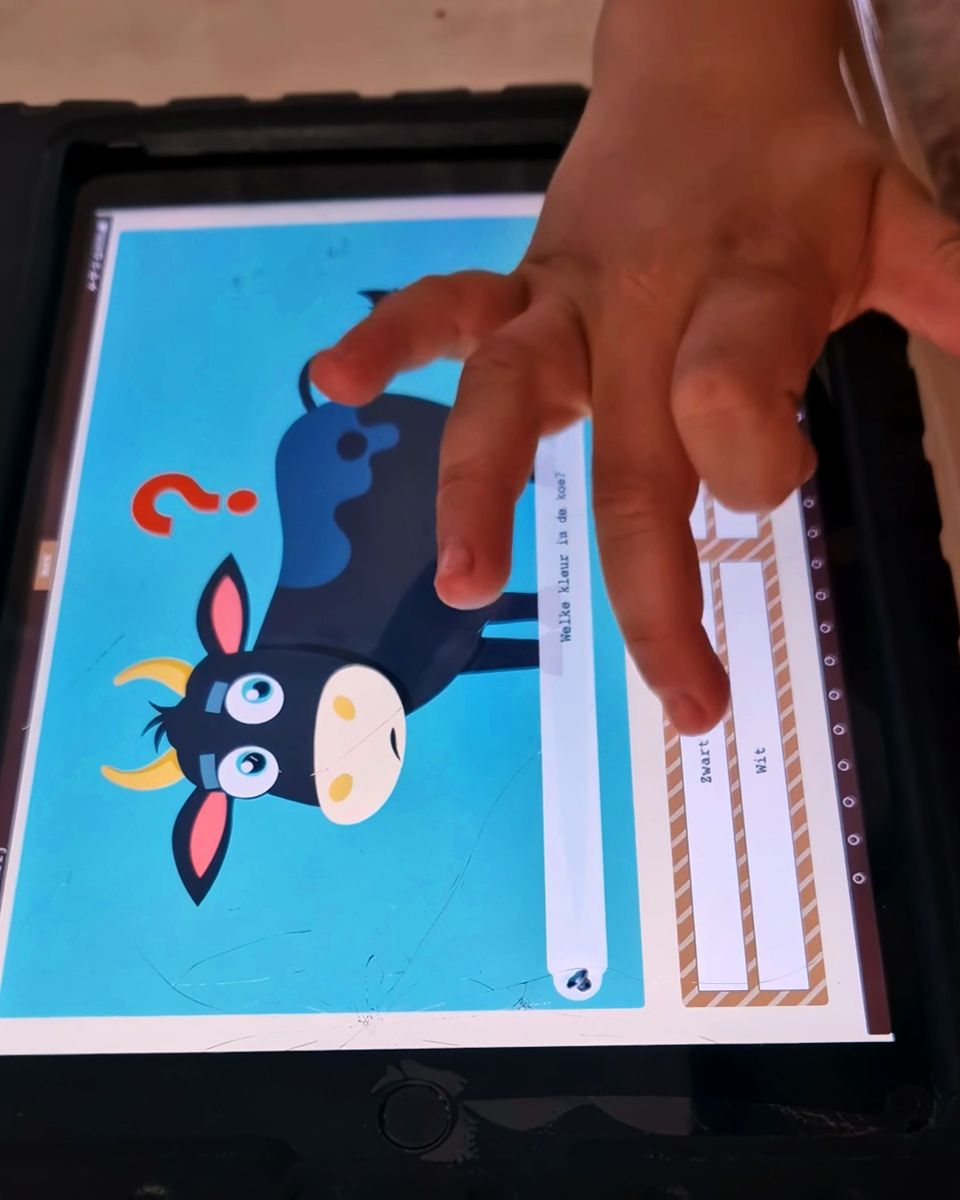
SuperChild works on a different layer. A behavior analyst picks targets from 342 ready-made trainings, 159 mapped to VB-MAPP milestones and 183 to ABLLS-R tasks. The learner practices them in 5 to 20 minute tablet sessions: one instruction, a small field of choices, immediate feedback. Each training has 10 levels (6 teaching, 3 generalization with new exemplars, 1 assessment), and every trial lands in the clinician dashboard. The product page shows the full setup.
So the question in a CentralReach vs SuperChild search is usually “do we need the second one,” since they don’t compete for the same job.


 Correct, trial 14 of 20 saved
How CentralReach and SuperChild work together in a learner’s week
In a clinic that uses both, CentralReach holds the schedule, the in-person session data and the billing, while SuperChild fills the gaps between sessions and at home with short practice blocks on the same targets.
Take a learner with ten hours of center-based ABA a week. The RBT runs table-time and natural environment teaching, and records the session in CR Mobile. Between two programs, the child does a 10 minute SuperChild block on a matching or listener responding target while the RBT stays beside them. On weekday evenings a parent sits with the child for another short block at home.
At supervision, the BCBA looks at two sets of data: the staff-run session graphs in CentralReach and the independent practice data in SuperChild. If a target is stuck on the tablet but moving at the table, that tells the analyst something about stimulus control or generalization. Our ABA therapy guide covers why both settings matter.
- 1Assess and pick targetsThe analyst runs the VB-MAPP or ABLLS-R and writes the plan in the clinic’s system. The VB-MAPP goal mapper can help turn milestones into goals.
- 2Assign practiceThe same targets that fit a screen get a SuperChild training, with field size and exemplars set by the analyst.
- 3Run sessions as usualRBTs keep running and recording sessions in CentralReach. SuperChild blocks slot in between programs and at home.
- 4Review bothAt supervision, the analyst reviews CentralReach graphs and the SuperChild dashboard, then adjusts prompting, moves to generalization or sets a new target.
Where the data lives: an honest note on integration
SuperChild does not sync with CentralReach today. SuperChild’s practice data is reviewed in SuperChild’s own dashboard, and CentralReach holds the clinic’s session data, notes and billing.
We would rather say this plainly than let a reader assume an integration. There is no connector between the two products, and neither company lists one. SuperChild trial data (accuracy, level, session length, stuck and mastered targets) stays in SuperChild, under SuperChild’s EU hosting and data processing agreement.
In practice, teams that use both treat SuperChild as a separate data source the analyst checks at supervision. If you want a line about independent practice in a progress report or a CentralReach session note, a staff member writes it from the SuperChild dashboard. For probes away from the tablet, the free ABA data sheets, ABA graph maker and IOA calculator cover paper data, graphs and reliability checks.
CentralReach pricing, cost and reviews
CentralReach does not publish pricing: its /pricing page returned a 404 in November 2026 and sales are demo-led. Third-party estimates exist but are unverified, so we don’t repeat them here.
If you are searching for CentralReach cost, the honest answer is that you get a number from their sales team after a demo. Pricing for platforms like this usually depends on how many staff accounts you need and which modules you take, so ask for an itemized quote that separates the core platform, the AI products, implementation and training.
On reviews, the CR Mobile App has a 4.6 rating from 652 App Store ratings. Capterra shows a 4.3 overall score on about 155 reviews. Read recent reviews from practices your size, since a 400-staff enterprise and a three-BCBA clinic use the platform very differently.
SuperChild has no public pricing either. It is priced per learner, and parents, tutors and staff accounts are free; you get a quote after a demo. Because SuperChild does a narrower job, it is a smaller line item that sits alongside a practice management system rather than in place of one.
Looking for a CentralReach alternative in ABA practice management software?
SuperChild is not a CentralReach alternative for practice management, because it has no scheduling, billing or EMR. If you want to move off CentralReach, compare other ABA practice management software such as Rethink, Motivity, Catalyst, Raven Health or Theralytics.
People who type “CentralReach alternative” usually want one of two things. Some want different ABA software to run the clinic, with a different price, contract or workflow. For them, SuperChild is the wrong page, and our ABA data collection software comparison is a better start.
Others are happy with how the clinic runs but feel the children are not getting enough practice, or that home programs drift between visits. That is the gap SuperChild fills, and you can keep CentralReach while you fill it.
- Moving your whole clinic system: compare practice management and data collection platforms side by side.
- Keeping CentralReach, adding practice: look at SuperChild for independent practice on the targets you already wrote.
- Only replacing paper data sheets: the free ABA data sheets may be enough for a small caseload.
For European and UK teams that don’t bill US insurance
European and UK behavior analysts who don’t bill US insurance often don’t need CentralReach’s claims and EVV tools. SuperChild is EU-hosted, GDPR and HIPAA compliant, and ISO 27001 and ISO 9001 certified, with learner activities in English and Dutch.
Much of CentralReach’s product, as described on its homepage and App Store listing, is built around US workflows: insurance claim checking, claim denials and EVV, a US Medicaid requirement. Its named customers on the homepage are US providers. We did not find a statement about EU data hosting on the CentralReach pages we checked, so if that matters to you, ask them directly.
In the Netherlands, the UK and Ireland, ABA and developmental support is funded and documented differently: youth-care contracts, local authority funding, EHCPs in English schools. A UKBA(cert), QBA or IBA running home programs may need a way to set targets, hand practice to parents and see the data remotely far more than a claims engine.
SuperChild hosts children’s data on EU servers, treats it as special-category data under GDPR Article 9, and signs a data processing agreement with DPIA support. Read the details on the security page. Organizations can see how teams roll it out on the for organizations page.
When SuperChild is the wrong choice
SuperChild does not fit teams looking for an EHR, billing or scheduling system, learners who cannot yet tap or select on a screen, or goals that can’t be practiced on a tablet, such as articulation or daily-living routines.
Some learners need to build tablet skills first, or do better with people and real objects for now. Many targets belong at the table or in natural environment teaching: manding, imitation, play, social skills, toileting. Those stay with the RBT and in your clinic’s data system.
SuperChild also does not write programs or replace the analyst’s judgment. The professional picks the targets, decides on prompting outside the tablet, and plans generalization. If you want the child-facing practice and the clinical oversight in the same place, see for professionals and how it works.
Sources
- CentralReach homepage (tagline, AI products, 4,000 practices, customers)
- CentralReach pricing page (returned 404, November 7, 2026)
- CR Mobile App on the App Store (4.6, 652 ratings; offline, EVV)
- Capterra: CentralReach reviews
- HIT Consultant: Roper Technologies acquires CentralReach (March 2025)
- Behavioral Health Business: CentralReach buys SpectrumAI and AI Measures (August 2025)